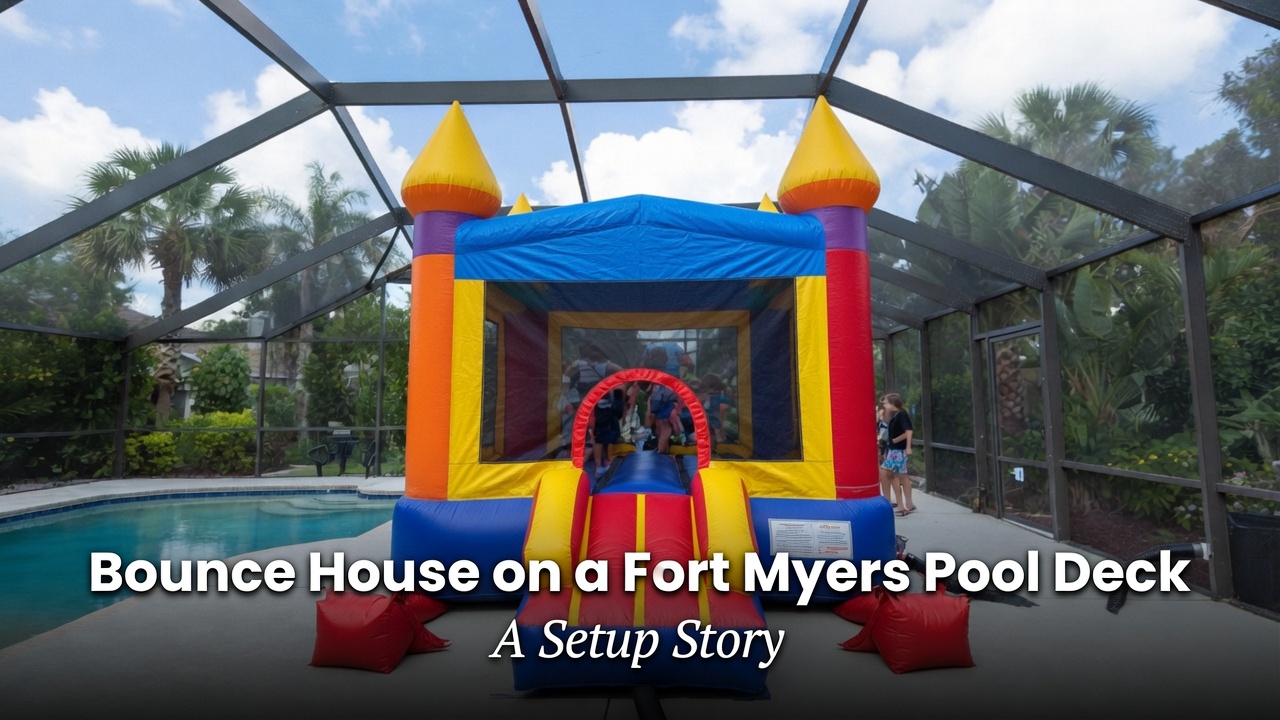
The call came in on a Tuesday evening from a mom in the Iona section of South Fort Myers, off McGregor Boulevard near the Whiskey Creek line. Her son was turning seven that Saturday, she had 14 kids confirmed, and she had just walked the backyard with her husband and realized they had a problem. The yard had three mature royal palms, a screened pool cage that ate most of the open space, and a side yard that sloped about ten inches toward the rear neighbor's fence. The only piece of flat, level, debris-free real estate on the property was the concrete pool deck inside the cage. And she wanted to know: can you actually put a bounce house on concrete?
Yes. You can. But the conversation about how you do it — and what it does to the unit you can rent — is worth writing up, because this scenario comes up roughly once a week from Fort Myers and South Cape Coral families with screened cages and not much grass.
The first question every concrete-anchor parent asks
It is always the same question, and it is always the right question. "Is it safe?" The honest answer is that grass with 18-inch ground stakes is the gold standard for inflatable anchoring, and we will always prefer it when it is an option. ASTM F2374 — the consensus safety standard for inflatable amusement devices — calls for each anchor point to resist 1,125 pounds of pull, which a properly driven stake into sod will do without breaking a sweat. On a concrete surface, that same anchor point gets replaced with sandbags or water weights, and the math gets specific in a hurry.
For a small residential bounce house on concrete, the working rule we use is 75 pounds of sandbag per anchor point, with four anchor points per unit, totaling 300 pounds of ballast. For larger combos and slides, it scales upward — some of our bigger units want 100 pounds per corner, which means we are hauling 400 to 500 pounds of sand onto your pool deck and putting it back on the trailer when we pack up. That is a real consideration for the driver and for the homeowner whose pool deck happens to be on the second story above a garage. Hers was not. Hers was slab-on-grade, the standard Florida 4-inch reinforced pour, which will take any inflatable we own without flinching.
What we lose by going to concrete
Two things, mostly. The big water slide is the first one. Our 22-foot Tropical Hurricane wants a 25-by-45 footprint and a heavy stake pattern, and it is not a unit we put on a pool deck inside a screened cage even when the math says we could. The runout at the bottom of a tall slide gets unpredictable, the kids land wet on a hard surface, and the parents are uneasy the whole time. We do not rent it for that setup, and any operator who tells you they will is not someone you want anchoring an inflatable in your backyard.
The second thing we lose is the water option on the unit itself. Any inflatable that runs a water feature soaks the surrounding surface, and a soaked concrete pool deck around a bounce house creates two problems: the kids enter and exit on a wet hard surface, and the runoff has nowhere to go except either into the pool or onto the deck drain, neither of which is what the homeowner wants. So when the pool deck is the setup, the bounce house is dry. Period.
Her actual yard
Once we had the concrete-versus-grass conversation, the rest of the planning was fast. The pool deck inside her cage was 18 feet wide by 30 feet deep, with the pool itself taking up about half. The dry corner of the deck — the south corner away from the pool steps — was 14 feet by 14 feet of clear concrete, with overhead screen clearance of about 11 feet to the cage beams. That is a tight envelope, and it ruled out the combo bounce-and-slide units we usually recommend, which run 11 to 13 feet tall and want a larger floor plan.
The answer was a 13-by-13 classic castle bounce house. Floor capacity of about four to six smaller kids at a time, 10 feet of inflated height (clears the cage beams with margin), and an anchor pattern that fit her deck corners. For 14 seven-year-olds, you rotate four at a time in five-minute waves, and the wait line becomes a feature of the party rather than a frustration. The single-unit, single-feature castle is also the easiest inflatable on a small footprint to supervise — one entrance, one exit, the parent sitting next to it can see every kid.
The CFO check
I cannot stop myself from doing this on every customer call. Five different companies as CFO — still doing it on the side — and the all-in cost is the first number I care about. For her party, the back-of-envelope ran:
- 13-by-13 classic castle, three hours: $179
- Concrete-anchor sandbag setup (no extra charge — we bring the sand): $0
- Lee County sales tax on the rental at 6.5 percent: about $12
- Food (pizza for 14 kids plus drinks and a cake): $140 to $180
- Goodie bags and paper goods: $60 to $90
All-in: roughly $390 to $460 for a respectable backyard seventh birthday. That is the lower end of the Cape Coral and Fort Myers range I usually quote for kid parties at this scale, because we did not stack a second unit or a water feature. A modest castle on a pool deck does not cost what a 22-foot slide on the lawn does, and the kids at age seven do not care.
Setup morning
I rolled up to her cul-de-sac off McGregor at 9:15 on Saturday for an 11 AM start. The cage door on her pool screen was 36 inches wide, which is enough to walk a deflated 13-by-13 unit through, but not enough to walk it through inflated. So the setup sequence on a pool deck job is slightly different than on a lawn: unfold the unit on the deck where it will sit, run the blower hose under the cage door, plug into a GFCI outlet on the pool equipment side, inflate in place, and then walk around the unit with the sandbags.
The sandbags are the part the homeowner usually does not anticipate. Four bags, about 75 pounds each, in red nylon mesh because that is what we use so they are visible to the kids and the parents. Two on each side, lashed to the anchor straps with the same heavy-duty webbing we use on grass stakes. Set time on a pool deck job, from trailer arrival to ready-to-bounce, is usually about 35 to 45 minutes. Hers ran 38.
One detail that matters: the GFCI outlet on the pool equipment side of her cage was on the same 20-amp circuit as the pool pump. The blower on a 13-foot bounce house pulls about 6 amps continuous, and the pool pump on most residential setups pulls 8 to 10. So we were fine on amp draw. On a bigger combo unit pulling 9 to 11 blower amps, you can trip that breaker, and the fix is either turn off the pool pump for the party or run a heavy-gauge extension cord to a separate house circuit. Worth knowing in advance, not in the middle of the cake.
The party itself
I am not at her party, so I am working off the photos and the follow-up text she sent Sunday morning. The bounce ran from 11:15 to 1:45. Kids tagged in and out in rotations the parents managed without me. A short downpour came through around 1:30, which on a screened pool deck is a complete non-event — the cage roof took the water, the bounce stayed dry, the kids kept going. The unit was packed and on the trailer by 2:30.
What I would do differently
One thing. I would have asked her to clear the pool deck of patio furniture the night before, not the morning of. We lost about 10 minutes of setup time because the table and four chairs that had to move were still there when I arrived. On a tight envelope job, every square foot of working room matters, and shuffling furniture around an inflated unit is harder than shuffling it before the unit goes down.
The second thing is a note for anyone with a similar setup. If your screened cage has a slight droop in the center beam — some of the older Lee County cages built in the early 1990s do — measure overhead clearance at the lowest point, not the highest. The difference at hers was about four inches, which would have been just enough to push a 10-foot-6-inch unit into trouble.
Common questions about concrete and pool-deck setups
Is a bounce house on a pool deck safe?
Yes, when anchored correctly with the right ballast. We use four sandbags of roughly 75 pounds each per small unit, conforming to ASTM F2374 anchor-load requirements. We do not stake into concrete. We do not skip ballast. If a setup does not allow proper anchoring, we will tell you on the phone, not after we are at your house.
Can I have a water slide on a pool deck?
No, and any operator who says yes is taking a risk we will not take. Slides need stake-pattern anchoring and a soft runout at the bottom. The 22-foot Tropical Hurricane and our other water slides are grass-only units. If you want water on a concrete-only property, we look at a smaller dry combo plus a separate freestanding splash element instead.
Does a screened cage affect setup?
Almost always. Cage door width sets the unit footprint. Cage beam height sets the unit height. We measure both before we confirm a rental for a pool-deck setup. The good news is that a screened cage is a built-in rain canopy for the bounce, which on a Fort Myers June afternoon is a feature, not a workaround.
If you have a yard like hers — sloped, treed, dominated by a screened cage — and you have written off the backyard party because you did not think a bounce house would work, give me a call. We work concrete jobs every week in Fort Myers and South Cape Coral. The number is (239) 212-0011, and you can also look at our Fort Myers service area page for the units we run in your neighborhood.
About the author
Gabriel Denny — Co-owner, SWFL Amusements LLC
Gabe owns SWFL Amusements. He spent 20+ years in the Air Force, first enlisting after high school before commissioning and retiring as a Major. He is a 5x CFO, which he continues to do when not working bounce houses. He lives in NW Cape Coral and answers the company phone himself, including at 2am.