I have surveyed enough Cape Coral lots over the years that I can usually pace one off in my head before I get out of the truck. The original Cape Coral plat divides most of the city into 40-by-125-foot building lots, with the long axis running east-to-west on the older sections. A standard single-family R1 home sits on a double-wide combination — 80 by 125, or 10,000 square feet on the nose. When somebody calls about the 30-foot slip-and-slide, the first thing I do is picture that 80-by-125 rectangle and figure out where it goes.
This is a closer look at our 30-foot slip-and-slide as a piece of equipment, and at the questions that come up when you try to make it fit a Cape Coral back yard in the last week of June. Hopefully it saves somebody a phone call. If it does not, the phone call is fine too — the number is on every page.
The unit, in one paragraph
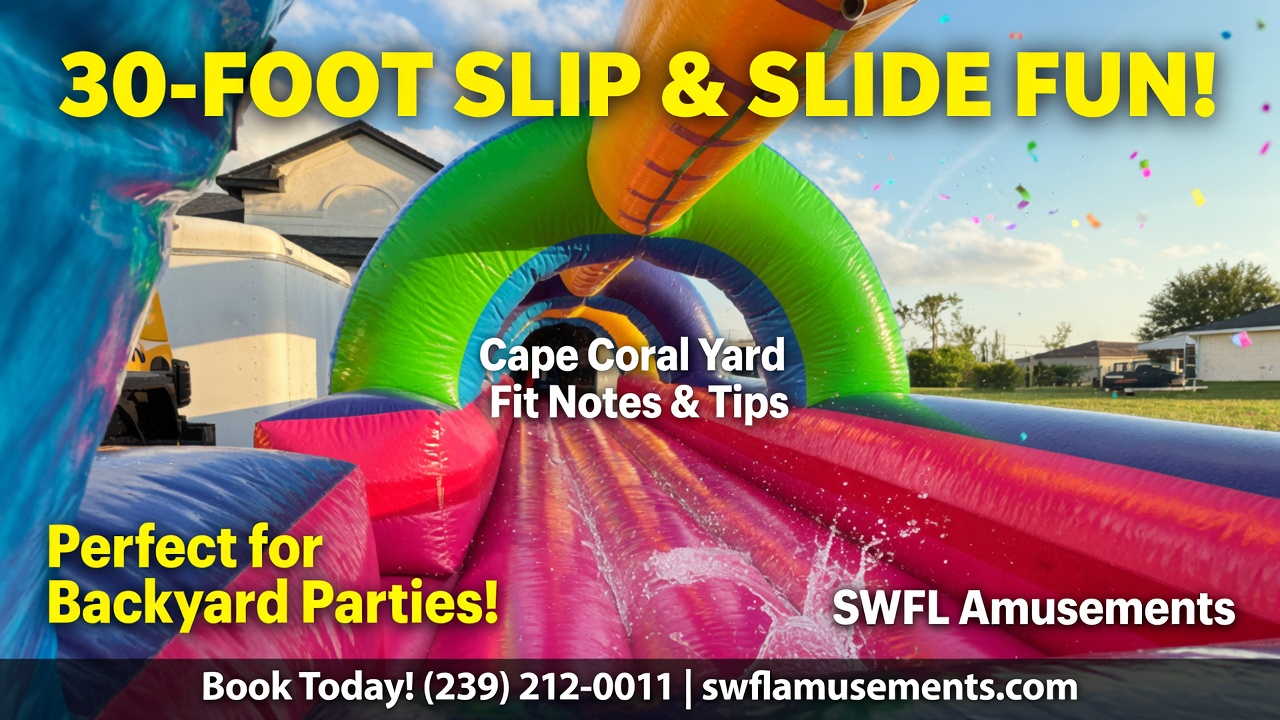
The 30-foot slip-and-slide is a single-lane inflatable, 30 feet long end-to-end, with an inflated bumper rail on either side and a small splash pool at the bottom. The slide bed itself runs about 5 feet wide. Sliders go feet-first, head up. It runs off a single 1-horsepower blower plugged into a standard 110-volt outlet. Water comes from a regular garden hose feeding a perforated header at the top of the slide that mists the bed continuously while it is in use. We deliver, set up, anchor, and break it down. You provide the hose, the water, and the kids.
Why the 30-foot footprint matters on a Cape Coral lot
The actual setup footprint is not just 30 feet. You need clear run-out at the bottom — the splash pool is small, and a 60-pound kid still has momentum at the end of a wet 30-foot slide. We tell people to keep about 8 to 10 feet of clear grass past the splash pool. You also need a foot or two of clearance on each side for the bumper rails to seat and for the hose to run. So the real footprint a Cape Coral yard has to absorb is closer to 38 to 40 feet long by 8 feet wide.
On the standard 80-by-125 Cape Coral lot, with a single-family home centered between the side lot lines, you usually have a back yard that runs somewhere between 30 and 50 feet deep from the rear wall of the house to the back property line. That is the dimension that matters. If the back yard is 40 feet deep or more from house to fence and the slide can run along the long axis — or if there is a long side yard available — the unit fits. If your back yard is 28 feet deep because the pool cage eats up the first 20, the slide goes in the side yard, or in the front-corner yard on a corner lot, or it does not go at all.
The side yard option is real in the Cape because the original plat gives most of these lots a 7.5-foot side setback. That means there are usually 10 to 15 feet of side yard between the house wall and the property line on each side of a standard build. It is long enough — the lot is 125 feet deep — but it is narrow. The slide's 8-foot width plus a foot of safety clearance on each side adds up to 10 feet. If your side yard is 12 feet wide, it works. If it measures out to 9 feet, it does not.
Sun angle and the east-west platting
One thing the original Cape Coral street grid gives you is fairly consistent house orientation. The grid south of Pine Island Road and east of Burnt Store Road runs almost true north-south on the cross streets and east-west on the through corridors. So most back yards in the older Cape face either due north or due south, depending on which side of the street the house sits.
For a slip-and-slide in late June — sun rising close to due east-northeast and setting close to due west-northwest, with the noon sun nearly overhead at Cape Coral's latitude — orientation matters less than the shade. South-facing back yards take the full day of sun. North-facing back yards behind the house get afternoon shade from the house itself starting around 3 PM in late June.
I tell customers booking a slip-and-slide for a north-facing back yard to plan a midday or early-afternoon party. The shade pulls into the yard right when the kids start to get tired anyway, and the water on a shaded vinyl slide bed stays cool enough that you do not get the burning-hot-feet complaint. For south-facing yards, the unit needs an early start — 10 AM to about 2 PM is the comfortable window before the slide bed itself runs oven-hot in any patch the water is not actively wetting.
Water — what the slide actually uses
The slip-and-slide runs off a continuous garden hose feed. A standard 5/8-inch hose at city pressure in Cape Coral delivers somewhere between 8 and 14 gallons per minute, depending on how many other fixtures in the house are running and where the lot sits on the supply main. Call it 10 gallons per minute on the average Cape lot.
Over a 4-hour rental, that is theoretically up to 2,400 gallons if the hose ran nonstop, which it does not — people throttle it down between rides. A realistic number is closer to 1,200 to 1,800 gallons for a full afternoon party. Cape Coral residential water-and-sewer rates land in the rough neighborhood of $10 per thousand gallons combined once both halves of the bill are counted — check your utility statement for your exact tier — so the marginal water cost of an afternoon on the slide works out to roughly $12 to $20. Less than a large pizza.
If you are on a dual-line property with reuse irrigation, do not run the slip-and-slide off the irrigation valve. Reuse water is not potable, and kids on a slip-and-slide swallow water whether they mean to or not. The slide hooks to a regular hose bib on the potable side of the house. Most Cape Coral homes built after about 1995 are dual-line; the irrigation valves are usually labeled and color-coded purple. If you are not sure which is which, the safe bet is the spigot closest to the kitchen wall, which is almost always potable.
Anchoring on grass vs. deck
On grass, the slide stakes down with 30-inch ground stakes through the manufacturer-marked anchor loops. Cape Coral soil in late June is usually a thin mat of St. Augustine over sand, with the water table sitting close enough to the surface that the stakes drive in cleanly and hold well in wet sand. We use four corner stakes plus side stakes along the slide bed, typically six to eight stakes total.
If your yard is mostly hardscape — pavers, a stamped concrete deck, or a poured slab — the slide cannot stake. We anchor with sandbags instead, the same way we handle any inflatable on a hard surface. A slip-and-slide on pavers is not my first recommendation, though. The hard surface holds heat, the slide bed runs hot at the edges, and the run-out zone past the splash pool is now also pavers, which is rough on a wet kid sliding to a stop. If grass is an option anywhere on the lot, take it. If not, we can make pavers work, but we lay extra padding past the splash pool and you brief the kids on stopping in the pool, not past it.
The 4-hour shape of the day
A slip-and-slide party has a different rhythm than a bounce house party. The bouncer goes nonstop for four hours. The slide does not. Kids ride it hard for 20 to 30 minutes, then go find shade and snacks, then come back. The actual run rate is about three to four rides every five minutes if there is a line of two or three kids, then a break while everyone catches their breath. Over a 4-hour rental, ten kids will rack up something on the order of 80 to 120 slide runs total. Plenty.
The water also draws a different crowd. A bouncer crowd is your kid's class. A slip-and-slide crowd is your kid's class plus a third of the neighborhood once the splashing gets loud. Plan for towels. We do not bring towels.
One more thing the surveyor in me notices — if your yard has any noticeable slope, set the slide so the splash pool ends up downhill, not uphill. Even an inch or two of fall over the 30-foot length helps the water move the way it is supposed to and keeps the bed from puddling in the middle. Most Cape Coral lots are graded with a slight crown toward the street and a slight fall toward the rear swale, which means a slide running parallel to the side lot lines is usually working with the grade, not against it. We figure that out on site when we set up.
If you are pricing a 30-foot slip-and-slide for the back yard of a standard Cape Coral lot in July, the math usually works out. The unit fits an 80-by-125 lot with room to spare, the water bill is small, the sun angle is manageable on a north-facing yard, and the run-out clearance is the only real dimension worth measuring before you book. If your lot is non-standard — a corner with a 125-foot front, a canal cut that eats the rear, a peninsula on a Yacht Club street with a seawall instead of a fence — give us a call and I will pace it off the same way I pace off a survey. (239) 212-0011.
About the author
Christopher Johnson — Co-owner, SWFL Amusements LLC
Chris is co-owner of SWFL Amusements and a professional surveyor by day. He spends his working hours mapping Southwest Florida properties, which means he knows the canal-front quirks, the older Cape circuit grid, and which intersections back up during snowbird season. He proudly lives in Cape Coral, where he was born and raised.