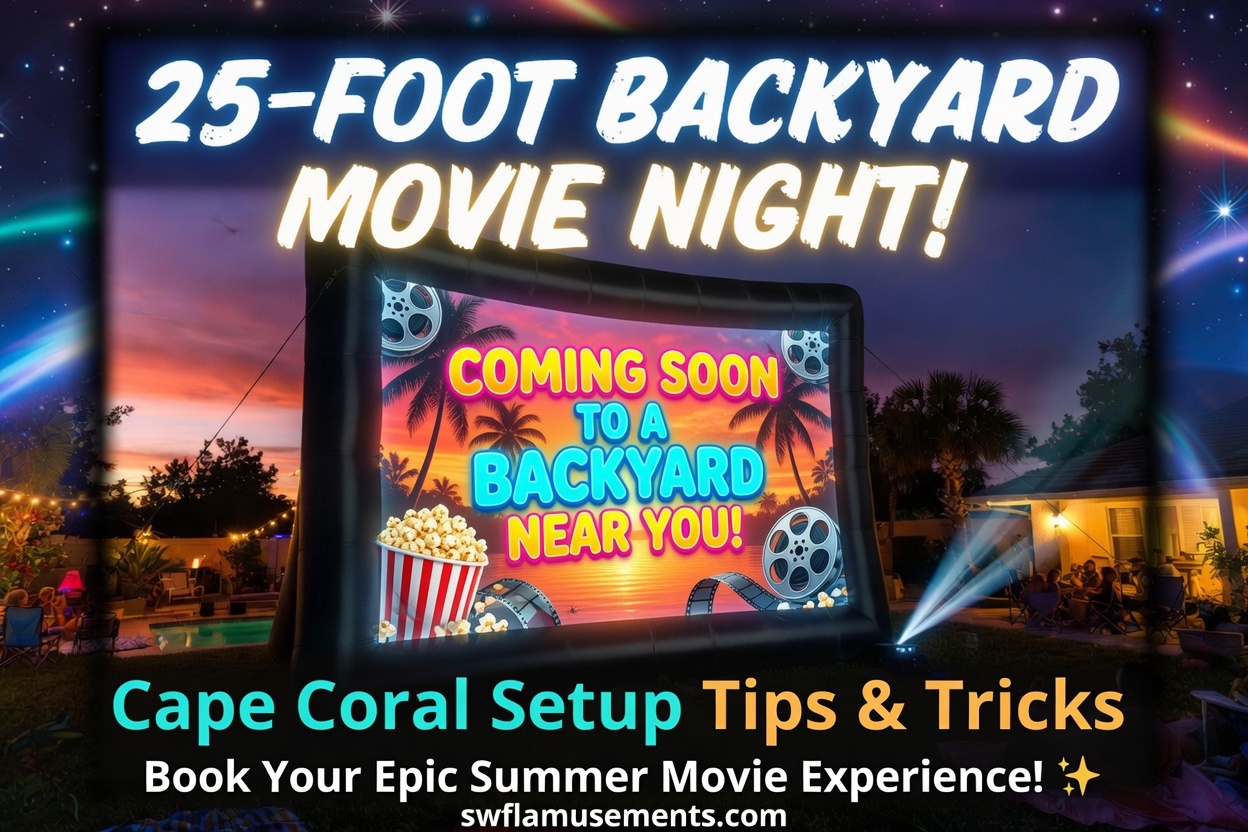
The 25-foot inflatable movie screen is the piece of our inventory that surprises people most on delivery day. On the phone, a host has a picture in their head of a bedsheet on a garage door. When the truck opens and the bundled screen comes out, the reaction is almost always the same short sentence: “Oh. That is bigger than I thought.” Twenty-five feet is a two-story roofline. On a standard Cape Coral single-family lot, it consumes roughly a quarter of the depth of the property. That physical fact is where every good backyard movie night in this city starts, and where every bad one goes wrong.
Most of what we do on the phone before a rental like this is measuring — in the surveyor sense — the space, the light, and the sight lines. There is not much mystery to the equipment itself. There is real work in the yard around it.
What you actually get
The unit is a self-supporting inflatable frame with a front-projection screen surface in the middle. A small electric blower keeps it inflated for the entire rental. It is 25 feet tall at the top of the frame. The screen surface itself is smaller than the outside dimensions — the black inflatable border is what gives the picture contrast against a lit backyard. Delivered price is $249 for an all-day rental with free delivery, setup, and teardown inside Cape Coral. Outside the city, delivery is quoted per address; call (239) 212-0011 for a number.
The short spec box:
- Overall height: 25 feet
- Power: one dedicated 20-amp circuit for the blower, running continuously
- Projector: not included — host provides
- Sound: not included — host provides
- Setup and teardown: included
- Rental window: all day
- Delivery: free inside Cape Coral
The two things that are not included — projector and audio — are the two things that decide whether the night looks like a movie theater or a slide show.
Where 25 feet actually fits on a Cape Coral lot
A standard residential lot in Cape Coral is 80 feet wide by 125 feet deep, or 10,000 square feet. The 80 feet is street or seawall frontage; the 125 feet is depth. The Rosen brothers' Gulf American Land Corporation platted the city in the late 1950s in two 40-foot parcels per building site, and that 80-by-125 rectangle still sits under the great majority of single-family homes here. Triple lots, more common in the SW and NW quadrants, are 120 by 125.
The screen's footprint on the ground is small — roughly 22 feet wide by 12 feet deep at the inflatable base. The real space it consumes is above and in front of it. You want at least 15 feet of viewing depth before the first row of chairs, and 20 to 25 feet to the back of the seating area. Screen plus seating is 40 to 45 feet, front to back.
On an 80-by-125 lot, subtract the house footprint (typically 40 to 50 feet deep), a pool (another 30 to 40), and a screened lanai (another 12 to 18). What is left is usually the last 30 to 45 feet between the pool cage and the rear property line — exactly the window the screen needs. Without a pool cage in the sight line, it fits cleanly. With one, the honest answer is usually that the screen belongs on the side yard or the driveway.
The sight-line question
A 25-foot screen is tall enough that the top of the picture clears almost every backyard privacy fence on a Cape Coral lot. That is good for viewers but real for the two neighbors on either side. If your rear neighbor's back windows face the screen at the right angle, they are watching the movie whether they wanted to or not. On a canal-front lot, the neighbor across the water gets the same view.
That is not a city problem. It is a courtesy one. A short text or a group-chat note with the movie title and the run time is worth the effort. The two questions the neighbors care about are how long the sound will run and how loud. Answer those in advance and the sight line stops being an issue.
From the seating side, aim the screen so the back row is looking away from the brightest light source in your yard. In central Cape Coral that is almost always the streetlight on the utility pole at the front corner of the property, throwing light back along the driveway line. Set the screen parallel to the back property line and the streetlight is behind the viewers. Set it perpendicular to the street and the streetlight cuts across the viewing area and washes out the darker scenes.
Streetlights, canal reflection, and the July dusk window
Cape Coral sunset in mid-July is around 8:20 to 8:25 p.m. Full darkness — the point at which the projector actually delivers a real picture — is 40 to 50 minutes after that, or between 9:00 and 9:15 p.m. With young kids in the audience, a 9:00 p.m. start is the honest earliest workable time in July. That is why a lot of Cape Coral backyard movie nights become double-features that end past 11:00.
Canal-front lots have a second consideration. Until about 30 minutes after sunset, the water surface reflects a surprising amount of sky light back at any west-facing yard. If the screen's back is to the canal, that reflected light hits the picture. If the screen faces the canal, the audience is looking at the reflected light, which is easier to tolerate. On the pre-visit walk we usually recommend the screen face inward toward the house rather than outward toward the canal.
Power — a note from the older SE Cape
The blower needs its own 20-amp circuit and stays on the whole time the screen is up. It is a small draw compared to a bounce house, but the dedicated-circuit rule still applies — sharing the outlet with a projector, a laptop, and powered speakers on one extension cord will trip a breaker at exactly the wrong moment.
In the older sections of Cape Coral SE and central — homes built in the 1970s and early 1980s off Coronado, Country Club, and the older Del Prado neighborhoods — exterior GFCI outlets are sometimes on a shared kitchen or lanai circuit, and sometimes on a single 15-amp legacy circuit that a modern electrician would not spec that way today. In the newer sections north of Pine Island Road and out in the NW quadrant, exterior outlets are almost always modern dedicated 20-amp GFCI runs. If you are in an older Cape home, plug a hair dryer into the exterior outlet before delivery day and confirm the circuit holds. If it does not, the cord runs from a garage outlet instead.
Sound: the part people underestimate
A television speaker or a small Bluetooth speaker will not fill a backyard for 20 or 30 guests. The most common regret we hear after a first-time movie night is not the picture — the picture is almost always fine with any decent 1080p or 4K projector — it is that dialogue was hard to hear from the back row. For 20 to 40 people spread across a Cape Coral back yard, a powered PA speaker with at least 300 watts of usable output, or a pair of powered bookshelf monitors, is the practical minimum. We rent a Monster GI30 speaker separately if the host does not have their own audio.
Whatever the source, run one long cable from the projector to the speaker rather than relying on Bluetooth. Bluetooth audio in a backyard adds a variable delay that puts the lips out of sync with the words by half a second, and once you hear it you cannot un-hear it.
Rain, dew, and the July humidity issue
The screen and frame handle Florida weather. The projector does not. If the forecast shows any real chance of a pop-up shower during the viewing window, the projector belongs under a small pop-up canopy or a lanai roof with a clear line of sight to the screen. A patio umbrella works if it is angled correctly. The screen sheds a light rain without damage and the blower holds it up through reasonable wind gusts, but a full afternoon thunderstorm needs a pause — we deflate and re-inflate rather than let it take a hit sideways.
Dew is the second thing. By 10:30 p.m. in July, humidity in a Cape Coral back yard puts a real film of moisture on any hard surface, including the top of the projector and the lens. A microfiber cloth in your pocket during the second half of the movie is the whole answer.
What “all day” actually means
Priced at $249 delivered in Cape Coral. For a backyard movie night, delivery lands between 10 a.m. and 2 p.m. on the day of the event; teardown happens the following morning between 8 and 11 a.m. The screen stays inflated overnight — deflating and re-inflating mid-party is not something anyone wants to do. The blower runs continuously on the same 20-amp circuit; the extra overnight power cost is pennies. No separate overnight fee.
When to book
Backyard movie nights are our July and August product. Peak booking pressure is Friday and Saturday evenings from the second week of July through Labor Day weekend. Saturday movie-screen availability generally books two weeks out during that window; weeknights have much shorter lead times. If a specific date matters — a birthday, a graduation, a farewell party for a family moving out of state — two to three weeks of lead time is the honest recommendation.
If you are thinking through whether it fits your specific yard, call the office at (239) 212-0011 and describe the property. Ten minutes on the phone with someone who has walked hundreds of Cape Coral lots is usually enough to get to a yes or no, and if it is no we will say so rather than take a booking that ends in disappointment.
About the author
Christopher Johnson — Co-owner, SWFL Amusements LLC
Chris is co-owner of SWFL Amusements and a professional surveyor by day. He spends his working hours mapping Southwest Florida properties, which means he knows the canal-front quirks, the older Cape circuit grid, and which intersections back up during snowbird season. He proudly lives in Cape Coral, where he was born and raised.