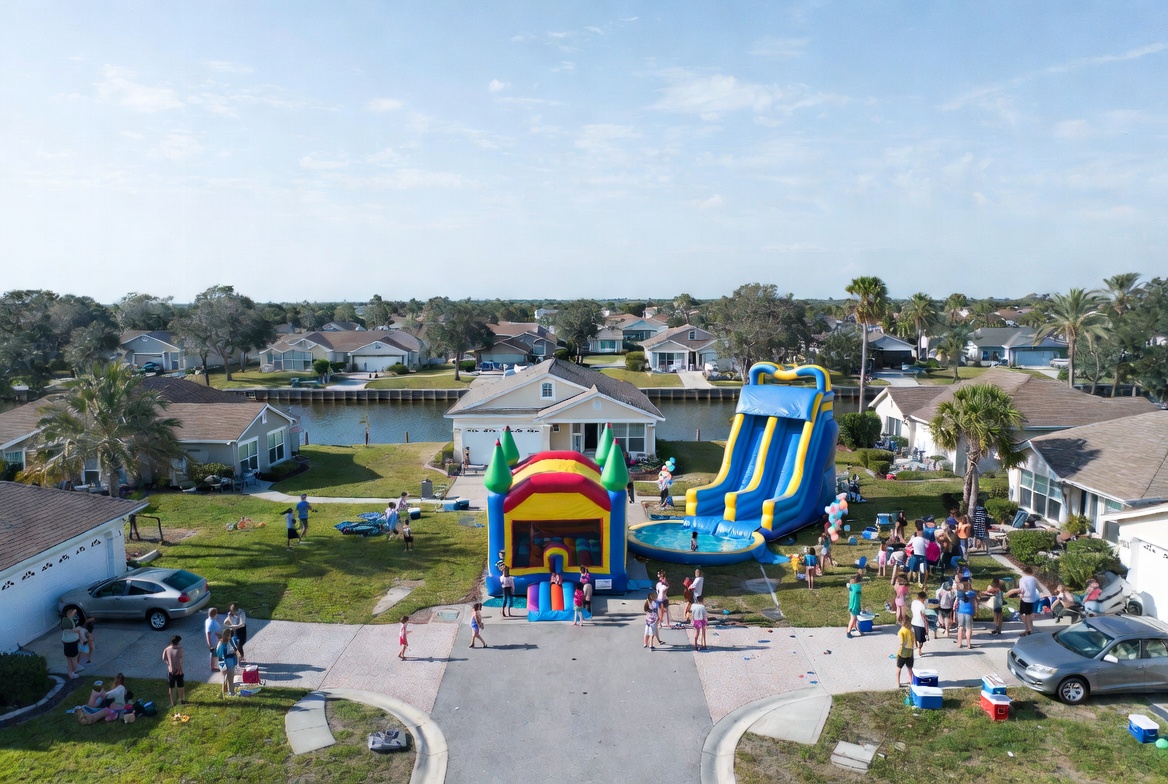
Most of you have heard the canal stat. Cape Coral has more than 400 miles of navigable saltwater and freshwater canals — more than any other city in the world by most counts. What that statistic does not tell you is what it does to the street pattern up here, and what it does to a block party.
I have lived in Cape Coral my whole life. I survey property in this city for a living. Between those two things I have walked or driven a sizable fraction of every street in town, and I have a strong opinion about which ones can host a backyard birthday that spills out onto the curb and which ones cannot.
This is a notes post about block parties in Cape Coral — which neighborhoods support them, what the city grid does to the logistics, where the power and water tend to be, and a couple of things I have learned from staking inflatables down on real Cape Coral streets.
The grid is not one grid
When Gulf American Land Corporation started laying out Cape Coral in the late 1950s, they did not draw a single uniform grid. They drew a series of overlapping plats, each one keyed to the canal system they were dredging into place. That means today Cape Coral is a patchwork of layouts that look superficially similar from a car but read very differently if you walk them.
The Old Cape — south of Pine Island Road and east of Chiquita, roughly — has long “circuit” streets. These are blocks that run a long straightaway before dead-ending at a canal. The numbered terraces and avenues run east-to-west, the named streets run north-to-south. There are fewer cross streets than the map first suggests because canals interrupt them. That is one of the reasons GPS routes through Cape Coral feel inefficient. The canals force the algorithm to backtrack.
The newer subdivisions north of Pine Island, where I have surveyed a lot in the last decade, look more like a Florida builder's standard layout. Coral Oaks, Sandoval, the streets around the Cape Coral High area, the newer pockets in NW Cape where Gabe lives — these have cul-de-sacs, loops, and planned green spaces. Blocks are shorter, streets curve, and the traffic patterns are different.
Then you have the gated waterfront communities — Cape Harbour, Tarpon Point, parts of the Yacht Club area — with their own internal road structures and their own rules about what you can stage in a common area.
Which patterns actually support a block party
I get asked at least once a week if a particular street works for a bounce house out front. Here is the rough mental model I use, in order from easiest to hardest.
Cul-de-sacs are the easiest
You have a closed loop at the end. No through traffic. Neighbors share the bulb. A 15-by-15 bounce house can sit on the grass strip in the middle of a cul-de-sac bulb without blocking anyone's driveway, or it can sit on a host driveway with the entrance facing the bulb so the kids run out into open space instead of toward the street. Most of the NW Cape subdivisions have at least one or two streets like this per square mile.
Circuit dead-ends are almost as good
These are the Old Cape streets that terminate at a canal. The last two or three houses share a quieter pavement than the rest of the street because the canal is the wall. If your house is at the end of one of these, your block party is only competing with the neighbors who are also at the end. The cars driving past are almost always headed to one of the houses on the block, not through it.
Long connectors are the hardest
Some Cape Coral streets carry traffic between major arteries. Locals use these to avoid Veterans, Pine Island, or Del Prado, particularly in season. A block party on one of these is fighting traffic the whole afternoon. If your address falls on a connector, the back yard is almost always a better answer than the curb, and an inflatable in the driveway should be staked well clear of the sidewalk.
HOA neighborhoods have a different answer
Sandoval, certain Cape Harbour subsections, parts of the Tarpon Point area — these often have a clubhouse, a pool deck, or a common green that the HOA can reserve. We have delivered inflatables to several of those for community events. The logistics are completely different from a residential street, and the right call is to be talking to the HOA office, not to the city.
The logistics, briefly
A few things I have learned setting up on Cape Coral streets that are not obvious until you have done it.
Keep one lane clear for fire access
This is a real rule, not a suggestion. Lee County emergency vehicles need a path through a residential street even if your neighbors are out at the curb. If your inflatable plus the cars at the curb closes the street, you have a problem. Plan around it before delivery, not after. On a typical 25-foot residential pavement, that means staking on grass or shoulder, not in the travel lane.
Power is usually close
Most Cape Coral homes have a GFCI exterior outlet near the garage or carport. A standard inflatable blower draws around 8 to 10 amps, and a normal 20-amp household circuit will handle it as long as nothing else big is on the same breaker. The older homes in the Old Cape sometimes have fewer exterior outlets, in which case an outdoor-rated extension cord from a screen-porch outlet is the usual fix. If you are running two blowers, run them on two different circuits if you can. The breaker panels in 1970s Cape homes do not love a sustained double draw on one leg.
Water is usually close too
If you are doing a water slide on a block party, you need a hose bib that is not buried behind a planter bed. On Cape Coral lots the front hose bib is usually on the side of the house nearest the garage, and the back one is on the side nearest the lanai. Walk it before booking.
Mind the canal
I sound like a broken record on this, but a surprising number of Cape Coral lots back to a canal with no fence and a steep seawall edge. If your block party drifts into the back yard, brief the parents and watch the toddlers. A two-year-old with a juice box and a head start is faster than you think.
A word on permits
For a normal residential birthday or anniversary — a bounce house in the yard or driveway, neighbors over, no street closure, no amplified PA system — the City of Cape Coral does not require a special event permit. The city's process is built for genuine public events, actual street closures, and amplified-sound situations.
If you actually want to close your street — barricades up at both ends, no through traffic — you need to coordinate with the city, and I would not try to do that on a weekend without lead time. For a typical front-yard-spilling-onto-the-cul-de-sac block party, it is not necessary.
HOA neighborhoods are a separate question. Read your covenants, talk to your board. Some HOAs have explicit policies about inflatables on common areas and some do not. The rules in Sandoval are not the rules in Cape Harbour are not the rules in Coral Oaks.
The summer timing piece
A block party in Cape Coral in June, July, or August is a morning event. Surface temperatures on a black asphalt cul-de-sac at 2 PM in July run hot enough to cook through the soles of cheap sandals. The kids will not want to be on the street that late in the day, and your neighbors will not either.
Most of the block parties we deliver to in summer start at 10 AM and are wrapping up by 2 PM, before the afternoon storms typically build off the Gulf. The bounce house gets shade by 1 PM if you stage it right, the splash pool stays cool, and the adult food shifts to the lanai for the rest of the afternoon. That is the shape that works on a Cape Coral street in summer. It is not a 10-to-8 event, and trying to make it one is how you end up with a thunderstorm cell over your inflatable at 3:30 PM.
Closing
I like the block party tradition we have here. Some streets do it every summer, some do it once a year, some never have. The geometry of Cape Coral — the canals, the circuits, the cul-de-sacs, the patchwork plats laid down over sixty years of buildout — gives certain blocks an advantage and certain blocks a disadvantage. Knowing which one your street is saves a lot of trouble before you spend any money on inflatables and food.
If your neighborhood is putting one together this summer and you want to talk through what fits, call (239) 212-0011. I do not need to come look at the lot if you can describe the street to me. The pattern is usually enough.
About the author
Christopher Johnson — Co-owner, SWFL Amusements LLC
Chris is co-owner of SWFL Amusements and a professional surveyor by day. He spends his working hours mapping Southwest Florida properties, which means he knows the canal-front quirks, the older Cape circuit grid, and which intersections back up during snowbird season. He proudly lives in Cape Coral, where he was born and raised.