Cape Coral was carved out of Southwest Florida in 1957 by the Rosen brothers and their Gulf American Land Corporation, and one of the first decisions they made changed how the city has thrown parties ever since. Instead of laying the whole property in a Chicago-style grid of continuous through streets, they cut more than 400 miles of canals through it — more navigable waterway than any other city on the planet, roughly fifteen times what Venice has. When a canal meets a residential street, the street stops. That single decision, made almost seventy years ago, is why Cape Coral in summer 2026 is a city of thousands of quiet residential dead-ends. And it is why, every July and August, I get a phone call at least once a week about a cul-de-sac block party.
I want to write about that phone call this morning. What it usually sounds like, what I have learned from listening to it, and the handful of practical things every host should know before Saturday.
Why Cape Coral is a cul-de-sac city
The historical piece is worth a couple of paragraphs. Gulf American Land Corporation was founded in 1957 by brothers Jack and Leonard Rosen. They bought a piece of coastal land north of the Caloosahatchee River, master-planned it in a strict grid, and hired dredges to carve saltwater and freshwater canals through the interior. The canals had two commercial purposes: they created a huge inventory of “waterfront” lots to sell in hotel-banquet dinner meetings across the country, and they gave the developer a cheap way to drain a low-lying peninsula.
The unintended civic result, sixty-plus years later, is a city where a large share of the residential streets end at water. If you have driven Chiquita Boulevard or Del Prado Boulevard and turned off into a neighborhood, you already know what that looks like on the ground. A short spine of a residential street peels off the arterial, runs for six to twelve houses, and then ends in a bulb, a canal, or both. That geometry is the city's single most defining physical feature after the water itself, and it is the geometry that quietly produces the modern Cape Coral summer block party.
What a cul-de-sac block party actually looks like
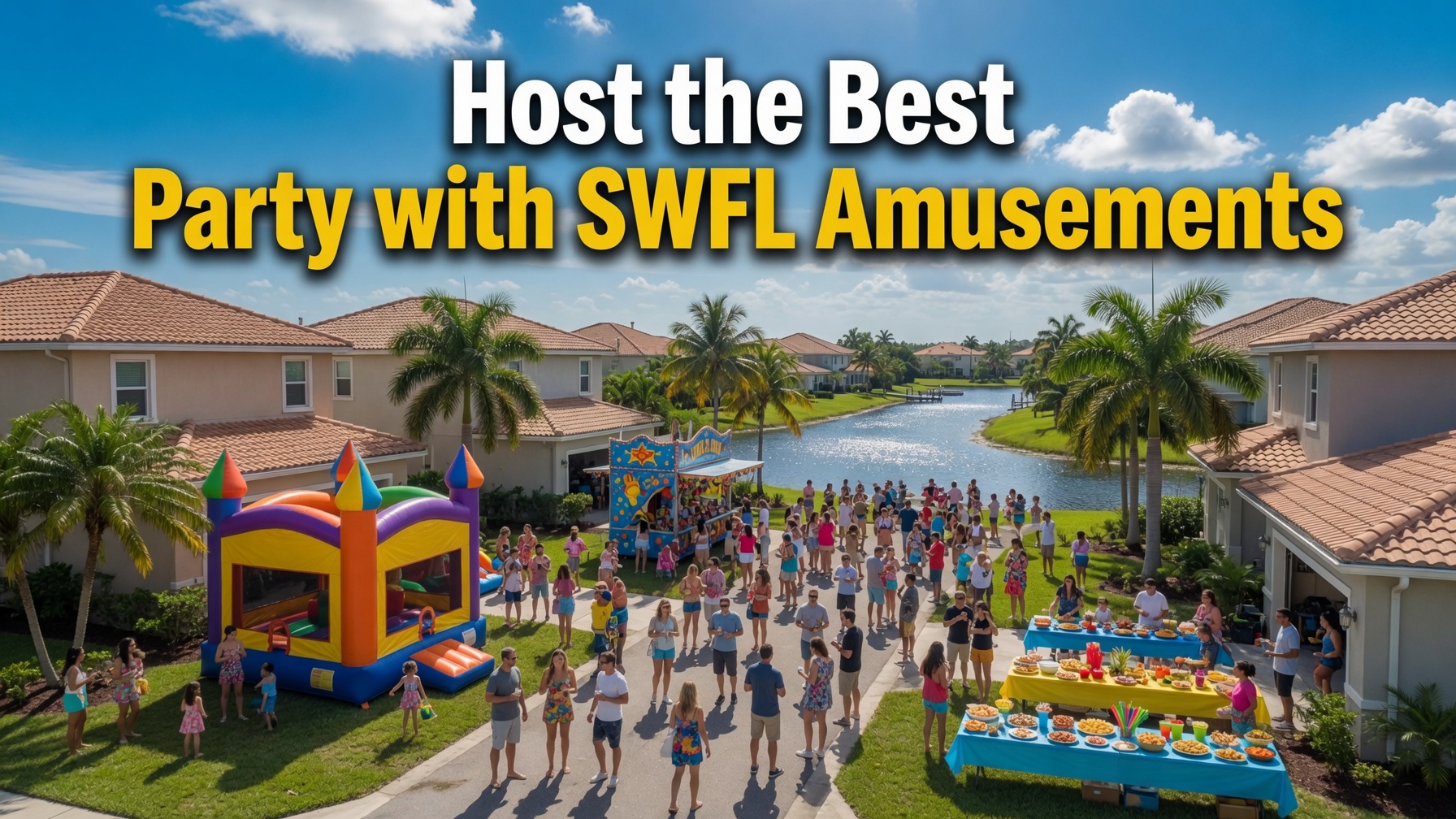
The phrase “block party” can mean a lot of things. In an older Midwestern city grid it means closing a through street with cones, notifying the city, and hosting several dozen households. In Cape Coral, most of what I see is more modest: five to twelve homes on a residential dead-end pitch in on a Saturday afternoon in July, one house acts as the anchor, and the party spills into the bulb of the cul-de-sac and back into a couple of side driveways.
Because the street is a private residential dead-end with no through traffic, the party does not need a City of Cape Coral street-closure permit the way a public through street would. You do not put up barricades, and you do not file paperwork. You knock on doors, or text the group chat, and you agree on a Saturday. That is how the vast majority of these parties get organized in this city.
The two civic-adjacent things that do come up: the residential noise ordinance, and courtesy notification of the immediate neighbors. Cape Coral limits amplified sound at higher levels late in the evening, and almost every complaint I have heard traces back to one of two things — music running past midnight, or the neighbor at the end of the street who did not know it was happening. A five-minute walk with a plate of something and the date on a note card solves the second one.
The fire truck visit
The single highest-value add-on for a Cape Coral kids' block party is a Cape Coral Fire Department truck visit. This is a real, publicly available program run by the department's community services office. If you email the community coordinator at [email protected] two to four weeks in advance, and your block party falls on a Saturday or Sunday when the on-shift crew in your zone can spare fifteen minutes, they will often send a truck for a fifteen-to-twenty-minute stop. The crew stays with the truck the whole time, the kids get to sit in the cab, and it is by an enormous margin the highest-value photo of the day.
The caveat, which the department is honest about when you talk to them, is that they are on shift for a reason. If there is an active call in your zone, the truck leaves. That happens. Plan the schedule so the fire truck visit is early in the party window, not the finale, so a sudden departure does not feel like the party ended. And do not schedule it for the same fifteen minutes the bounce house is being anchored — two loud draws overlapping wastes both.
What a cul-de-sac actually fits
The typical Cape Coral cul-de-sac bulb is roughly forty to sixty feet across at its widest, measured curb to curb. That is enough clear space for almost any single unit in our inventory. It is not enough space for a dual-lane 22-foot slide plus a bounce combo plus an obstacle course all at once. If the block is planning big, plan on staging the equipment across the bulb and two adjacent driveways rather than trying to jam it all into the pavement of the bulb itself.
The more common footprint is one anchor unit in the bulb and one or two smaller add-ons on the anchor host's driveway. A 14-by-14 Classic Castle bounce house at $199 sits comfortably in the middle of the cul-de-sac, leaves clear walking space around it, and works for the four-to-ten age range that dominates most block parties. A pedestal joust or a basketball challenge fits on the driveway for the older kids. That is the classic Cape Coral cul-de-sac configuration, and it is what most of the block chats settle on once we walk through the math on the phone.
Power is worth one sentence. Every unit we deliver needs a dedicated 20-amp circuit. On a Cape Coral cul-de-sac, that circuit comes from the anchor host's garage or exterior GFCI outlet, and the extension cord runs across the driveway, over the curb, and into the bulb. Nothing crosses the pavement without a rubber cord protector, which we bring. This is the sort of detail that sounds trivial until a delivery truck arrives and the host is scrambling to find an outlet, so it is worth locking down when you book.
The insurance question
I get asked whether the host's homeowners policy covers a block party. The honest answer, from the CFO chair I still occupy part of my week, is: probably, up to the personal liability limit on the policy, for injuries to a guest, but I would not treat “probably” as a plan. Two practical steps.
First, our company carries commercial general liability insurance that covers the equipment operation itself, which is a materially different exposure than the party's liability. That policy is on file. We can furnish a certificate of insurance for the delivery if a host or an HOA is asked to see one. Second, if the block party has more than twenty guest households, or the host's policy has a low personal liability limit, it is worth a phone call to their agent that week to ask about a one-day event rider. Those riders are usually inexpensive and they close the biggest gap.
None of that is legal advice. It is a note on the actual conversation that happens on our end when a bigger cul-de-sac party is being planned, and I would rather write it here than leave a host to figure it out at 8 a.m. on Saturday.
The logistics discipline
I served in the Air Force for a little over two decades before this business. Most of that career was about moving people, equipment, and information to a specific place at a specific time under conditions that were not always cooperative. A cul-de-sac block party in July is smaller and much friendlier than any of that, but the same three questions apply: what is the arrival window, what is the departure window, and what is the plan if the weather turns.
For a Cape Coral summer block party those answers are usually: 10 a.m. bounce house arrival for a noon start, 4 p.m. pack-up, and if the 2 p.m. Gulf-front thunderstorm arrives on schedule, the anchor host's pool-cage lanai is where everyone consolidates for forty minutes until it passes. Every block chat that has run those three questions before Saturday morning has run a better party. Every one that has not has spent the party running them in real time, which works but is more stressful than it needs to be.
A short list of things worth doing the week before
- Walk the bulb and confirm the widest measurement across the pavement. If it is under thirty-eight feet, we need to have the conversation about which unit fits.
- Locate the anchor host's exterior GFCI outlet and confirm it is on a working circuit. Older Cape homes on the SE and central grid sometimes have exterior outlets that are on tripped breakers nobody remembers.
- Send one email to [email protected] with the date, address, and window if you want a fire truck visit. Two to four weeks out is the sweet spot.
- Text the two houses on either side of the anchor even if they are not attending. Not because they will complain, but because they will appreciate the heads-up and the party will feel like a block event, not a household event.
- Pick a rain-plan indoor or lanai space in advance and tell everyone. The plan does not have to be elaborate. It has to exist.
The one-line summary
Cape Coral is a cul-de-sac city because seven decades ago Gulf American laid the grid to sell waterfront lots. That grid is now a summer party asset if you use it well. Anchor the party in the bulb, add one or two smaller units on the driveway, book the fire truck early in the window, and think for five minutes about noise, neighbors, and the storm plan. That is the whole note.
If your block chat is starting to plan one, the honest thing I would say is call the office at (239) 212-0011 before the group locks in on a specific piece of equipment. Ten minutes on the phone can shape the whole afternoon, and it costs nothing.
About the author
Gabriel Denny — Co-owner, SWFL Amusements LLC
Gabe is co-owner of SWFL Amusements. He spent 20+ years in the Air Force, first enlisting after high school before commissioning and retiring as a Major. He is a 5x CFO, which he continues to do when not working bounce houses. He lives in NW Cape Coral and answers the company phone himself, including at 2am.