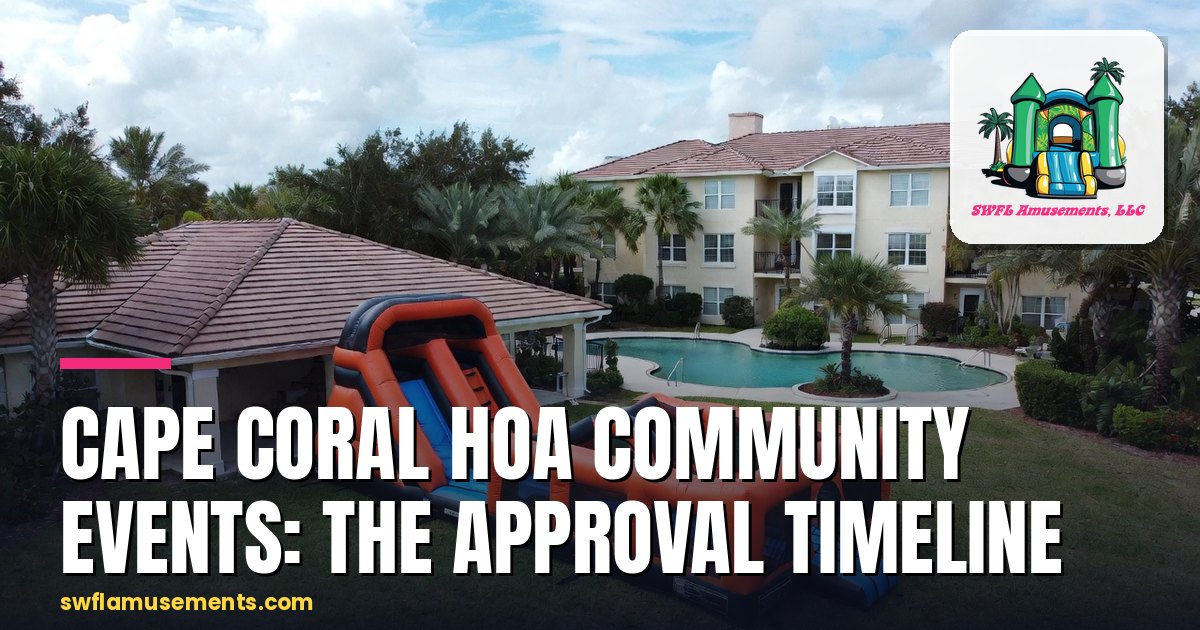
The HOA calendar in Cape Coral wakes up in October. It is predictable enough that you could set a watch by it. The association that could not get five people onto a Zoom call in August suddenly has a social committee with opinions, a treasurer back from Michigan, and a date circled for something on the clubhouse lawn.
I have surveyed inside a fair number of these communities — boundary work, easement locates, the occasional fence disagreement — and I have also backed a trailer up to their amenity centers. The two jobs taught me the same lesson from opposite ends: in an HOA, the paperwork takes longer than the setup, and almost nobody plans for that.
So this is a post about the unglamorous part. Not themes, not decorations. The sequence a volunteer committee in a Cape Coral homeowners association has to move through to get a community event approved, funded, and on the ground — and the places where Florida law puts hard dates on that sequence whether the committee likes it or not.
Three groups are involved, and only one of them can spend money
Almost every stalled community event I have watched in this town stalled for the same reason: the people with the enthusiasm and the people with the checkbook were not the same people, and nobody said so out loud.
The social committee generates the idea and does the work. In most Cape Coral associations it has no spending authority at all. It is a committee of volunteers, and its output is a recommendation.
The board of directors has the authority. Five or seven neighbors, unpaid, who are also handling the roof bid on the mail kiosk and a complaint about somebody’s boat trailer. A fall festival is one line item on a crowded agenda, and it will not get approved in the hallway after a meeting — it gets approved on a motion, in a noticed meeting, recorded in minutes.
The management company holds the mechanics. Notice, the official records, the certificate of insurance request, the gate list for a vendor truck. Management is not the decision maker, but if you skip them your approved event can still fail on the day because nobody put the vendor on the gate list. I have sat at a call box in Sandoval with a trailer behind me for twenty minutes over exactly that.
The notice clock Florida puts on your board
Homeowners associations in Florida operate under Chapter 720 of the Florida Statutes. If you live in one of the waterfront buildings along the Caloosahatchee or on Cape Coral Parkway, your community is probably a condominium association under Chapter 718 instead, and the rules differ — check which one governs you before you rely on any of this.
For a Chapter 720 association, three notice provisions set the real calendar:
- Regular board meetings. Under section 720.303(2)(c)1, notice of a board meeting must be posted in a conspicuous place in the community at least 48 hours in advance, or mailed or delivered to each member at least 7 days before the meeting.
- Money or rule changes on the agenda. Under section 720.303(2)(c)2, written notice of any meeting at which special assessments will be considered, or at which amendments to rules regarding parcel use will be considered, must be mailed, delivered, or electronically transmitted to the members and posted conspicuously not less than 14 days before the meeting.
- The annual members meeting. Under section 720.306(5), notice must be mailed, delivered, or electronically transmitted not less than 14 days before the meeting, and evidence of compliance with that 14-day notice is made by affidavit filed among the official records. Quorum for a members meeting is 30 percent of the total voting interests unless the bylaws provide for a lower number, per 720.306(1)(a).
Here is the practical read, and it is the part committees get wrong. A community social event paid out of an existing social or amenity line item in the adopted budget is ordinary board business. Forty-eight hours of posted notice, a motion, done. That is a two-week turnaround if the board meets monthly.
But the moment your event needs money the budget does not have, or needs the board to change a rule about what is allowed on common property — amplified sound past a certain hour, a vendor vehicle on the pool deck, inflatables on the common lawn at all — you have moved into 14-day notice territory. Add that to the gap before the next board meeting and you have burned a month before a single phone call goes out to a vendor.
None of this is a reason to give up. It is a reason to find out in September which bucket your event falls into.
Working the date backward
When a committee calls me in early October asking about a community event, the first question I ask is not what they want. It is what date they have, and whether the board has voted. Here is the sequence I would run if I were sitting on the committee:
- Confirm the funding source first. Pull the adopted budget and find out whether there is a social or community events line, and what is left in it. This single answer determines whether you are on a 48-hour notice track or a 14-day one.
- Get a number before the agenda, not after. Boards approve specifics. “Some inflatables” gets tabled. “Two units, $648 plus tax, delivery and setup included, certificate of insurance on file” gets a motion.
- Ask management to add it to the next properly noticed meeting. Give them the dollar figure, the date, the vendor, and the location on the property. Ask them in writing which notice provision applies.
- Request the certificate of insurance the same week the motion passes. Associations typically want to be named as an additional insured. That paperwork is routine on our end, but it is not instant, and it is the item most likely to still be outstanding the week of the event.
- Book the date before you finalize anything else. October and November Saturdays in Cape Coral go early. The decorations can be sorted out in week four. The Saturday cannot.
- Put the vendor on the gate list. Name, company, vehicle, arrival window. If your community has a staffed gate, call the day before and confirm it is actually there.
The common area is a site question, not a paperwork question
This is where my day job earns its keep. In a platted Cape Coral community, the common area is not just “the lawn by the clubhouse.” It is one or more platted tracts, and those tracts usually carry drainage easements, utility easements, and lake maintenance easements across them. The plat is public record through the Lee County Clerk, and your management company almost certainly has a copy on file. Before you commit to a spot, look at it.
Three things I check on an amenity-center lawn:
The irrigation. Community common areas are irrigated far more aggressively than a private yard, often by a mainline running directly under the best-looking stretch of grass. Stakes and irrigation mainlines are a poor combination. Ask maintenance where the heads and the lines run, and ask them to lock out the clock for the day. A zone firing at 4 PM under a bounce house is a problem that is entirely preventable the week before.
The lake bank. A lot of Cape Coral communities are built around their water features — Trafalgar Woods, off SW 20th Avenue between Trafalgar and Veterans Parkways, has two freshwater lakes with a fishing pier, and Coral Lakes up in the northeast Cape is organized the same way. Those banks are graded to shed water into the lake, and the last fifteen feet often falls more than people think. Inflatables tolerate a couple of inches of fall across the footprint. They do not tolerate four. Keep the unit up on the flat and away from the bank for reasons that have nothing to do with paperwork.
The pool deck and the hardscape. Sandoval, northwest of Veterans Parkway at Surfside Boulevard, has a zero-edge resort pool with a slide, a clubhouse, and a playground. Cape Royal, southeast of Pine Island Road and Veterans Parkway, is built around 27 holes of golf with a pro shop and tennis. Those are attractive settings and mostly the wrong surface. Decorative concrete, pavers, and cart paths cannot take ground stakes, which means sandbag ballast instead, which means more weight and a wider clear footprint. Workable, but decide it in advance rather than in the driveway.
One thing worth saying plainly, because it comes up every time: the prohibition on inflatables in City of Cape Coral parks does not apply to your association. Your common area is private property. The board sets the rule there, not the city. If your documents are silent on inflatables, the board can simply approve the event — and if the board wants to write a standing rule so future committees do not have to re-litigate it, that is the 14-day notice item worth spending once.
What a community-scale setup actually costs
Committees routinely guess high on this, which is part of why events die before they reach an agenda. Real numbers, from our rental pages:
- Our Giant Corn Maze is 34 feet by 33 feet with walls over 6 feet tall, holds 30 people at a time, and rents for $499. For an October community event it is the single best crowd-absorber we own, because it keeps thirty kids occupied without a line.
- The 38-foot Straight Shot Obstacle Course is $449 and runs two kids head to head, which gives you a natural flow instead of a queue.
- A 14-foot Classic Bounce castle is $199.
- The Little Kids Bounce & Slide Combo, built for ages 1 to 5, is $99 — and in a community with a lot of visiting grandchildren, it is the unit that keeps the under-five crowd out of the big inflatable.
Delivery and setup are included in those figures. A mid-size Cape Coral association can cover a toddler unit and one large attraction for under $600 before tax, which in most adopted budgets is an existing line item rather than a special assessment. That distinction is worth more to your timeline than any discount.
If your board has a date in mind and your committee has not worked out which notice rule applies yet, call (239) 212-0011 and ask for Chris. I will tell you what fits on your common tract and what it costs, so you can walk into the meeting with a number instead of an idea.
About the author
Christopher Johnson — Co-owner, SWFL Amusements LLC
Chris is co-owner of SWFL Amusements and a professional surveyor by day. He spends his working hours mapping Southwest Florida properties, which means he knows the canal-front quirks, the older Cape circuit grid, and which intersections back up during snowbird season. He proudly lives in Cape Coral, where he was born and raised.