It is June 22 in Cape Coral, three weeks into the 2026 Atlantic hurricane season, and the afternoon sky is doing the thing it does every afternoon in June — clear at 10 AM, gray by 2 PM, raining by 3:30, sun back out by 5. If you are planning a backyard birthday or a community event between now and the end of November, the weather is the conversation. Everything else is downstream of it.
I am going to walk through three things in this post: what the National Oceanic and Atmospheric Administration actually said about the 2026 season in its May outlook, what our company's weather policy actually is (the specifics, not the marketing version), and how I personally think about planning a Cape Coral summer party when the storms are real. The third part borrows from work I did in two earlier careers — first in the Air Force, then as a CFO — because contingency planning is a transferable skill and people use it in their personal lives less than they should.
What NOAA said in May
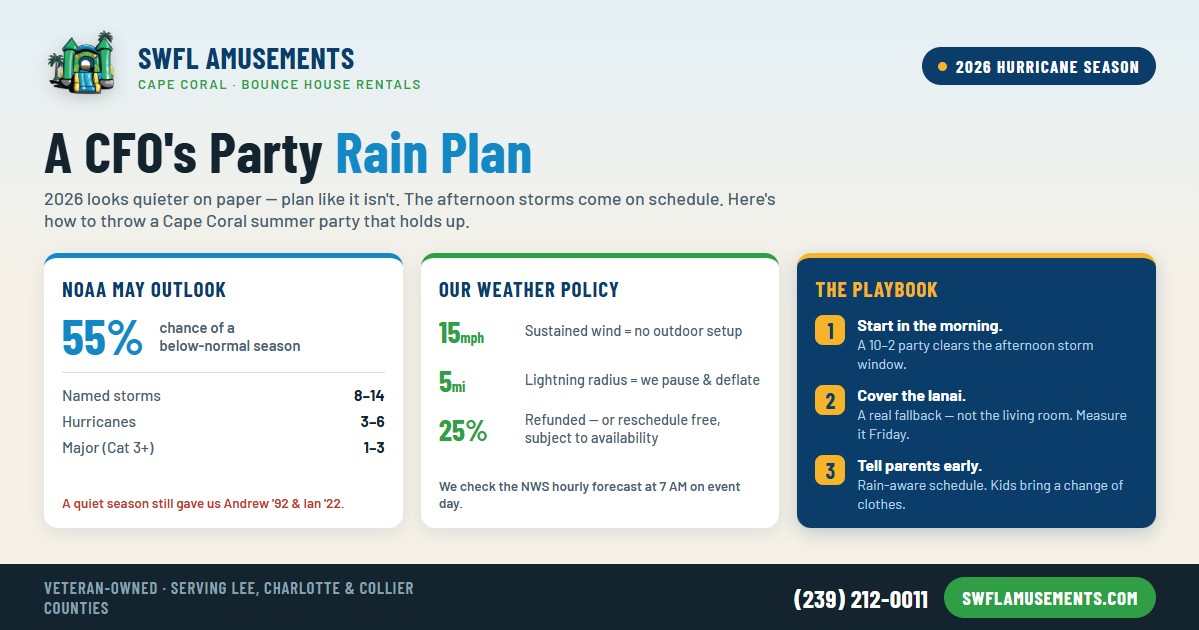
NOAA released its 2026 Atlantic hurricane season outlook in late May. The headline number: a 55 percent chance of a below-normal season, a 35 percent chance of near-normal, and only a 10 percent chance of above-normal activity. The range they gave for the season is 8 to 14 named storms, 3 to 6 hurricanes, and 1 to 3 major hurricanes (Category 3 or above).
The driver they cited is the developing El Niño pattern in the Pacific, which historically suppresses Atlantic hurricane activity by increasing wind shear over the basin. Ocean temperatures in the Atlantic are running slightly warmer than normal, and trade winds are weaker than average, both of which are pro-storm factors — but El Niño's shear effect is expected to win on net.
That is the official forecast. Here is the part I want every Cape Coral resident to remember.
A below-normal forecast is not a no-storm forecast
I am old enough to remember 1992. The 1992 Atlantic hurricane season produced only six named storms and one major hurricane. By the count, it was a quiet year. That one major hurricane was Andrew, and it destroyed Homestead. The 2004 season had four hurricanes hit Florida in six weeks. Hurricane Ian made landfall on September 28, 2022, came across the Cape and the Fort Myers Beach barrier islands as a Category 4, and it does not matter what NOAA's pre-season number was — for Lee County, that one storm was the whole season.
Pre-season forecasts tell you about basin-wide energy. They do not tell you whether your particular Saturday in August in Cape Coral is going to be the one where a tropical wave decides to organize over the Gulf. A below-normal season just means there are fewer dice rolls. Each individual roll is the same.
What it does mean practically is that 2026 is more likely than not to look like an ordinary SWFL summer — afternoon convection, occasional tropical waves, a few rain-canceled weekends, and a watch-the-cone moment or two between mid-August and mid-October. That is what we are planning around, and that is what you should plan around.
Our actual weather policy, in plain English
I want this part on the record because the version on the terms page is legal-document length and most people skim it. Here is what we actually do when the forecast looks bad.
At 7:00 AM on the morning of your event, we pull up forecast.weather.gov for your venue's zip code — the National Weather Service hourly forecast, not a phone-app aggregator — and we look at the conditions over your scheduled event window. If the forecast for that window shows thunderstorms, or sustained winds greater than 15 miles per hour, we will not set up outdoor inflatables. Sustained winds at 15 MPH means gusts will likely be in the 25 to 30 range, and that is past the safe operating envelope for a residential bounce house.
If your forecast trips one of those triggers and you have an approved indoor location — a covered pavilion big enough for the unit, a church fellowship hall, a garage that meets ceiling-height requirements — we move the event indoors and proceed. If there is no indoor alternative, the event cancels and you receive a 25 percent refund of the contract price. A same-day weather cancel costs us a delivery slot we cannot resell and the staff time already committed to your event — that is what the retained 75 percent covers. We are not penalizing you for the weather.
The other path we strongly prefer, and that we will work with you on at the time of cancel, is rescheduling. If you can pick another date that fits both your calendar and our availability, we will move your booking to that date at the same price. No re-quote, no rebooking fee, no cancellation hit. Most customers in this situation reschedule. The refund line is the fallback when a reschedule genuinely is not possible — out-of-town family flew in for a fixed weekend, a milestone birthday that cannot move, that kind of thing.
During an active event, if lightning strikes within five miles of your address — we use WeatherBug to detect it — we suspend equipment operation immediately. The unit deflates, kids come off, parents move to shelter. We require 30 minutes of clear conditions before we restart. Time lost to a weather pause during an active event does not get refunded, because the equipment was delivered and the staff was paid.
That is the whole policy, condensed. The legal version is on the terms page. The two numbers to remember are the 15 MPH sustained-wind threshold and the 5-mile lightning radius, because those are what actually get used.
How a CFO plans a Cape Coral summer party
This part is editorial. Take it or leave it.
When I sit down to plan a quarterly close as a CFO, I write the pre-mortem before I write the plan. That is, I write the paragraph that explains why the close failed, and I do that before I write the schedule that explains how it will succeed. The pre-mortem forces you to list the things that can actually go wrong and decide ahead of time whether you are going to mitigate them, accept them, or transfer them to someone else (insurance, a vendor, a backup plan).
For a Cape Coral summer party, the pre-mortem reads something like this. “The party failed because a thunderstorm hit at 1:45 PM and shut down the bounce house, the kids were stuck inside the house for the remaining two hours, and the rest of the food went to waste because no one wanted to eat in the rain.”
You read that paragraph, and three mitigations become obvious:
- Start earlier. A 10 AM start and a 2 PM end clears the typical afternoon convection window. A noon-to-4 party is fighting the storm cell. I have written this in other posts and I will keep writing it — June, July, and August parties in SWFL are morning events.
- Have a covered fallback that is not the living room. A lanai, a covered patio, a screen porch, a garage with the door up, a friend's clubhouse. Something that gets the kids out of the sun and the rain but not into your air-conditioned house. The lanai is the Florida answer here and almost every Cape Coral home has one.
- Set the parents' expectation early. Tell them at RSVP that the event is rain-aware, that you may shift the schedule, and that the kids should bring a change of clothes. This is the cheapest mitigation on the list and the one most people skip.
In Air Force planning we used to call this branches and sequels. A branch is what you do if the situation changes during execution; a sequel is what you do after the current operation ends. The party-planning version is the same idea at smaller scale: what is the branch if the radar lights up at 1 PM, and what is the sequel if you have to cut the event short by an hour? If you have answers to those two questions before the day starts, you are 80 percent of the way to a good outcome.
The two specific calls I would make this week
If you have a party booked between now and Labor Day, two practical steps.
First, check the actual NWS forecast for your event date about 72 hours out. Not the iPhone weather widget — that is a different model with different assumptions. Go to forecast.weather.gov, enter your zip code, scroll to the hourly graph. You are looking at probability of precipitation and wind speed over the event window. If POP is above 50 percent across your window and winds are climbing, start thinking about the branch plan.
Second, walk your covered fallback. If your plan is the lanai, measure it. A 13-by-13 bounce house wants roughly 15 by 15 of floor and an 8-foot vertical clearance, and most Cape Coral lanais are not that tall under the cage. A smaller unit may fit; the standard one usually will not. Knowing this Friday what fits and what does not is worth more than knowing it Saturday at 9 AM with a delivery truck pulling up.
A note on actual hurricanes
None of the above is about an actual landfalling hurricane. When a named storm is in the cone for SWFL, all bets are off. We do not deliver into storm watches or warnings, we contact every booked customer in the impact window proactively, and we reschedule. The cancellation policy on a contract bumped because of a National Hurricane Center cone is not the standard policy — we work with you on rescheduling for a future date because the storm is nobody's fault. That is in the contract. It also happens to be the right way to run the business.
The bigger point: when a real hurricane threat develops for Cape Coral, your bounce house is item number 200 on your list. Items 1 through 199 are shutters, fuel, water, prescription refills, evacuation routes for friends in zones A and B, and pet plans. Take care of those first. We will handle our end.
Closing
2026 looks like a quieter year on paper. Plan like it is not. The afternoon storms come on schedule regardless of what NOAA said in May, and the only reliable defense against them is an earlier start, a covered fallback, and parents who were told ahead of time that the schedule might move. That is the playbook.
If you are working on a summer party and want a second set of eyes on the rain plan, call (239) 212-0011. I have walked through this with several customers already this month and I would rather have the conversation Tuesday than Saturday morning.
About the author
Gabriel Denny — Co-owner, SWFL Amusements LLC
Gabe is co-owner of SWFL Amusements. He spent 20+ years in the Air Force, first enlisting after high school before commissioning and retiring as a Major. He is a 5x CFO, which he continues to do when not working bounce houses. He lives in NW Cape Coral and answers the company phone himself, including at 2am.