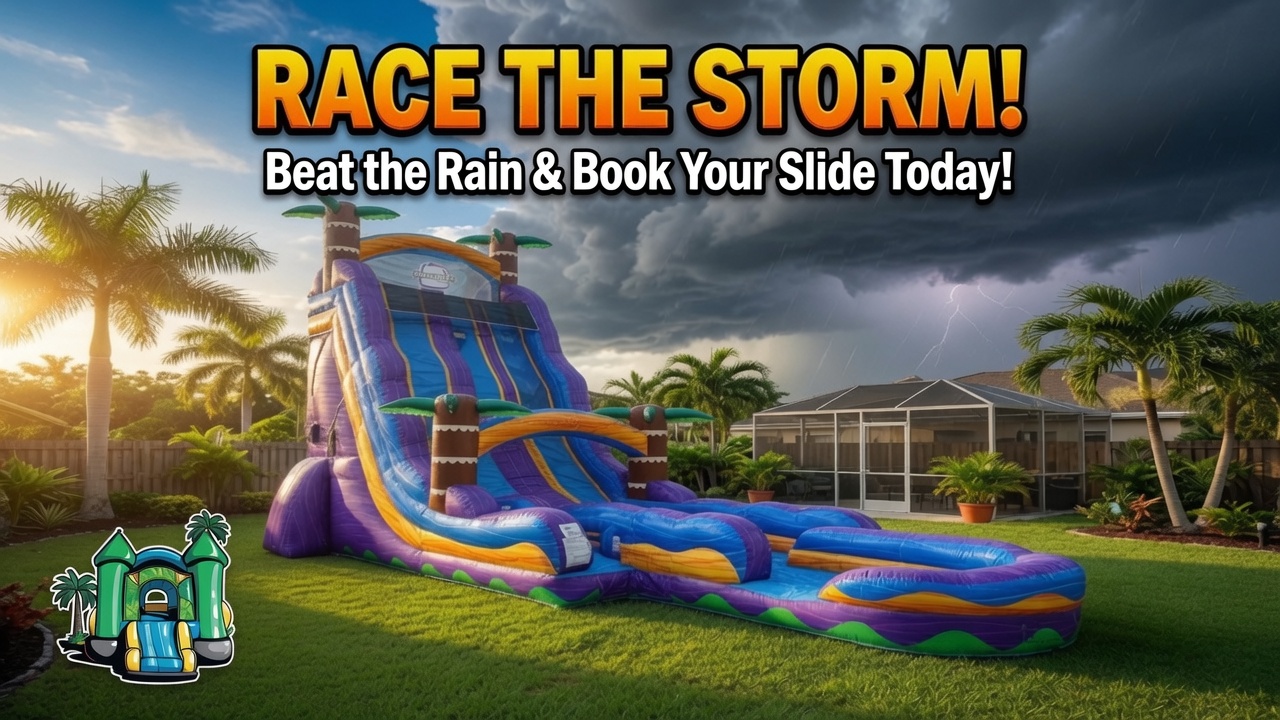
The single most common question I get from a Cape Coral or Fort Myers host in July, by a wide margin, is some version of “what time should we actually start the party?” What they mean is that they know a summer thunderstorm is going to show up in the afternoon, they have watched a couple of family birthdays get squeezed into a garage at 3 p.m., and they want a smarter answer than picking a time and hoping.
There is one, and it is boring. The Southwest Florida summer storm pattern is one of the most predictable weather features in the country. Time a bounce house party around it instead of against it and you get a much better afternoon. This post is how to do that in practice.
Why the storms fire at the same time every day
The National Weather Service office in Ruskin runs the public climatology for our area, and the physics is not a mystery. Florida is a narrow peninsula surrounded by warm water on both sides. On a July morning the land heats faster than the water, and two sea breezes start pushing inland — one off the Gulf, one off the Atlantic. Where those fronts collide, air is forced upward from both directions at once, and the tropical moisture over Florida does the rest. The leading edge of the west-coast sea breeze regularly detonates thunderstorms over Cape Coral and Fort Myers before the two fronts even meet.
NWS Tampa Bay’s public rainy-season climatology puts the peak storm-initiation window at roughly 1 p.m. to 5 p.m., with the most active hour usually between 4 and 6 p.m. depending on how strong the sea breeze runs that day. From June through September we sit under that pattern almost every afternoon. It is not random weather. It is a schedule, and it is on the NWS site if you want to see the source data yourself.
What “the storm window” means for a Cape Coral party
For our purposes as a bounce house rental company, a “storm” is anything that makes it unsafe or unpleasant to keep kids in an inflatable. That means lightning within roughly ten miles, sustained gusts above twenty miles per hour, or moderate rain. In practice, the 1 p.m. to 5 p.m. window is when all three of those show up together most often in Cape Coral, and the 4 p.m. to 6 p.m. window is when they are most severe.
The other side of that same window is what makes it useful. Mornings in July, from about 9 a.m. to noon, are typically clear or partly cloudy in Cape Coral. Late evenings, from about 6 p.m. onward, are typically clear again after the storm collapses. Those two blocks are the actual party windows. Not 2 p.m. Not 3 p.m. Not the middle of the afternoon.
Step 1: Set the party window around the storm, not through it
The two working slots for a July or August Cape Coral backyard party are 10 a.m. to 1 p.m. and 5 p.m. to 8 p.m. Both work. Neither has to be squeezed.
The 10-to-1 window is cooler on arrival and is fully done before the sea breeze fires. The tradeoff is it wraps at nap-and-lunch hour, and cake gets served before guests are hungry. The 5-to-8 window catches golden-hour light, is easier to feed, and the yard is already sun-dried from the afternoon storm. The tradeoff is that if the storm runs late, the 5 p.m. bounce house delivery lands in the tail of it. We deal with that on our end, but you should know it is a possibility going in.
The one window I would talk a host out of, most weeks in July, is noon to 3 p.m. That is the window that consistently blows up.
Step 2: Read the morning radar the day of
By 9 a.m. on any given July morning in Cape Coral, the NWS Ruskin office has already run its 6 a.m. and 8 a.m. upper-air soundings and pushed an updated hazardous-weather outlook. That outlook is free, plain-language, and specific to our forecast zone. The two things worth reading on it: the chance-of-storms percentage for the afternoon, and the timing note. If the outlook says storms possible “12 p.m. to 6 p.m.,” that is your window. If it says “3 p.m. to 9 p.m.,” the sea breeze is running late that day and the 5-to-8 party is going to have a rougher start than usual.
The best free tool I know for the day-of read is the NWS radar mosaic centered on Fort Myers, at radar.weather.gov, with the loop set to the last three hours. If the west-coast sea-breeze line has already fired at 11 a.m. over Pine Island Sound, your afternoon is going to arrive early. If nothing has fired by noon, the sea breeze is stalling and the storm window will slide two or three hours later. Either read takes a minute.
Step 3: Have a real forty-minute rain plan
Almost every backyard party in Cape Coral in July eats one forty-minute burst of rain somewhere. That is the honest number. A summer sea-breeze storm on the Cape almost never lasts longer than forty minutes at the surface — it is intense, and then it is over. Once you accept that, the rain plan is easier.
The plan needs three things: a covered space that fits the guests, a signal that moves everyone to it quickly, and a decision on whether the party ends or continues afterward. On a Cape Coral property with a screened lanai and pool cage, the covered space is already there and it fits a surprising number of children. On a property without one, the host’s garage becomes the plan, and the cars move to the driveway an hour before the party so the bay is clear.
The signal is whichever adult is watching the radar looking up and calling it. That call needs to go out roughly ten minutes before the rain actually arrives, not at the first drop. Kids in the bounce house have to be walked out, not run out, and the door has to be unzipped from the outside by someone tall enough to reach.
Step 4: Understand the bounce house shutdown protocol
Every unit we deliver has a written shutdown protocol taped to the blower. The two conditions that trigger it are sustained wind above twenty miles per hour and any lightning strike within ten miles. Both of those get worse fast during a sea-breeze storm. Our expectation, and our rental agreement, is that the operator on-site — usually the anchor host or a designated adult — walks the kids out, unplugs the blower, and lets the unit deflate before the leading edge of the storm arrives. Deflation takes about ninety seconds. It is not a big deal if you have thought about it in advance. It is a scramble if you have not.
If the party is booked with our on-site attendant option, we handle the shutdown call from our end. If it is a self-serve delivery, that responsibility sits with the host, and the safety-tip sheet we hand over at drop-off is the reference. Our full bounce house safety tips page has the same protocol written out for anyone who wants to read it before booking.
Step 5: What we do on our end
In July and August we build a weather buffer into the delivery schedule that does not exist in the dry season. Morning slots get an earlier drop; evening slots get flex. If a 5 p.m. delivery is going to land in an active storm, we call the host by 2 p.m. that afternoon and reset to a 5:30 or 6 p.m. arrival. The call is free and it does not affect total rental hours — we shift the pickup window with it. The alternative is asking the delivery crew to anchor an inflatable in forty-mile-per-hour outflow winds, which nobody wants.
The second thing worth knowing: our rental agreement has a weather-cancellation clause written specifically for the rainy season. If the NWS morning outlook has flipped to a high-end thunderstorm risk with severe potential and the host wants to cancel, we do not charge. That is the whole clause. We will do everything reasonable to make the party work first, but if the day is going to be genuinely dangerous, cancellation is free through the morning of.
A note on evening parties
The best-kept planning secret in Cape Coral summer, for what it is worth, is the 5 p.m. to 8 p.m. window in late July and August. The storm has usually collapsed by 5:30. The temperature has dropped ten degrees off the daytime high. The light is good, the mosquitoes have not fully come out yet, and the yard is already dried. Every year a handful of families figure this out and stop scheduling noon starts entirely. If your kids can handle a later dinner one Saturday, it is worth trying once.
The one exception is a very young age group. If the party is centered on kids under four, the 10 a.m. start is still the right answer — the evening window is past their curve. For a six-to-ten-year-old birthday, the evening slot is often the stronger party.
The logistics discipline behind all of this
I served in the Air Force for a little over two decades before this business. Most of that career was about moving people and equipment to a specific place at a specific time under conditions that were not always cooperative. A Cape Coral birthday party in July is smaller and friendlier than any of that work, but the same three questions apply: what is the arrival window, what is the departure window, and what is the plan if the weather turns. The families whose parties I remember as clean afternoons almost always answered those three questions before Saturday morning. The ones that turned into a scramble tried to answer them in real time. Neither is a failure. One is just less fun.
The one-line summary
The Southwest Florida summer storm window fires between 1 and 5 p.m. most July afternoons because of a sea-breeze collision that happens on a near-daily schedule. Cape Coral hosts get better parties by planning around that window — 10 a.m. to 1 p.m. or 5 p.m. to 8 p.m., with a real forty-minute rain plan for the storm that will probably arrive anyway. If you are working through a specific July or August date and want to talk through the timing, call the office at (239) 212-0011. Ten minutes on the phone will save an afternoon.
About the author
Gabriel Denny — Co-owner, SWFL Amusements LLC
Gabe is co-owner of SWFL Amusements. He spent 20+ years in the Air Force, first enlisting after high school before commissioning and retiring as a Major. He is a 5x CFO, which he continues to do when not working bounce houses. He lives in NW Cape Coral and answers the company phone himself, including at 2am.