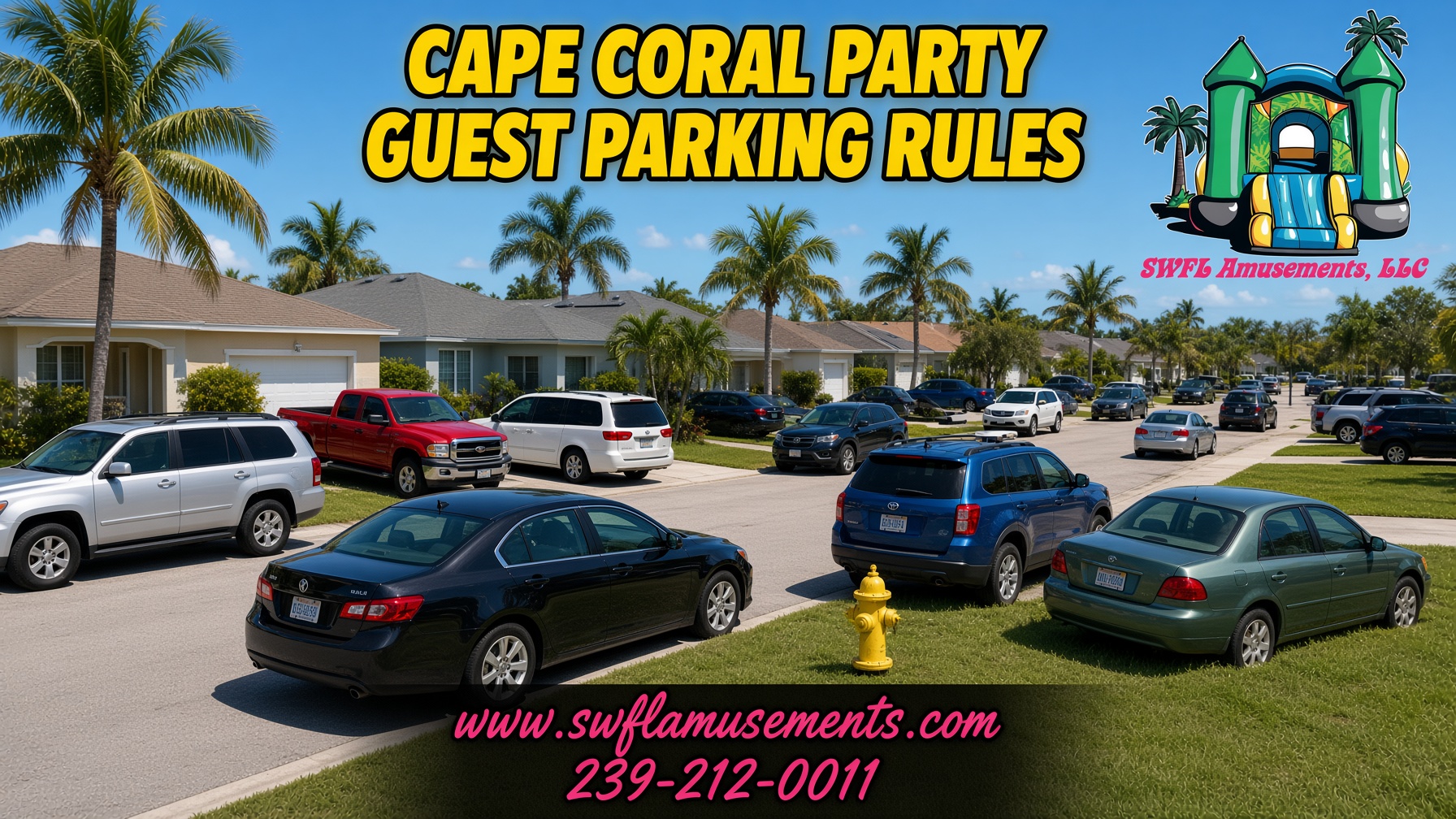
Nobody calls us about parking. They call about the inflatable, the delivery window, whether the blower will trip a breaker. Parking comes up around 2:15 on the afternoon of the party, when the eleventh car pulls up and the driveway holds four.
I notice it more than most people because of the day job. I survey Lee County property for a living, which means I spend a lot of time standing at the exact line where somebody’s lot stops being theirs and starts being the city’s. That line is almost never where people think it is. It is not the edge of the pavement, it is not the sidewalk, and on a lot of Cape Coral lots it is not the place where the mowed grass changes texture either.
So here is the parking question, worked the way I would work a boundary: figure out what land you actually control, figure out what rules apply to the land you do not, and then count.
Start by counting cars, not people
Every guest list I have ever been handed is a headcount. That is the wrong unit for this problem.
Twenty-five guests at a kid’s birthday is not twenty-five cars, but it is rarely five either. In my experience running deliveries around the Cape, a family birthday runs somewhere between two and three guests per vehicle — parents arrive together with two kids, then one grandparent comes separately, then the neighbor walks over, then somebody’s teenager drives himself. Twenty-five guests usually lands between nine and twelve cars.
A parallel-parked passenger vehicle needs roughly 22 feet of curb to get in and out without a three-point turn. Ten cars is 220 feet of curb. Your lot frontage is not 220 feet. This is the entire problem in one sentence.
Rule one: your own yard is more restricted than you think
This is the part that catches Cape Coral homeowners, including people who have lived here for decades.
The City of Cape Coral prohibits parking on pervious surfaces in residential zoning districts. The city’s Code Compliance division states it plainly: the prohibition includes, but is not limited to, parking on grass, sod, shell, rocks, dirt, or stones. Parking in residential districts is permitted on approved impervious surfaces — concrete, asphalt, paver block, stone pavers, and rock pavers.
Read that again with a party in mind. The overflow plan that everybody defaults to — "just pull up onto the grass next to the driveway" — is a code violation on your own property. It does not matter that it is your grass, that it is one afternoon, or that the car is only there for three hours. And in a neighborhood where somebody is annoyed about the noise, it is the easiest thing in the world to report.
The practical effect: your usable on-site parking is your driveway, and only your driveway. Measure it. A standard Cape Coral single-family driveway takes two cars side by side, sometimes a third stacked behind if it is a deep one and nobody needs to leave early. Call it two to four, and subtract one if your own vehicles are staying put.
Rule two: the street is governed by the state, not by your neighbors
Once you are off your lot you are into public right-of-way, and Florida Statute 316.1945 sets the rules. The relevant subsection is (1)(b), which prohibits standing or parking a vehicle — occupied or not, except momentarily to pick up or drop off a passenger — in these places:
- In front of a public or private driveway. Any driveway. Yours, your neighbor’s, the one across the street. This is the single most-violated rule at residential parties and the one that generates the most calls to non-emergency.
- Within 15 feet of a fire hydrant. Fifteen feet is shorter than most people picture — it is about two-thirds of a parked sedan. It is also non-negotiable, and it is the one a passing patrol car will actually write.
- Within 20 feet of a crosswalk at an intersection.
- Within 30 feet upon the approach to any flashing signal, stop sign, or traffic control signal located at the side of a roadway.
- Within 20 feet of the driveway entrance to any fire station, and within 75 feet on the opposite side when it is signposted.
Subsection (1)(a) adds the ones people forget: no stopping on a sidewalk, none within an intersection, none on a crosswalk, and none on the roadway side of a vehicle already parked at the curb. That last one rules out the double-park-just-for-a-minute move that shows up when the cake arrives.
A violation is a noncriminal traffic infraction, a nonmoving violation under chapter 318. It is not the end of the world. It is also a genuinely unpleasant thing to hand a guest on their way out of your kid’s birthday party.
The swale: know what you are guessing about
Here is where I have to be a surveyor and tell you that the honest answer is "it depends, and you should ask."
On a typical Cape Coral residential street, the platted right-of-way is wider than the pavement. The strip of grass between the edge of the asphalt and your front property line is city land that you are expected to mow, not yard that you own. Your actual front lot line is marked by iron rods or pipes at the front corners, usually set flush or just below grade. If you have a boundary survey from your closing, the front setback dimension is on it. If you do not, the corner markers are still out there — I find them under three inches of St. Augustine all the time.
Whether a passenger vehicle may sit on that swale strip during a party is a question I am not going to answer with a blanket yes or no in a blog post, because the pervious-surface prohibition, the right-of-way rules, and the drainage function of the swale itself all touch it, and the answer can turn on your zoning district. What I will tell you is this: it is city land, so it is a city question, and the city will answer it. Development Services is at 1015 Cultural Park Blvd, and the main line is (239) 574-0401. One phone call the week before beats a code case the week after.
The drainage side is worth a separate thought. Cape Coral swales are shallow stormwater conveyance, not decoration. Ten cars parked in a wet swale during our September rain pattern will leave ruts that hold water, and the ruts are yours to fix.
The walk-around, five steps
- Convert guests to cars. Divide your headcount by 2.5 and round up. That is your number.
- Walk your block and find the hydrant. Pace off 15 feet on each side of it — five normal steps — and know that stretch is gone. Do the same 30-foot pace at any stop sign on your block.
- Count driveways on both sides of the street. Every driveway removes roughly the width of the apron plus clearance from your usable curb. On the older Cape grid, where lots run 80 feet wide with a driveway on each one, you lose more curb than you keep.
- Reserve about 30 feet of curb near your driveway for us. Our delivery vehicle and trailer need a place to sit while a crew walks 300-plus pounds of vinyl into your backyard, and the shorter that walk is, the better the setup goes. If the whole street is full when we arrive, we park further out and everything takes longer.
- Send the parking plan with the invitation, not on the day. One line in the group text — "park on the odd-numbered side, leave the corner clear, do not block driveways" — solves this before anybody leaves the house.
Two Cape Coral situations worth calling out
Cul-de-sacs
The bulb looks like a parking lot and behaves like a trap. The usable arc is much shorter than the circumference suggests once you subtract every driveway feeding into it, and cars parked around the inside edge shrink the turning circle for anything longer than a pickup. Solid waste collection runs those streets, and so do we. If you are on a cul-de-sac, keep the center of the bulb open and park guests on the straight approach instead.
Corner lots
Corner lots in the Cape often have a stop sign on the cross street, which means the 30-foot approach restriction applies to a stretch of curb that looks completely open. Two frontages sounds like twice the parking. After the intersection setback, the crosswalk setback, and the sight-triangle visibility you want anyway, it usually is not.
What this actually costs you if you get it wrong
Not much money. A nonmoving violation is a modest fine and a code case for grass parking is usually corrected rather than fined on a first pass. What it costs is the hour of the party you spend outside moving cars instead of inside with your guests, and the relationship with the neighbor whose driveway got blocked while she was trying to get to work.
Five minutes with a tape measure and a phone call is cheaper than either.
When you book with us, put your cross street in the notes on the booking form and tell us if you are on a cul-de-sac or a corner. It changes where we stage the truck and how we route the walk-in, and it is the difference between a setup that takes 25 minutes and one that takes 50. If you would rather just talk it through, call (239) 212-0011.
About the author
Christopher Johnson — Co-owner, SWFL Amusements LLC
Chris is co-owner of SWFL Amusements and a professional surveyor by day. He spends his working hours mapping Southwest Florida properties, which means he knows the canal-front quirks, the older Cape circuit grid, and which intersections back up during snowbird season. He proudly lives in Cape Coral, where he was born and raised.