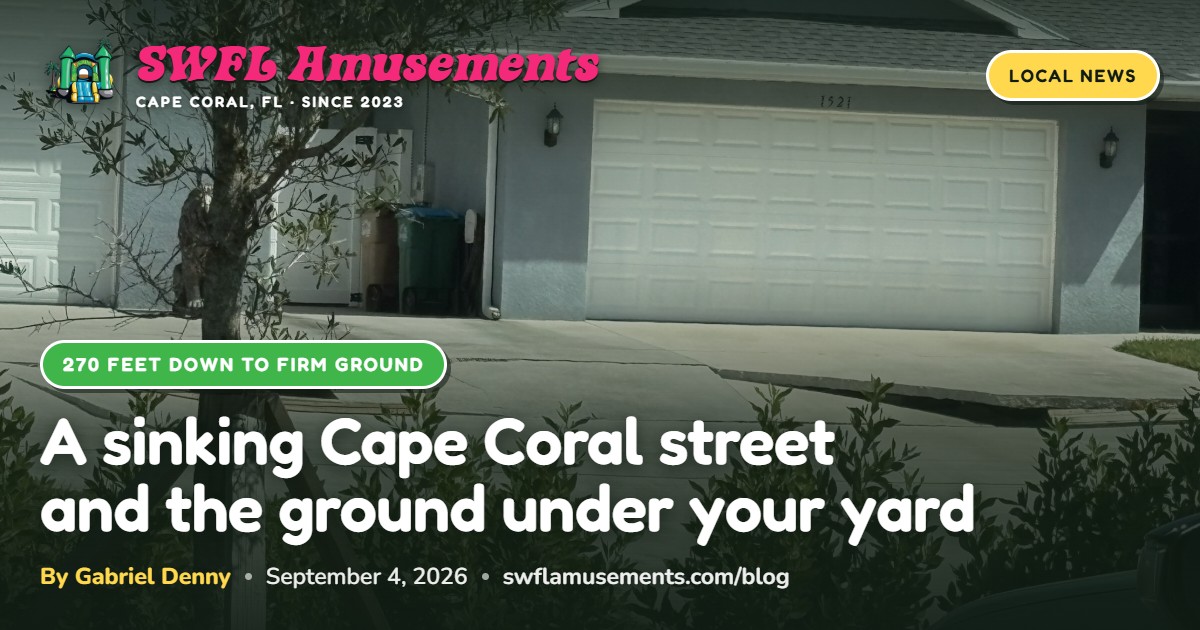
Cape Coral City Council spent a few minutes Wednesday on an agenda item that will not make anybody's year-end recap, then voted unanimously to authorize an emergency purchase order of up to $500,000 to fix a road that is sinking. The street is Northwest 16th Terrace, over near Diplomat Parkway and Chiquita Boulevard. That is my end of town, about a ten-minute drive from my driveway.
If you do not live on that block, the interesting part of this story is not the block. It is what the engineering report found underneath it, and how ordinary that finding is for a city built the way ours was built.
What the council actually approved
Deputy Public Works Director Bill Corbett walked council through the fix. Crews will inject grouted columns into the ground to build a firm base the road can be rebuilt on top of. The recommendation calls for 12 grout-injection locations at an average depth of 40 feet. Corbett noted that grout injected at depth does not stay in a neat vertical column — it spreads, which means the repair may end up supporting ground somewhat outside the right-of-way as a side benefit.
The geotechnical engineering report behind the decision was completed July 17, 2026 by ECS Florida, LLC. It found that the roadway "continues to subside" with no indication that the movement has stopped. Corbett attributed the settlement to loose soils and water, and raised the possibility that drawn-down aquifer levels are consolidating the layers below and pulling soil down with them.
Then there is the number that stopped me. Corbett told council the borings went down 270 feet before they found ground the engineers would call firm and stable.
Two hundred seventy feet, straight down, in a residential neighborhood where the houses are single story and the yards are flat, before anybody hit something they were willing to build on.
The resident who spoke
A resident of the street spoke during public comment and described a driveway he cannot use and a road in front of his house that holds standing water. He said the settlement started roughly 14 months ago, that he has already paid $17,000 to have the driveway repaired, that the contractor came out three times, and that the contractor will not come back until the city fixes the street. He identified himself as a retired disabled veteran on a fixed income.
I spent 20 years in uniform, so that last detail landed a certain way. But the part I want to pull out is the sequence, because it is the same sequence I have watched play out in a finance seat at five different companies: a small anomaly, a long stretch where it is nobody's emergency, and then a $500,000 line item plus a homeowner who is $17,000 into a repair that would not hold. Deferred small problems do not stay small and they do not stay cheap. They just change whose budget they land in.
Why a party rental company pays attention to a road repair
Fair question. We rent inflatables. We do not pour concrete or inject grout.
The connection is that our entire job is putting weight on other people's ground and then trusting it to behave for six hours. A large inflatable is several hundred pounds of vinyl before a single kid climbs in. A wet unit running water is that plus a few hundred gallons that have to go somewhere. The delivery truck and trailer are a lot more than that, and they have to get down your street, into your driveway apron, and back out.
So when the city's own consultant says the soil in a residential Cape Coral neighborhood is loose enough that a paved road is still moving, that is professionally relevant to me.
One clarification, because my business partner covered adjacent ground yesterday: Chris wrote about king tides and canal-front yards, which is a story about water that comes up for four days and then goes back down. Saturated sand holds a stake poorly this week and fine next week. What the ECS report describes is a different animal. Consolidation is not temporary. Ground that has settled does not un-settle when the tide goes out.
The Cape's ground, briefly
None of this is a scandal, and it is not unique to one street. Cape Coral was platted and sold starting in the late 1950s, and the developer dug the canal system with dredges and used the spoil to raise the building lots. A large share of this city is sand that was moved from somewhere nearby and placed where it is now. That is why the lots drain the way they do, and it is a reasonable part of why a boring log has to run a couple hundred feet before it finds something an engineer will sign off on.
The practical version for a homeowner: your yard is probably fine. Millions of square feet of Cape Coral yard hold up a bounce house, a truck, and a hundred kids every weekend without anybody thinking about it. But if your particular yard or driveway has started doing something new, that is worth taking seriously rather than filling in and forgetting.
What I actually look at on a delivery
This is not a formal inspection and I would not pretend otherwise. It is five things I notice while walking a lot:
- Fresh cracks in a driveway or walkway that step. A hairline crack is concrete being concrete. A crack where one side sits lower than the other is the slab telling you something moved under it.
- Standing water that has no reason to be there. Water pooling in a spot that used to drain is often the first visible symptom of a low spot forming.
- A soft or spongy patch of turf that gives underfoot differently than the yard around it.
- Gaps at the base of a fence post, mailbox, or A/C pad — small voids where the ground has pulled away from something set into it.
- Anything the homeowner mentions offhand. "That corner has always been weird" is the most useful sentence anybody says to me all day.
If a setup surface is actively moving, we will not put an inflatable on it, and honestly that is the easy call. The harder and more useful conversation is that a settling driveway is not a party problem. It is a geotechnical problem, and the person you want is a licensed engineer or a foundation contractor, not a guy with a trailer and an opinion. What we can do is move the unit to a stable part of the property, and we do that constantly — a hard surface gets sandbags instead of stakes, so a good driveway or an unused slab is often the most reliable spot on a lot, not the least.
If your street is the one being repaired
Road repair work in the Cape rarely closes an entire street, but it does narrow one, and a 20-foot trailer needs more room to swing than a car does. If a crew, plates, or cones are on your block on your party date, tell us when you book rather than on delivery morning. We have staged units from a neighbor's driveway and carried them in more times than I can count, and it is a non-event when we know in advance and a scramble when we do not.
For the record, I am glad the city bought the fix instead of another study. Emergency purchase orders are unglamorous and this one is a fair use of $500,000. I just wish it had cost $50,000 fourteen months ago.
If something in your yard or on your street has changed since the last time you had a party out there, call me at (239) 212-0011 before you pick a date. I would rather walk it with you two weeks out than figure it out with a truck in the road.
About the author
Gabriel Denny — Co-owner, SWFL Amusements LLC
Gabe owns SWFL Amusements. He spent 20+ years in the Air Force, first enlisting after high school before commissioning and retiring as a Major. He is a 5x CFO, which he continues to do when not working bounce houses. He lives in NW Cape Coral and answers the company phone himself, including at 2am.