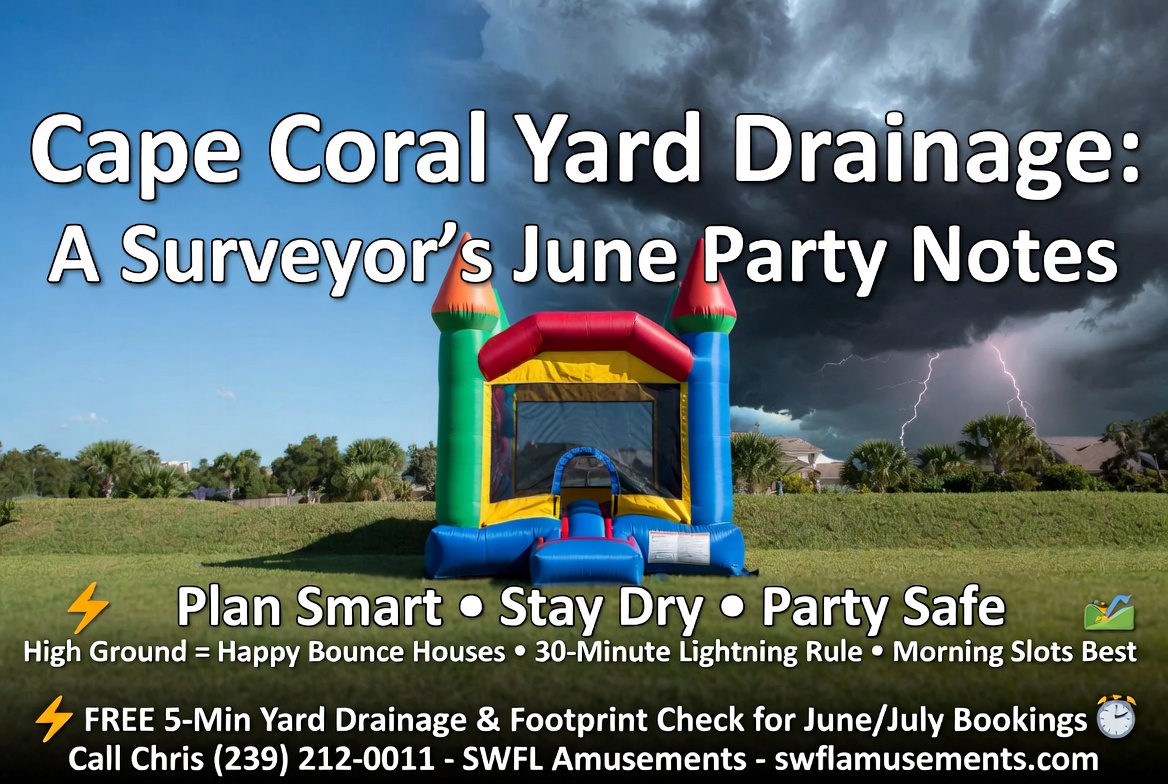
Atlantic Hurricane Season officially opened on Sunday, June 1, and the local news cycle treated it the way it always does — lots of cone-of-uncertainty graphics, a reminder to fill up the gas cans, a quick interview with somebody from Lee County Emergency Management. None of that is wrong. But for a Saturday backyard party in Cape Coral this month, the named storm is not the thing that gets you. The thing that gets you is the everyday 3 PM thunderstorm.
I survey property for a living. Reading a lot for where water wants to go is most of the job. So instead of writing another generic “watch the weather” post, I want to share what I actually look at when I walk a Cape Coral backyard before a bounce house drop — and why some yards in this town drain very differently from others, even on the same street.
Where does water actually pool on a Cape Coral lot during June rain?
Short answer: on most Cape Coral residential lots, rainwater wants to leave your yard along one of two paths. Either it runs to the street swale at the front of the property and into a storm inlet there, or it runs to the rear of the lot — toward a canal, an easement, or the neighbor's lot if the original grading has been disturbed. The piece of yard that stays driest during a hard afternoon downpour is almost always the high middle of the lot — the crown — provided no one has paver-locked it, pool-decked it, or built a tiki bar on it.
That crown is where I want the bounce house if the radar looks busy. It is rarely where homeowners suggest, because the natural instinct is to push the inflatable toward the back fence to get it out of the way. The back of a 1960s-era dry-lot Cape Coral property is often the lowest corner of the parcel.
The city plumbing under your party
According to the City of Cape Coral Public Works department, the stormwater system here moves water through more than 500 miles of storm pipes and nearly 23,000 catch basins and inlets before it reaches the city's 400-plus miles of canals. The freshwater portion of that canal network is roughly 300 miles long and controlled by 25 weirs that hold water during the dry months and release it through the rainy season. Cape Coral has more canal miles than any other city in the world — that line gets used on the real-estate brochures, but it is also a functional fact. The whole peninsula is, in engineering terms, a giant drainage grid.
What that means for your backyard party in June: the system is designed to move water off your property, not hold it. But it does that on a delay. A 25-minute, two-inch downpour will sheet across your yard faster than the inlet at the corner can swallow it, and you will see standing water for ten to thirty minutes after the rain stops. The bounce house does not care about ten minutes of standing water if it sits on the crown. It cares a lot if it sits in the swale.
Older Cape lots versus newer infill
Cape Coral was platted starting in 1957 by Gulf American Land Corporation. The first four houses were completed in May 1958 on Riverside and Flamingo Drives. The original Rosen-era grid — south of Cape Coral Parkway, east of Chiquita, north into the lower 40s — was laid out with shallow drainage swales and a fairly flat overall pitch. Those lots have had sixty-plus years of owners adding pools, paver patios, screen rooms, French drains, and side-yard concrete pads. The original drainage path on a 1960s lot is almost never still intact.
When I walk one of those older parcels, I look for three things. Where does the gutter downspout actually discharge? Is the swale at the front of the lot still a swale, or has it been filled and sodded flat? And is there a hump somewhere in the middle of the back lawn that is doing the job of the crown? Often the answer to that third question is yes, and that hump is where the bounce house goes.
Newer infill lots — the post-2000s construction up in the NE Cape, out by Diplomat or Andalusia, and the pockets of newer builds west of Burnt Store — are different. Lee County's newer site-grading standards require more aggressive slope from the building pad to the property line, and most of those yards have a clearly defined rear drainage easement. On a newer lot the inflatable usually goes in the middle of the yard, and the drainage takes care of itself.
Canal-front lots are not always the drier choice
People assume a canal-front lot drains better than a dry-lot interior parcel. In terms of total volume during a heavy rain, that is usually true — water runs from the building pad toward the seawall, and the canal accepts it. But canal-front lots come with two complications that matter for a bounce house setup.
First, the seawall setback. I will not anchor a 200-pound, 18-foot-wide inflatable within six feet of an aging seawall. The bank behind older Cape Coral seawalls is often undermined — you cannot see it from the lawn side, but it is there, and the load from a bouncing inflatable plus eight kids is not a load you want on a compromised bank. Move the unit toward the house side of the lot.
Second, the slope to the canal can be sharper than it looks. Most homeowners do not realize their backyard drops three to five inches across the last fifteen feet to the seawall. That is fine for water, not great for an inflatable, which needs reasonably level ground for the blower to keep it pressurized and for kids to land predictably. Inflatables tolerate a couple of inches of fall across the footprint. They do not tolerate four.
The thirty-minute lightning rule, written down
NOAA publishes a lightning safety rule that the bounce house industry quietly relies on. If you can count fewer than thirty seconds between the lightning flash and the thunder, the storm is within six miles — close enough to be dangerous. Move everyone indoors. Do not resume outdoor activity until thirty minutes after the last clap of thunder. We power down and deflate the inflatable for the duration. Your party can absorb a thirty-minute pause. It cannot absorb a strike. For our broader thinking on this, see our bounce house safety notes.
When I call the party from the surveyor side of the truck
Wind is the other variable. Manufacturer specs on residential inflatables put the operating ceiling at sustained winds around 20 to 25 mph, depending on the model. Once the gust front of an afternoon storm rolls in, we are usually seeing 30-plus mph for ten to twenty minutes. That is a deflation event, not a wait-it-out event. If the morning forecast shows a 70-percent rain chance with a gust front signature on the HRRR model, I have already called the customer and we have a Plan B — either an earlier start time or a different Saturday. Gabe describes this as the Air Force planning instinct. I just call it knowing the weather we actually get.
A short list of June-specific things I look at on a site walk
- Where does the rear gutter downspout discharge? If it points at the proposed bounce house footprint, we move the footprint.
- Is the lawn over a leach field or septic drain? Cape Coral is mostly on city sewer now, but pockets are not, and a saturated drainfield does not anchor stakes well.
- Is there an irrigation timer set to run mid-party? This sounds obvious. It is not obvious to the kids who get blasted by a 4 PM pop-up zone.
- Where is the breaker panel and which outdoor outlet shares a circuit with the pool pump? Gabe wrote about this last week. On 1970s NW Cape panels it is more common than you would think.
- What direction does the prevailing afternoon wind come from? In June in Cape Coral it is east-southeast, off the Atlantic. Orient the inflatable so the entrance faces away from the gust.
The shape of a June Saturday party in Cape Coral
If you are putting together a backyard party for June, plan the schedule against the weather you will actually get, not the weather you want. Morning slots from 9 AM to noon are the safest window in this town — the convective activity has not built yet, the humidity is bearable, and you are off the lawn before the storm column forms over the Gulf at one or two. Late afternoon slots from 4 PM to 7 PM look attractive on paper because the worst of the heat is past, but they put your party in the heart of the lightning window. I have done both ends of the day for sixty years between Gabe and me, and the morning slot wins almost every time.
If you want me to walk your specific yard before you book a June or July Saturday, I am happy to do a five-minute drainage and footprint check on the phone. Call (239) 212-0011 and we will talk it through with you.
About the author
Christopher Johnson — Co-owner, SWFL Amusements LLC
Chris is a co-founder and former co-owner of SWFL Amusements, and a professional surveyor by day. He spends his working hours mapping Southwest Florida properties, which means he knows the canal-front quirks, the older Cape circuit grid, and which intersections back up during snowbird season. He proudly lives in Cape Coral, where he was born and raised.