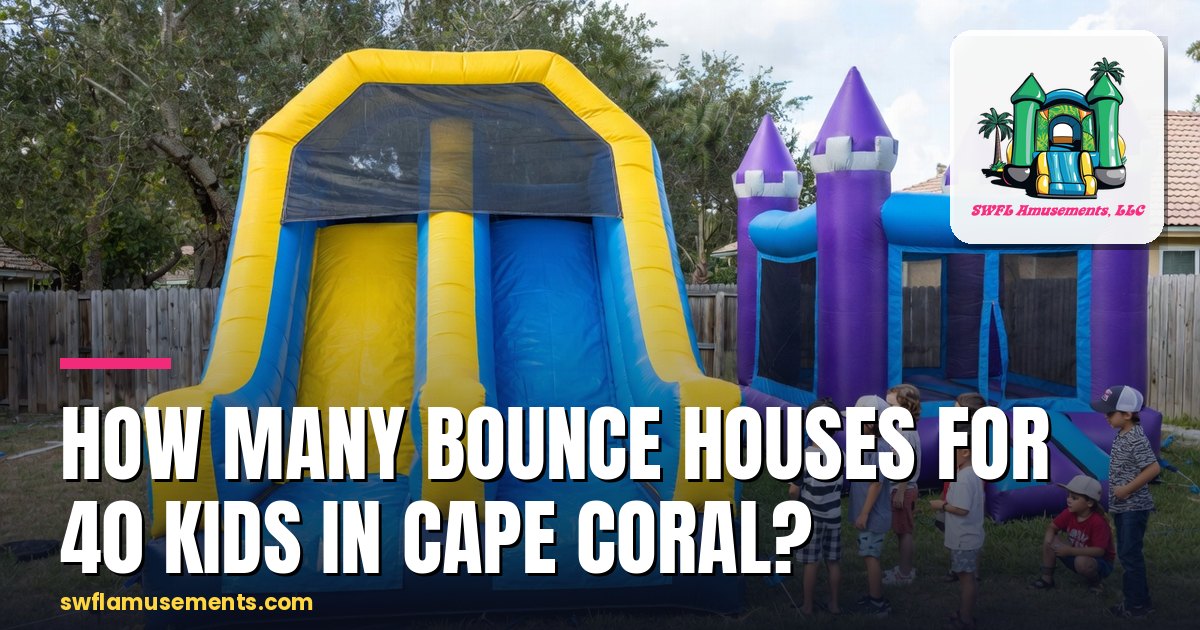
The question I get most often on the phone is some version of “how many kids does it hold?” I understand why people ask it. It is also the wrong number to plan a party around, and it is why some Cape Coral backyards end up with a line of bored eight-year-olds along the side of the house while the equipment they are waiting for sits half empty.
Capacity tells you how many children can be inside a unit at one instant. What you actually need to know is how many children that unit can get through in an afternoon, and how many of your guests are even eligible to use it. Those are three different numbers, and the gap between them is where parties go sideways.
I spent two decades in the Air Force moving people and equipment on a clock, and I have closed the books as a CFO five times. Both jobs teach the same lesson: you do not size a system to its headcount, you size it to its throughput. A birthday party is no different. Here is how I would walk the numbers for a Cape Coral yard.
Step 1: Get the real head count, not the invite count
Most elementary birthday guest lists in this city are not an arbitrary number. They are a classroom.
Florida’s class size rules cap core classes at 18 students in prekindergarten through grade 3, 22 students in grades 4 through 8, and 25 students in grades 9 through 12, measured at the classroom level. So when a parent at Pelican, Trafalgar, Patriot, Diplomat, Skyline, Caloosa, Gulf or Cape Elementary tells me they are inviting the whole class, I already know the invite list is roughly 17 to 21 other kids before a single neighbor gets added.
From there the arithmetic is boring and reliable:
- Invites: the class, minus the birthday child, so call it 20.
- Actual yes rate: on a Saturday in season, plan on 60 to 75 percent. Call it 14.
- Siblings nobody mentioned: roughly one for every three guests who show. Call it 5, and most of them are younger.
- Adults: at this age, about half the families stay. Call it 12 to 16.
That is how a 20-name invite list becomes 40 bodies in a yard. It is also how you end up with 19 children rather than 20, and 5 of those 19 being three years old.
Step 2: Filter the head count down to riders
This is the step that gets skipped, and it is the one that decides whether the money you spent gets used.
Every unit has a rider envelope. Our 22-foot Tropical Hurricane dual-lane slide requires riders between 48 and 76 inches tall and between 55 and 220 pounds, ages 4 and up. That envelope fits a third grader comfortably and fits a four-year-old cousin not at all. The little kids bounce and slide combo runs the other direction: ages 1 to 5, 74 pounds per child, 386 pounds total, which works out to about 4 or 5 small children inside at a time. The 14-foot classic castle sits in the middle and comfortably holds 6 to 8 children at once depending on age and size.
Run the 40-body party through that filter and it looks like this: 14 school-age guests plus the birthday child who can use the slide, 5 younger siblings who cannot, and 16 adults who are not riding anything. Your rider count is 15, not 40. If you rented one attraction and that attraction has a 48-inch floor, you also just rented nothing for five of the children standing in your yard.
That is the actual reason a second, smaller unit is often worth more than a bigger single one. It is not variety for its own sake. It is coverage.
Step 3: Capacity is not throughput
Here is the part I wish more people knew before they book, because it explains almost every line I have ever seen form at one of our setups.
Some equipment serves guests in parallel and some serves them in series, and they behave completely differently under the same crowd.
A bounce house is parallel. Six to eight children are inside simultaneously, they come and go on their own schedule, and nobody is waiting on the child in front of them to finish. Take the castle: 7 inside at a time, with kids cycling out every 5 to 7 minutes on their own, works out to somewhere north of 130 turns across a two-hour open-bounce window. For 15 riders, that is not a constraint. It is not close to a constraint.
A slide is serial. The Tropical Hurricane allows a maximum of two riders on the slide surface at once, one per lane. A rider climbs, slides, and walks back around, and honestly that is 60 to 75 seconds per lane including the climb. Two lanes gives you roughly 100 to 120 rides an hour for the whole unit. A dual-lane obstacle course behaves the same way: two racers head to head, then a reset, then the next two.
Both of those hourly numbers are fine for 15 riders on paper. The problem is that guests do not arrive evenly. At a birthday party they arrive in a 20-minute clump, and all 15 of them want the slide first. A serial unit meets that clump with a line. A parallel unit absorbs it.
So the practical rule is not more capacity. It is this: if your party has a water slide or an obstacle course, you want something parallel next to it, because the parallel unit is what drains the queue the serial unit creates.
Step 4: Do the arithmetic for your actual window
Four lines, and you can do them on the back of the invitation:
- Riders, not guests. Subtract the adults. Subtract anyone outside the height and weight envelope of the unit you are considering.
- Minutes of active window. A three-hour rental is not three hours of riding. Cake, presents, and pizza eat 45 to 60 minutes of it. Call a three-hour party 120 active minutes.
- Turns available. For a serial unit, divide active minutes by the per-rider cycle and multiply by lanes. For a parallel unit, this almost never binds, so skip it.
- Turns per rider. Divide. If the number is under 4, your guests will spend more of the party in line than on the equipment, and you need a second attraction rather than a longer rental.
For the 40-body party above with one dual-lane slide: 120 active minutes, about 2 riders per 70 seconds, call it 200 rides, across 15 riders. Thirteen rides each. That is plenty, as long as the line is not all 15 of them standing in it at 11:05 a.m.
Step 5: Price the real options side by side
These are the numbers off our own product pages, not a range:
- 14-foot classic castle bounce house — $199
- Little kids bounce and slide combo, ages 1 to 5 — $99
- 22-foot Tropical Hurricane dual-lane water slide — $449
- Jurassic bounce combo — $399
- 38-foot straight obstacle course — $449
- Venom Run dual-lane obstacle course — $499
- Foam machine — $150
Now compare two ways to spend roughly the same money on that 40-body, 15-rider party. Option one is the 22-foot slide on its own at $449, which covers 10 of your 15 riders and nothing for the five preschoolers. Option two is the castle plus the toddler combo plus the foam machine at $448, which covers all 15, spreads them across three places to be, and leaves no line anywhere.
I am not telling you option two is always right. If it is 92 degrees and half the guests brought swimsuits, the slide is worth the queue and worth the money. I am telling you that the two options cost the same dollar and serve very different guest lists, and that nobody works that out at the party. They work it out two weeks before, or not at all.
Step 6: Assign an adult to the serial unit
One last thing, and it is free. Parallel equipment largely polices itself. Serial equipment needs a person at the front of it, because a line of children with no adult at the head of it becomes a negotiation.
Adult supervision is required at our units regardless. But specifically: put one adult at the bottom of the slide ladder whose entire job for the first 30 minutes is sending one rider per lane and keeping the climb clear. That half hour is when the clump arrives, and it is the only half hour where the line is a real problem. After that it manages itself.
If you want a second set of eyes on the plan, the safety notes page covers the supervision side in more detail.
If you are sitting on an invite list right now and are not sure whether your number needs one unit or two, call (239) 212-0011 and read me the guest list and the ages. That is a five-minute conversation and it is the cheapest part of the whole party.
About the author
Gabriel Denny — Co-owner, SWFL Amusements LLC
Gabe is co-owner of SWFL Amusements. He spent 20+ years in the Air Force, first enlisting after high school before commissioning and retiring as a Major. He is a 5x CFO, which he continues to do when not working bounce houses. He lives in NW Cape Coral and answers the company phone himself, including at 2am.