If you have driven Del Prado or Burnt Store in the last week you already know what this post is about. They are back. The second lovebug flight of 2026 is starting, and it is going to run through most of September.
Nobody in this industry writes about lovebugs. I understand why — it is not a glamorous subject and it does not sell anything. But we have a September and October calendar that is filling up with school festivals, church fall events, and birthday parties, and this is a real thing that shows up in a real backyard on a real Saturday. So here is what I actually know about it, what the entomologists say, and the handful of decisions it should change on your end.
What is actually flying right now
The lovebug is Plecia nearctica, a small fly related to gnats. University of Florida research documents two flights per year — one in late April and May, and a second in late August and September. Each flight runs roughly four to five weeks. That puts today, August 27, right at the front edge of the second one.
Norman Leppla, the UF entomologist who has studied these things for decades, makes a point worth repeating: an individual adult lovebug lives only a few days. What you are seeing is not the same bugs hanging around for a month. It is wave after wave emerging, mating, and dying over a four to five week window. That is why it feels relentless and then abruptly stops.
Two behavioral details matter for party planning, and they are both well documented:
- They need roughly 68 degrees to fly. In Cape Coral in September that threshold is met basically every hour of every day, so it offers you nothing. In February it would be your whole strategy. Not now.
- They are day fliers. Swarming is heaviest from mid-morning through dusk. They do not fly at night.
That second one is the only real lever you have, and I will come back to it.
The lab-escape story is not true
I am going to spend one paragraph on this because a parent brings it up at roughly every third setup in September.
The story is that lovebugs were engineered at the University of Florida to eat mosquitoes and then escaped. UF's own entomology department has publicly debunked this more than once. Lovebugs are native to Central America and moved into the Gulf states on their own over the course of the 20th century, reaching Florida in the 1940s. They do not eat mosquitoes. Adults feed on nectar. The larvae are decomposers — they eat dead plant matter and return nutrients to the soil, which makes them mildly useful and completely harmless. Lovebugs do not bite, do not sting, and carry nothing.
I mention it because knowing they are harmless changes how you handle a swarm at a kid's party. You are managing an annoyance and a cleanup problem, not a safety problem.
Why we care more than you do: the vinyl
Here is the part that is specific to our business.
Lovebug body fluids are mildly acidic. On its own that is not enough to hurt much of anything. The damage mechanism, per UF, is time plus bacteria: as the remains sit and decompose, bacterial action drives the acidity up, and that is what etches automotive clear coat. The published guidance is that trouble starts when residue sits for several days, not several hours.
Bounce house vinyl is not car paint, but it is a coated fabric sitting in direct Florida sun, and the same logic applies. A unit that comes back with a few hundred lovebugs baked onto a sunlit wall and then sits folded in a warm trailer for three days is a unit with a stained wall.
So during flight season our turnaround changes. Every unit gets sanitized between rentals regardless of the season — that is not new. What is new in late August is that the wash-down happens the same day it comes off the truck, not the next morning, and it happens with plain water and mild soap while the residue is still soft. Once it hardens in the sun you are scrubbing, and scrubbing coated vinyl is how you shorten its life.
You do not have to do any of that. It is our problem, not yours. But it is worth knowing why the guy picking up your unit at 8 p.m. on a Saturday in September looks a little more interested in your wall panels than usual.
The Cape Coral part: your lawn is the nursery
Adult lovebugs are the visible half of the story. The larvae are the half that explains why some yards are worse than others.
Female lovebugs lay their eggs in moist, decaying plant material — specifically the thatch layer in turfgrass, along with grass clippings, mulch beds, and damp organic debris. The larvae live down in that thatch for most of the year, feeding on dead vegetation.
Now consider a standard Cape Coral lot. St. Augustine turf, which builds thatch faster than almost anything else grown here. A graded swale along the front that holds moisture after every afternoon storm. Mulch beds. And it is late August, meaning that lawn has been wet nearly every day for three months.
That is close to an ideal nursery, and it is replicated on more than 100,000 platted lots across this city. It is not that Cape Coral has a lovebug problem. It is that the way we build and landscape here is exactly what the insect wants.
What that gives you is one genuinely useful action item: do not mow the morning of the party. Mow two or three days ahead. Fresh clippings are an active invitation, and a bagged, mowed, raked lawn is a less appealing surface than one with a fresh layer of cut grass sitting in it. Dethatching in the fall helps over a longer horizon, though that is a lawn decision, not a party decision.
Actually scheduling around them
Since temperature is not going to help you in September, timing is. In rough order of how much difference each one makes:
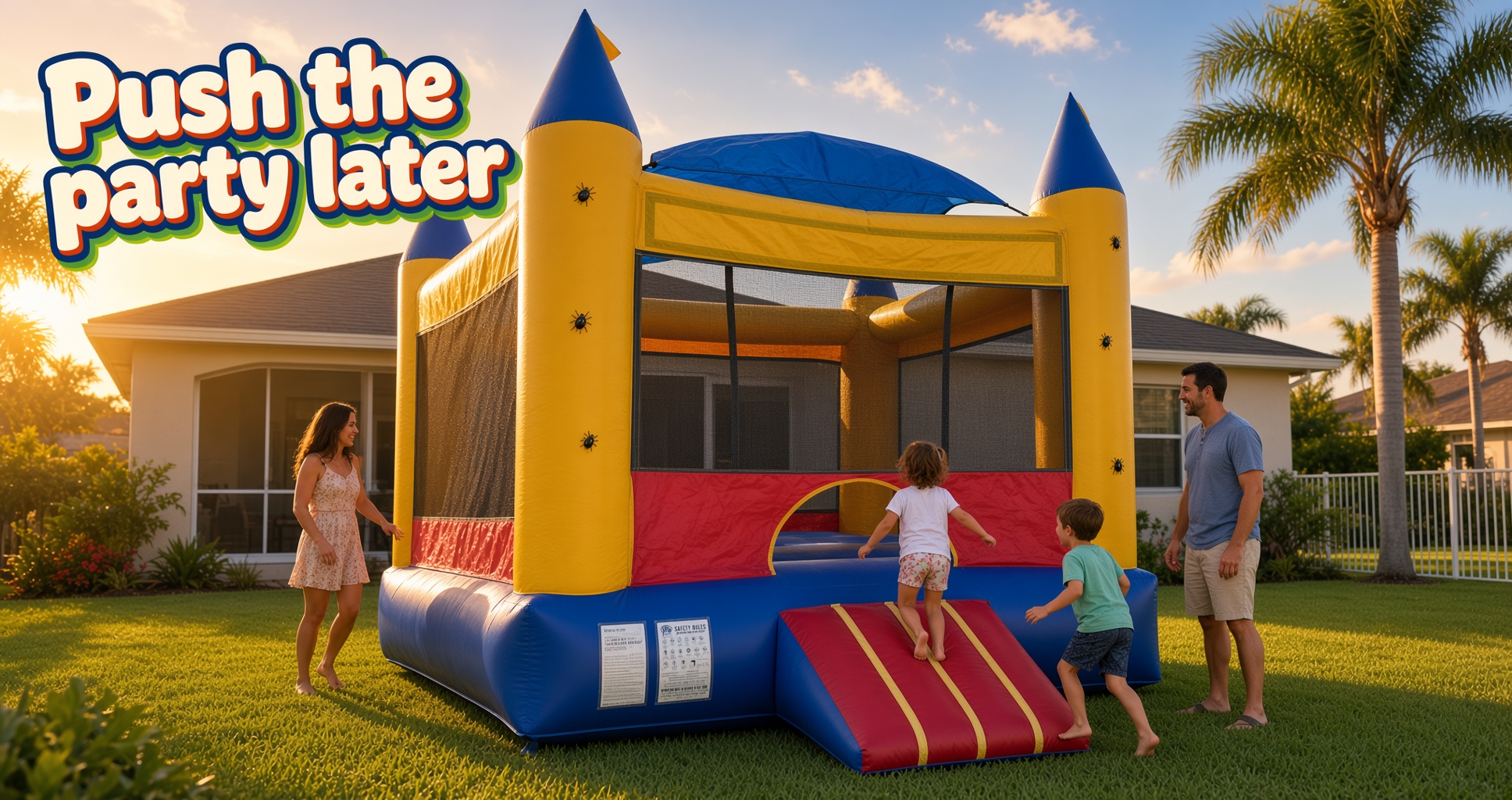
- Push the party later. A 4 p.m. to 8 p.m. window puts most of the event past peak swarm and into dusk. A 10 a.m. to 2 p.m. window puts you dead center in it. This is the single largest lever available, and it costs nothing.
- Watch the wind. Lovebugs are documented as weak fliers. A steady breeze off the river breaks up a swarm noticeably. A dead-calm, humid morning concentrates one.
- Mind the color. They are drawn to light surfaces in open sun. If you have a choice between a shaded side yard and the open middle of the lawn, the shaded placement is better on both counts — fewer bugs and a cooler unit. We wrote separately about how to read your Cape Coral lot for shade, and the same reasoning applies here.
- Skip the yard spray. I would rather lose the booking than have someone chemically treat a lawn with kids about to be barefoot on it. Insecticides do not meaningfully reduce an incoming flight anyway — the adults are arriving from everywhere, not living in your yard. You would be spraying for no gain.
- Put a hose or a rinse station near the exit. Kids come off the unit with bugs on them. A rinse and a towel handles it. If you are already renting a water slide, this solves itself.
What we do differently on the delivery side
Two small operational things, in case they are useful to anyone else hauling equipment this month. We wash the trailer front and the truck grille the same day, for the same acid-plus-time reason. And we stage the trailer in shade at the shop rather than in the open lot, because a hot light-colored trailer parked in full sun is a lovebug magnet and everything we load into it afterward inherits the problem.
That is the kind of thing you learn in year one and never think about again. Twenty years of preflight and postflight inspections in the Air Force left me with a bias toward writing this sort of thing down and doing it the same way every time, which turns out to transfer reasonably well to a business with a trailer and a schedule.
The honest summary
Lovebugs are not going to ruin your party. They are not dangerous, they are not going to hurt the equipment in a single afternoon, and the flight will be over in about a month.
What they will do is get on the food table, stick to the sunny side of the inflatable, and end up in a couple of photos. If that bothers you, move the start time to late afternoon and mow earlier in the week. If it does not bother you, do nothing at all — this is Florida in September, and most of us stopped noticing years ago.
If you are trying to pick a September Saturday and want to talk through the start time, call us at (239) 212-0011. We book by the day, so a later window costs you nothing extra.
About the author
Gabriel Denny — Co-owner, SWFL Amusements LLC
Gabe is co-owner of SWFL Amusements. He spent 20+ years in the Air Force, first enlisting after high school before commissioning and retiring as a Major. He is a 5x CFO, which he continues to do when not working bounce houses. He lives in NW Cape Coral and answers the company phone himself, including at 2am.