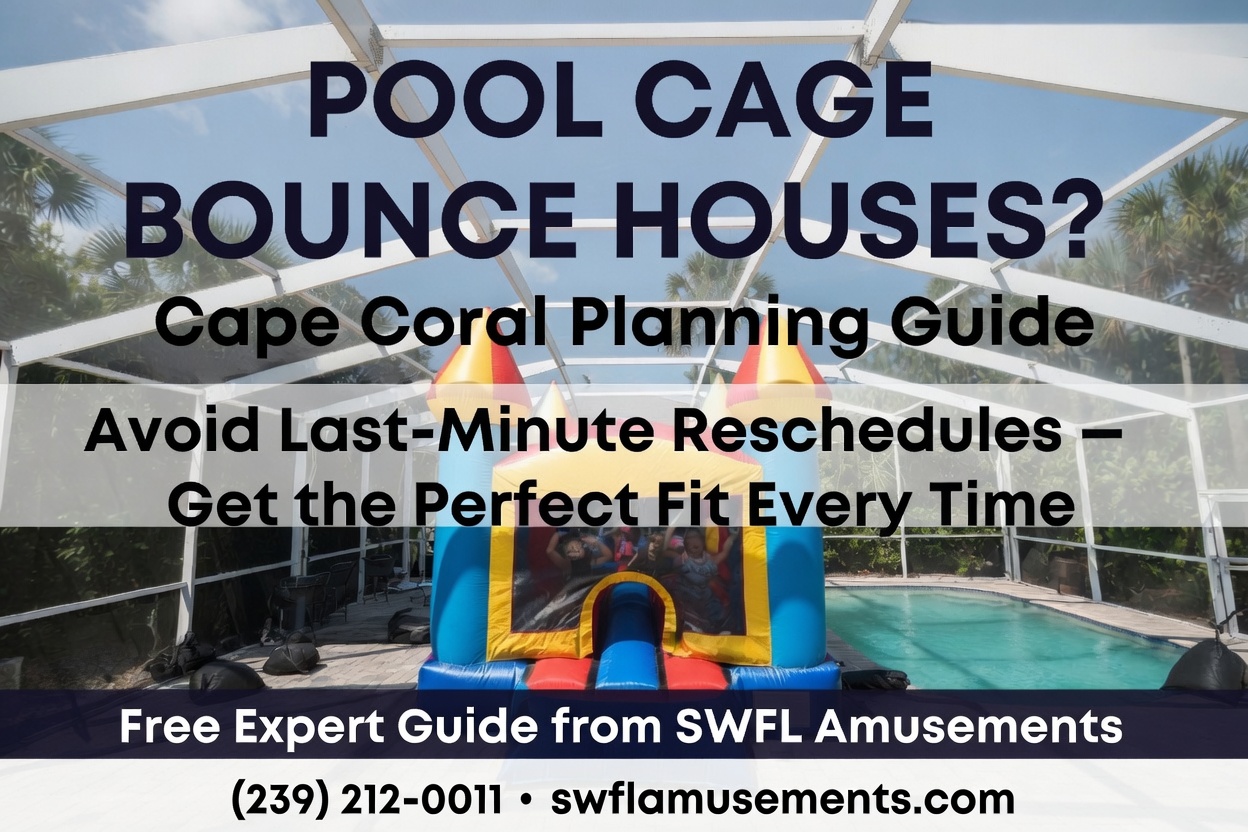
Just about every house I have surveyed in Cape Coral built after about 1975 has a pool cage on it. The cage becomes part of how people think about the back yard — it is where the grill lives, where the patio table goes, where the kids dump pool toys. People treat it as a permanent fixture until they call to rent a bounce house and find out the cage has opinions about where the inflatable goes.
This is the post I wish more callers had read before they picked a unit. Pool cage geometry is the single most common reason a Cape Coral backyard rental gets reshuffled the morning of, and almost all of it is predictable from the lot. I survey lots for a living. Here is how I read a Cape Coral pool cage when somebody asks about a bounce house.
How much height the cage actually gives you
Pool cage roof heights vary more than people think. The mansard-style cages you see on most Cape Coral homes from the 1980s and 1990s peak somewhere around 11 to 13 feet at the center ridge. The taller hip-roof and gable-style cages on newer pool builds — the ones with the picture-window screen panel facing the canal — commonly come in between 14 and 18 feet at the peak. A handful of high-end cages on newer Burnt Store Road and Tarpon Point builds push past 20 feet.
That peak number is not what matters. What matters is the height at the spot you actually want the inflatable. The cage ridge runs down the middle of the pool, which usually is not where the unit goes. Where the unit goes — on the deck around the pool, against the screen panel or under a side eave — you are working with the eave height, not the peak. On a 1990s mansard cage that is often 9 to 10 feet of clearance. On a hip-style newer cage you may have 12 to 14.
For reference, our standard 15-by-15 castle bounce house is about 13 feet tall at the front turret. Our 22-foot Hurricane water slide is 22 feet tall. Most of the inflatables we deliver land between 12 and 15 feet at the highest point. If your eave is 10 feet and you want to put a 13-foot bouncer where the eave is, the math does not work. The roof picks the unit, not the customer.
Screen door widths and the carry path
The other geometry problem is getting the unit into the cage in the first place. Most Cape Coral pool cages have two access points: a single screen door, usually 36 inches wide, on the side facing the lanai, and sometimes a double door, often 72 inches when both panels are open, on the side facing the yard.
A deflated 15-by-15 bouncer rolls into about a 3-foot-by-3-foot bundle. It will go through a 36-inch door if we cant it on edge and have a clean carry path. A 20-foot combo or an obstacle course bundles bigger — closer to 4 feet by 4 feet by 5 or 6 feet long — and a 36-inch door is borderline. A 72-inch double door is fine for almost anything we carry. If your cage only has the single screen door and you want a unit bigger than the 15-by-15, ask. Sometimes the answer is the back yard.
The other thing about the door is what is on the other side of it. If the single door faces the lanai and the lanai has potted plants, a grill, and a patio dining set on it, the carry path is a real consideration. We are not going to move your patio set. Either it is clear when we arrive or the inflatable goes somewhere else.
Anchoring on pavers and concrete
The other shift inside a pool cage is the anchoring. Almost every Cape Coral pool deck is either pavers, stamped concrete, or a poured concrete slab with a textured finish. None of these accept a 30-inch ground stake. So inside the cage we anchor with sandbags or water weights, not stakes.
The rule of thumb the industry uses is roughly 75 pounds of weight per anchor point on a hard surface, with a minimum of four corner anchors and additional weights for any unit with a slide tower. Our 15-by-15 takes four to six anchors. The 22-foot Hurricane water slide takes ten or more. We bring the sandbags. They sit at the four corners and on any tie-down loop the manufacturer marks. They do not damage your pavers.
One thing to flag — sandbag anchoring is rated for normal operating wind, which on residential inflatables is about 20 to 25 mph sustained. It is not a magic substitute for stakes in a real storm. If the afternoon thunderhead builds early, we still power the unit down. Sandbags hold a deflated inflatable in place. They do not hold an inflated one against a 40-mph gust front, and nobody else's do either.
Inside the cage or outside the cage
Once we have the height and the door figured out, the next question is whether the unit even belongs inside the cage. There are good reasons either way.
Inside the cage
The cage gives you shade. By 1 PM in late June a Cape Coral pool deck under a cage runs noticeably cooler than the open lawn — the screen cuts a meaningful percentage of the direct solar load, and the breeze still moves through. The cage also keeps the no-see-ums down a notch, which between sundown and 8 PM is a real consideration on the canal-front lots. If your unit fits and the door clears, inside is comfortable.
The cost is the screen itself. A jumping kid landing against a screen panel can pop the spline that holds the screen in. Replacement spline-and-screen runs roughly $3 to $5 per square foot in Cape Coral right now, and a single popped panel is usually a $150-to-$300 repair. Not catastrophic, but real. If you have a six-year-old who hits walls instead of bouncing in the middle of the unit, you want at least three feet of clearance between the bouncer and any screen panel. I tell customers to keep four if they can.
Outside the cage
Outside, on the open yard, you trade the shade for room. The unit can be bigger, the anchoring is real stakes in real grass, and the screen is not at risk. The cost is heat. On a 92-degree June afternoon in Cape Coral the vinyl surface temperature on a sun-baked bouncer can run 30 to 40 degrees hotter than the air. Kids will tell you. They will leave the unit and come back into the cage where it is cooler. That is fine if you planned for it. It is a surprise if you did not.
If the yard has afternoon shade from the house or a mature oak by about 2 PM, outside is usually the better answer. If the yard is full sun until sundown, the cage starts looking attractive. I walk this with customers on a quick phone call — sun angle, eave height, what the cage roof is doing at the spot they want. Three minutes of conversation usually settles it.
The lanai-only path
Some Cape Coral homes have a covered lanai but no pool cage — or the cage covers only the pool and not the patio. The lanai is the covered concrete or paver porch attached to the back of the house, usually 10 to 15 feet deep and the full width of the great room. People sometimes ask whether a small bouncer can go on the lanai.
The answer is usually no for the standard castle bouncer. Lanai ceilings are typically 9 to 10 feet, which is shorter than the bouncer at peak. The unit will inflate against the ceiling, deform, and the blower will labor. We have a few smaller toddler-only inflatables that come in under 8 feet tall and will fit a lanai, but for a real birthday party with school-age kids the lanai is the snack and shade zone, not the bouncing zone. Plan around that.
The structural conversation, briefly
I get one or two calls a year from a homeowner whose cage took hurricane damage and is in some intermediate state of repair. If the cage frame has visible bowing, broken cross members, or screen panels held in with packing tape, we are not setting up inside it. The inflatable does not put a huge load on the structure, but it does displace air, and a compromised cage frame plus a 200-pound bouncer plus eight kids landing in coordinated waves is not a combination I am willing to underwrite. That is a back-yard setup or a reschedule.
Similarly, if the cage has obvious mildew or rot at the bottom of the screen rails, the screens themselves are probably weaker than they look. Brief the kids. Keep the bouncer well away from the panels. You can have a great party in a tired cage — you just have to know it is tired.
What I tell people who call
Most of the planning work happens before delivery. When somebody calls about a pool cage party, I usually ask four questions:
- About when was the cage built, and is it the original cage or a replacement?
- How tall is the eave on the side of the pool you are thinking about?
- Is your screen door a single 36-inch door, a double, or both?
- Is the deck pavers, stamped concrete, or a smooth slab?
Those four answers tell me which units fit, where in the cage they go, and whether we are bringing sandbags or stakes. I can usually give you a yes or no on a specific bouncer in five minutes on the phone. I do not need to come look at most cages — the pattern is consistent enough that the answers point at the right unit on their own. The cages that need an in-person look are usually the unusual ones, and those owners already know they are unusual.
If you are putting together a Cape Coral pool cage party in July and want to talk it through before you book a unit, call (239) 212-0011 and ask for Chris. I would rather spend five minutes on the phone with you than have us show up Saturday morning with a unit that does not clear your eave.
About the author
Christopher Johnson — Co-owner, SWFL Amusements LLC
Chris is co-owner of SWFL Amusements and a professional surveyor by day. He spends his working hours mapping Southwest Florida properties, which means he knows the canal-front quirks, the older Cape circuit grid, and which intersections back up during snowbird season. He proudly lives in Cape Coral, where he was born and raised.