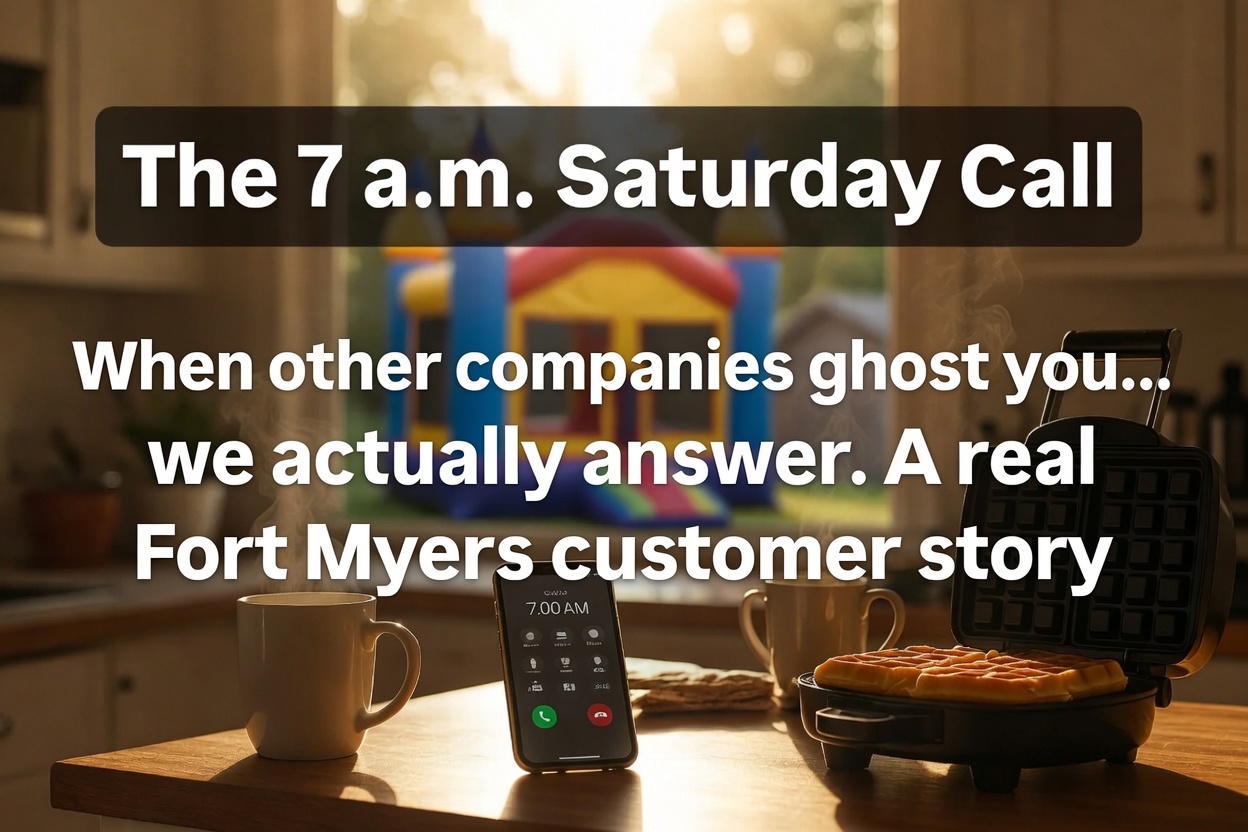
The phone rang at 7:12 on a Saturday morning. I had been up for about an hour because the dog gets up when the dog gets up, and I was already on coffee number two making breakfast for Waffle Saturday before loading the trailer with bounce houses. I picked up because the number on every page of our website is my cell, and most people who call before 8 on a weekend have a real problem.
It was a business owner in Fort Myers, hosting a major customer event scheduled to kick off at Nonon that same day, with the inflatable being one of the headline attractions for the families attending. The bounce house company they had booked weeks earlier had emailed late Friday night saying the unit was unavailable, no reschedule offered, deposit to be refunded eventually. The owner had seen the message after he woke up that morning. By 7:12 they had already left voicemails at four other rental companies and gotten exactly zero call-backs.
The first thing the owner said when I answered was, “I cannot believe someone actually picked up.”
That sentence is a useful data point about the rest of the industry. It should not be remarkable that a service business in Southwest Florida answers the phone on a Saturday morning during peak summer event season. It is, though. Most of our competitors are one truck and one person operating out of a garage, and that one person is often the same person who has to load the truck, drive the truck, set up the unit, and answer the phone. Something has to give. Usually it is the phone before about 9 a.m. on weekends.
Triage on the phone
I asked three things in roughly this order. Where is the event. What was the original company supposed to bring. What surface are we setting up on. Fort Myers, at the owner's venue. The original booking was for a standard mid-size dry castle bouncer. Setup was indoors, on the venue's main event floor — a smooth hard surface with plenty of overhead clearance.
I had a comparable castle on the rack, the warehouse is in Cape Coral, and the drive across the bridge to that part of Fort Myers on a Saturday morning before the weekend crowd kicks in is comfortably under 40 minutes. I told the owner we could be on site between 10:15 and 10:30, which gave us a clean 30-minute window for setup, safety walk-through, and a sign-off before doors at 11. I quoted the price, which was the price — not a panic surcharge, not a markup because I had a customer over a barrel — and we ran the deposit through on the call. They were on the schedule by 7:21.
The triage on a save call like this takes about four minutes if you stay disciplined. Address, footprint, original equipment, surface, payment. I do not ask for the story until after I have confirmed I can solve the problem, because the story is what is keeping the customer in their head, and they cannot stop telling it until they know they can stop worrying. The fastest way to be kind on a call like this is to be useful first and listen second.
The drive across
The Cape Coral-to-Fort Myers drive on a Saturday morning is one of the underrated good things about doing this work in this region. Northbound traffic on the Midpoint Bridge before about 9:30 is sparse. The trip from our warehouse off the older Cape grid to a venue in Fort Myers is a known quantity — we run that corridor multiple times a week. For an indoor setup I load a different kit than the outdoor stake kit. The bouncer, the blower, the safety pad set, the heavy-duty floor-protection tarp that covers the full setup footprint plus a border, a full set of 50-pound anchor sandbags sized to exceed the unit's published indoor ballast requirement with margin, and the binder. On the road by 9:25, on site at 10:18.
The owner met me at the front entrance and walked me to the event floor. The section where the bouncer would live was already cleared — chairs pushed back, a clean rectangle of hard floor marked off, room to maneuver. I walked the footprint before unloading. Overhead clearance was well over what the unit needs to the lowest fixture. The floor itself was a smooth hard surface in good shape — exactly the kind of surface our indoor kit is built for. Stakes were obviously not the right tool. Floor-protection tarp first, then sandbag ballast through the manufacturer anchor loops.
That is the part that matters most about an indoor setup. The tarp goes down before the unit does. It is heavy-grade, it covers the full footprint plus a generous border, and it is what protects the floor from the scuffs and drag-marks that an inflatable would otherwise leave when 30 kids are climbing in and out for four hours. Without the tarp, an indoor setup on a finished floor leaves a mark every time. With it, we have walked off finished hardwood and polished concrete and high-grade vinyl plenty of times without leaving so much as a scuff. The customer should not have to worry about their floor, and on an indoor setup the floor protection is what you are really paying for.
Unit positioned on the tarp with the entrance facing the seating the owner had arranged along one wall. Sandbag ballast at each corner anchor loop and additional bags along each long side, sized to exceed the unit's published indoor ballast spec with margin. Blower plugged into a clearly-labeled 20-amp outlet the facilities tech on duty had walked me to. Inflated, walked, safety briefing given to the two staff members the owner had assigned as inflatable monitors. Sign-off at 10:48. Twelve minutes of margin before doors opened.
The text at 2 p.m.
The owner texted me a photo around 1 p.m. of a line of kids about ten deep at the entrance to the bouncer, parents along the perimeter, a couple of staff in matching shirts managing the line. A second one came at 4:15 p.m. — the unit deflated and folded next to the door ready for pickup, the floor tarp folded on top, the floor underneath as clean as we found it, with a note: “Nobody who walked in knew the original company had cancelled.” That last line is the entire point.
I want to be careful about the moral of this story because there are two morals and they pull in different directions. The first one is the obvious one for a business blog — we answered the phone on a Saturday morning, we had reserve inventory on the rack, we showed up. Fine. The second one is less flattering to our industry. Vendors bailing on confirmed bookings the night before is not a rare event in Southwest Florida. We get these calls weekly through the summer, and the volume picks up sharply in the run-up to major holiday weekends when small operators get overcommitted and start triaging which contracts they actually try to honor. Most weeks we can save it because we hold reserve inventory specifically for situations like this. Some weeks we are already booked solid and we cannot, and then we spend a few minutes calling the operators we trust in this region to see who has the right unit and an open truck. There are very good operators in Southwest Florida. There are also operators who treat a deposit as a refundable maybe.
What to ask before you book anybody
The practical advice tucked inside this story applies just as much to a business owner planning a customer event as it does to a parent planning a backyard birthday. When you book a bounce house in Fort Myers, Cape Coral, or anywhere in Southwest Florida, ask the company two questions before you put down a deposit.
First, what is your weather and equipment-failure policy, in writing, where can I read it on your site. Second, what specifically happens if you cannot deliver on the morning of the event. A company that has a clean answer to both has thought about the failure modes and built a process around them. A company that gets vague, or that needs to “check with the office,” or that says some version of “don't worry, that never happens” — that is going to be the company that emails you at midnight Friday before a Saturday event.
For our part, the answers are on the booking page and they have not changed in the years we have been doing this. We deliver. If a unit fails the on-truck inspection at our warehouse, we swap to the next-closest equivalent in the fleet and you pay the lower of the two prices. If weather kills the day, you reschedule inside our published policy window with no fee. If you need an indoor setup, we have the floor-protection kit to make that work without marking the floor. If you need to talk to a human, you talk to one of us. There are exactly two of us. Chris answers when he is not on a survey crew. I answer the rest of the time, which includes 7 a.m. on a Saturday.
If you are reading this on a weekend morning because the company you booked just told you they cannot make it, the number is (239) 212-0011. I will pick up.
This is a true story, but has been annonymized and put into narrative format
About the author
Gabriel Denny — Co-owner, SWFL Amusements LLC
Gabe is co-owner of SWFL Amusements. He spent 20+ years in the Air Force, first enlisting after high school before commissioning and retiring as a Major. He is a 5x CFO, which he continues to do when not working bounce houses. He lives in NW Cape Coral and answers the company phone himself, including at 2am.