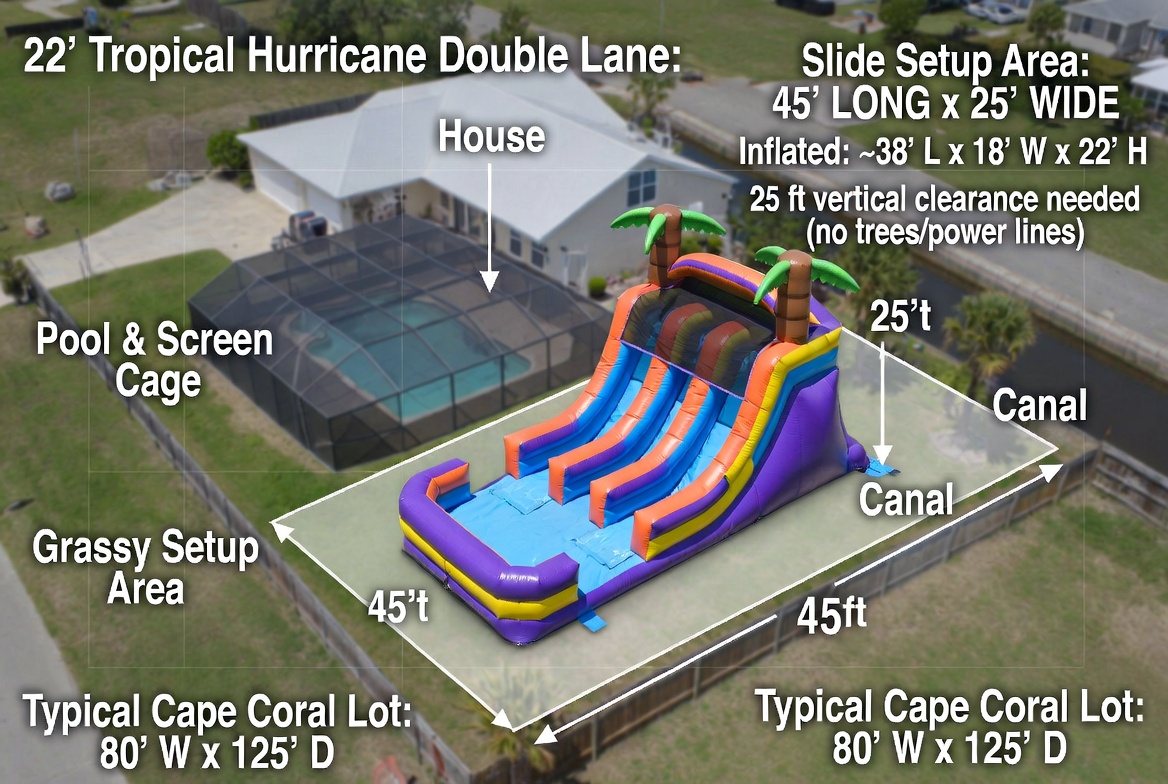
The 22' Tropical Hurricane is the biggest slide we carry. It is also the one customers ask about most, usually in the same sentence: will it actually fit in my yard?
The short answer
The 22' Tropical Hurricane needs a clear setup zone of 45 feet long by 25 feet wide by 25 feet up. Most standard Cape Coral lots can handle it. The catch is where on the lot you put it — and what your mature oak is doing 22 feet over your head.
I get this question two or three times a week. I am also a surveyor by day, so when a customer calls and asks "will it fit?" my answer is usually "send me your address and I will pull the plat." Below is what I look at and why it matters.
What the slide actually takes up
Pulled straight from the spec sheet on the 22ft Tropical Hurricane product page:
- Inflated dimensions: 38 ft long × 18 ft wide × 22 ft high
- Recommended setup area: 45 ft long × 25 ft wide × 25 ft high (includes safety clearance)
- Capacity: Four riders at a time, two on the slide surface (one per lane)
- Rider window: 48–76 inches tall, 55–220 lbs, ages 4 and up
- Power: One 110V GFCI outlet on a 15 amp circuit, commercial 2 HP blower included
- Water: Standard garden hose, soaker sleeve installed on site
- Anchoring: Steel stakes in grass, 150 lb sand weights on hard surface
- Wind limit: 15 mph maximum during operation (ASTM F2374)
Note the gap between the inflated size and the setup area. The extra seven feet of length and seven feet of width is the safety clearance for the entry steps, the splash pool exit lane, and the blower. We will not skip that clearance, so when you measure your yard, measure for the 45 by 25 number, not the 38 by 18 number.
What a standard Cape Coral lot actually gives you
A standard Cape Coral residential lot, going back to the original Gulf American Corporation grid in the 1950s, is 80 feet wide by 125 feet deep. That is the lot I see most often when I am out staking property corners for a pool screen or a fence permit. The city land development code requires:
- Front setback: 25 feet
- Side setback: 7.5 feet on each side
- Rear setback for the main structure: 20 feet
- Rear setback for a pool or screen cage: 10 feet
- Corner-lot side setback (street side): 10 feet
That leaves a usable building envelope of roughly 65 feet wide and 80 feet deep, minus your house, your driveway, your A/C pad, your pool, and any screen enclosure. The slide goes on whatever is left.
If your house sits on a typical 40 to 50 foot footprint and you have a 24 by 12 pool cage in the back, you usually have one of two zones to work with: the side yard between the house and the side lot line (about 16 to 20 feet wide once you account for the A/C condenser and the meter base), or the back yard between the cage and the rear property line (often 20 to 30 feet deep).
Neither side yard alone is wide enough for the 25 foot clearance the Hurricane wants. The back yard is usually the answer — and that is where I run the actual numbers.
Three lot situations that cause problems
1. Canal lots in SW and SE Cape
Canal-front yards south of Veterans Parkway lose depth fast. The rear setback runs to the seawall, and that is often where the screen cage stops. Once you subtract the cage and the deck slab, the open turf strip between the cage and the seawall is sometimes only 12 to 18 feet deep. That is not 25 feet, and we are not going to anchor a 22 foot slide where a rider could roll off into a canal at the end of a run. On those lots we usually shift the slide to the front yard with HOA permission, or we swap to a shorter slide.
2. Older NE Cape lots with mature canopy
Most of the NE Cape grid (Coral Oaks Golf Course area, the streets around Diplomat Parkway, and the older neighborhoods off Old Burnt Store Road) was built in the 1980s and early 90s. The live oaks and slash pines there have been growing 30 to 40 years. The slide is 22 feet tall. Mature live oak canopy in SWFL routinely hangs at 18 to 25 feet. I stand in the yard and look straight up before I look across — if a limb is in the way, the slide is in the way.
3. Corner lots in the newer NW Cape grid
Corner lots use a 10 foot side setback on the street side instead of 7.5 feet, and they are also subject to a 25 foot visibility triangle at the intersection. That eats into the front yard option in a way most homeowners do not realize until I show them the plat. Corner lots have more total square footage but less usable square footage. We always measure these on site.
How we measure before we deliver
If you are within Cape Coral and you book the Hurricane, I will offer a free pre-delivery measurement check. Here is what that looks like, and what you can do yourself before you call:
- Pace off 45 feet long by 25 feet wide on the spot you have in mind. A walking pace is roughly 2.5 feet, so that is 18 paces by 10 paces.
- Look straight up. Is there 25 feet of clear air? Power lines, screen frames, palm fronds, the soffit of a second story — all of it counts.
- Find the closest GFCI exterior outlet to that spot. Our blower runs on a 50 foot cord that we supply. If the nearest outlet is further than 50 feet, we need to know in advance so we can stage a generator.
- Find the nearest hose bib. Same 50 foot limit on the soaker sleeve.
- Check the ground. Sod is ideal. Pavers and concrete are fine with 150 lb sand weights. A split footprint that lands half on grass and half on a pool deck is workable if the grass half is the rear of the slide.
If you want to send me your address before you book, I will pull your plat from the Lee County Property Appraiser and your aerial, and we can talk through it on the phone. That has saved several customers a delivery they would have had to cancel at the gate.
Power and water — the part people forget
The blower wants its own circuit. That is the single biggest field issue we run into in older Cape homes. A pre-2002 Cape Coral house typically has one 15 amp circuit shared between the exterior outlet, the garage outlets, and sometimes the door opener. Plug a 2 HP commercial blower into that, add the garage fridge and a kid charging a phone, and the breaker trips. The slide deflates. We are then resetting a breaker instead of running the party.
Not sure what shares your exterior outlet? Plug something high-draw (a shop vacuum, a hair dryer) into it for ten seconds. If the garage lights flicker or the breaker trips, the circuit is shared. Note it on the booking and we will bring a portable generator at no extra charge.
Water is simpler. The slide takes a normal garden hose. We provide a Velcro soaker sleeve that wraps the top for even sheet flow down both lanes. Cape Coral municipal pressure is fine. If you are on a private well in Lehigh Acres or out past Burnt Store, we will check pressure on arrival.
Wind, anchoring, and the 15 mph rule
The Hurricane has a 15 mph operating wind limit. That is sustained wind, not gusts. In SWFL during the May 15 to October 15 rainy season, sustained winds above 15 mph almost always come with a thunderstorm cell, and we are deflating the slide before that cell hits anyway. The 15 mph rule is one we follow strictly — it is a manufacturer specification and an ASTM F2374 industry requirement, not a suggestion.
On grass we use 18 inch steel stakes driven flush, four per anchor point. On pavers, concrete, or any non-driveable surface we use 150 lb sand weights at every anchor point. We do not ratchet to a fence post, a screen frame, or a palm tree, and we will tell you why if you ask: those structures are not engineered for lateral loads from a 38 foot inflatable, and any of them can fail before the slide does.
When the Hurricane will not fit, here is what we do instead
If your yard cannot give us the 25 foot horizontal or vertical clearance — usually a tight side yard, a low canopy, or a small canal lot — we have shorter slides that work in much less space. The Blue Wave runs about 18 feet tall and needs roughly 35 by 18 feet of clearance. The classic slip and slide is essentially flat and works in almost any yard with a 40 foot run. We will swap the equipment on the booking rather than try to shoehorn the Hurricane into a yard it does not belong in.
How much space do I need for a 22 foot water slide?
You need 45 feet long by 25 feet wide of clear ground, plus 25 feet of vertical clearance with no overhead obstructions. On a standard 80 by 125 Cape Coral lot, that almost always lands in the back yard between the screen cage and the rear property line, or across the back yard parallel to the seawall on canal lots that are deep enough.
Can the slide go on pavers or concrete?
Yes. We swap the stakes for 150 lb sand weights at each anchor point. The unit performs the same on a hard surface as on grass. The only thing that changes is the anchoring method and the small puddle of splash water that ends up on the deck instead of soaking into the lawn.
Closing
If you have a Cape Coral or Fort Myers yard you are not sure about and you want the Hurricane specifically, send a photo of the setup spot and your address to [email protected], or book it online at swflamusements.com/swfl-booking.php and drop a note in the comments. I will walk the spot with you before delivery day so we are not finding out at 9 a.m. on a Saturday.
About the author
Christopher Johnson, Co-Owner, SWFL Amusements LLC
Chris is co-owner of SWFL Amusements and a professional surveyor by day. He spends his working hours mapping Southwest Florida properties, which means he knows the canal-front quirks, the older Cape circuit grid, and which intersections back up during snowbird season. He proudly lives in Cape Coral, where he was born and raised.