I get a phone call about three times a week that starts the same way: “Will the bounce house fit in my yard?” The customer is usually standing in the back yard looking at the spot they want, and what they want from me is a yes or a no. A surveyor’s answer is more useful than a sales rep’s, because it depends on half a dozen things that are not visible in the photo they were about to text me.
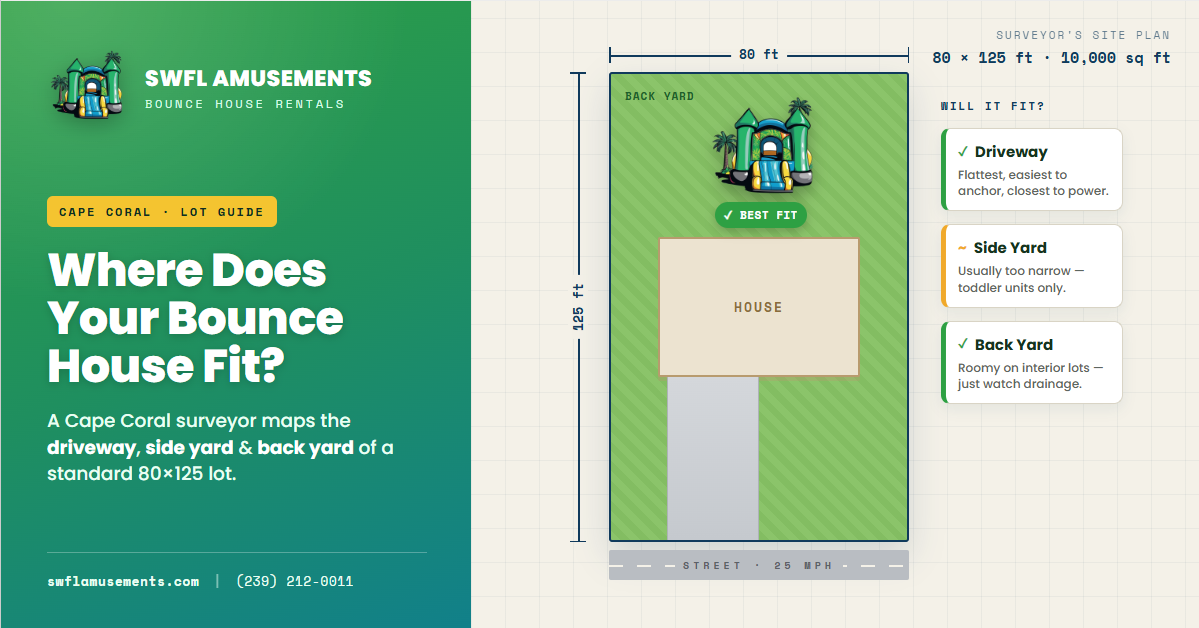
Cape Coral is mostly built on a single lot template. The standard residential lot is 80 feet wide by 125 feet deep — 10,000 square feet. That platting runs from Pelican to the NE Cape inventory north of Diplomat. Some lots are wider, the canal-front lots have their own geometry, and corner lots add a little width on one side. For figuring out where a 15-by-15 inflatable goes, the 80-by-125 baseline is the right place to start.
What the Cape Coral setbacks actually cost you
Cape Coral’s single-family residential zoning requires a 25-foot front setback, a 20-foot rear setback, and a 7.5-foot side setback. Those are the minimum distances from your property line to a permanent structure. A bounce house is not a permanent structure and does not have to honor those setbacks to set up, but the setback is the gap that exists between your house and your property line. It is the geometry you are working with.
On a standard 80-by-125 lot with a single-story house footprint of roughly 40 by 60 feet, the side yards run 7.5 to 15 feet, the front yard is 25 to 35 feet from house to curb, and the rear yard is 25 to 40 feet depending on whether you are canal-front or interior. That is the box you are trying to put a 15-by-15 inflatable into.
Option 1: The back yard (interior lots)
The back yard is the right starting point on almost every Cape Coral lot. It is where the lanai is, it is where the parents will sit, it is shaded by whatever has been planted back there over the years, and the grass is gentler on bare knees than concrete. It is also the spot the kids already think of as the party. You should default to the back yard and only move off it for a specific reason.
Interior Cape Coral lots — the ones not on a canal — usually have the deepest back yards in the city. With no seawall, the rear setback is 20 feet and the lot depth is 125 feet, which after a typical 40-by-60 house footprint leaves you 25 to 40 feet of clear grass behind the house. That is enough for almost any single inflatable in the catalog, including the 22-foot Tropical Hurricane slide, which needs roughly 25 feet of straight run.
The thing to watch on an interior back yard is drainage. Cape Coral’s flat topography pushes water to the low corner of every back yard, and on lots that pitch east-to-west you will find a low strip along the rear property line that holds water for a day after a hard rain. I wrote about Cape Coral yard drainage in a piece two weeks ago. The short version: walk the yard 24 hours after a heavy rain and look for the spot the grass is still squishy. Set up the inflatable on the high side, not the low side. Anchor with the 18-inch stakes that come with the unit — sod over a Cape Coral sand subgrade holds a stake fine.
The other thing to check is overhead clearance. The interior back yards that fail the walk usually fail because a mature ficus or live oak is hanging over the candidate spot. A standard bounce house needs 16 to 17 feet of vertical clearance, and a slide needs more. If the canopy is lower than that, move to the open part of the yard or trim the branch the week before.
Option 1b: The back yard, canal-front lots
Canal-front yards are still the back-yard default, but the geometry is set by the seawall, the dock, and the pool. On the older Yacht Club and Pelican canal-front inventory, the back yard between the rear of the house and the seawall is often 25 to 30 feet, with a pool taking the middle 12 feet. That leaves two lanes — one between the pool and the house, one between the pool and the seawall — and one of them is often wide enough for a 13-by-13 or 15-by-15 unit if the pool sits to one side of the lot.
If the pool eats the bouncing zone outright, you move to the driveway. But do not assume that just because there is a canal. I have walked plenty of Pelican and SE Cape canal-front lots that have a clean 16-by-18 patch of grass between the lanai screen and the seawall. Measure before you pivot.
Option 2: The driveway
The driveway is the right answer when the back yard fails the walk — canal-front lots where the pool takes the entire rear, lots with a low rear corner that holds water, lots with a gate narrower than 30 inches, lots where a mature tree drops the overhead clearance under 16 feet. It is the option Cape Coral homeowners forget to consider, and it is the cleanest fallback we have.
A standard two-car driveway in Cape Coral is 18 to 24 feet wide and 20 to 30 feet deep. That fits a 15-by-15 bounce house comfortably, with room for the blower and a clear path around it. Concrete is a strong anchoring surface, the front of the house is where the breaker panel and the closest exterior outlet almost always live, and the unit ends up close to the front door rather than around back.
The two things people worry about with a driveway setup are heat and traffic. Heat is real — concrete in mid-June reads hotter than grass, and the inflatable on top will run a few degrees warmer than the same unit in the yard. Traffic is rarely a problem on a residential Cape Coral street, but push the unit to the back of the driveway, away from the curb, and put a cone at the apron. Anchor with sandbags, not stakes. You do not want stakes punched through your concrete. Tuck the unit next to the garage door on the side that takes afternoon shade if you can — that puts the inflatable in shade from roughly noon onward.
Option 3: The side yard
The side yard is a niche option. With a 7.5-foot side setback and a roughly 5-foot eave-and-gutter intrusion on most single-story Cape homes, the usable side-yard width can be as little as 6 to 7 feet — enough for a slip-and-slide or a narrow toddler unit, not a standard 15-by-15. The wider 12 to 15-foot side yards you see on some older corner lots will fit a 13-by-13 toddler unit, but rarely the full standard size.
Its one advantage is privacy. If the front yard is exposed to the street and the back yard borders a canal with weekend boat traffic, the side yard is the one slice of the lot nobody can see into. The constraint I see most often is the AC condenser — Cape Coral code requires 3 feet of clear space around it, and that four-foot pad in a ten-foot side yard leaves you six feet of usable width. Not enough.
The five-minute tape-measure check
If you want certainty before you book, here is the site walk. Five minutes with a 25-foot tape and the unit dimensions from the product page.
- Measure the candidate footprint. For a 15-by-15 unit you need 17 by 17 to give a one-foot perimeter. For a 22-foot slide, closer to 25 long by 14 wide.
- Check overhead clearance — 16 to 17 feet for a standard bounce house, more for a slide. Walk under any tree branches, eaves, or low service drops.
- Measure to the nearest exterior outlet. A 50-foot 12-gauge outdoor-rated cord reaches most of the lot if the outlet is near a corner of the house.
- Check the surface. Flat grass, flat concrete, or flat pavers are fine. Sloped, root-cracked, or loose shell-rock is not.
- Check the gate. A 36-inch gate is workable; a 30-inch gate is tight; a 24-inch gate means the unit is coming through the garage or over a fence panel.
What I tell first-time customers
If you are renting for the first time, start in the back yard. It is where birthdays happen, where parents can sit on the lanai while the kids bounce, and the grass is gentler on knees and elbows than concrete. Walk the candidate footprint, look up for overhead clearance, and check the spot 24 hours after rain. If the geometry and drainage work, you are done.
The driveway is what you turn to when the back yard fails the walk: canal-front lots where the pool eats the rear, lots with a low corner that holds water, narrow gates, mature trees that drop clearance under 16 feet. In those cases the driveway is not a downgrade — it is the right answer for that lot. The side yard is for the narrow case of a toddler unit on a private corner of the house.
The answer to “will it fit” is not a yes-or-no — it is a where. Almost every Cape Coral lot has somewhere a 15-by-15 will fit. The job is finding the right spot for your unit, your party, and your shade window. That is what the five-minute walk is for.
If you want me to walk it with you
I look at lot geometry on Cape Coral properties for a living. If your party is in the next two or three weeks and you want a second set of eyes before you book, call (239) 212-0011 and ask for Chris. Five minutes on the phone with the lot dimensions, or a quick stop-by if you are in NW or NE Cape. The point is so the answer to “will it fit” is “yes, here, like this” — not a guess from a photo.
About the author
Christopher Johnson — Co-owner, SWFL Amusements LLC
Chris is co-owner of SWFL Amusements and a professional surveyor by day. He spends his working hours mapping Southwest Florida properties, which means he knows the canal-front quirks, the older Cape circuit grid, and which intersections back up during snowbird season. He proudly lives in Cape Coral, where he was born and raised.