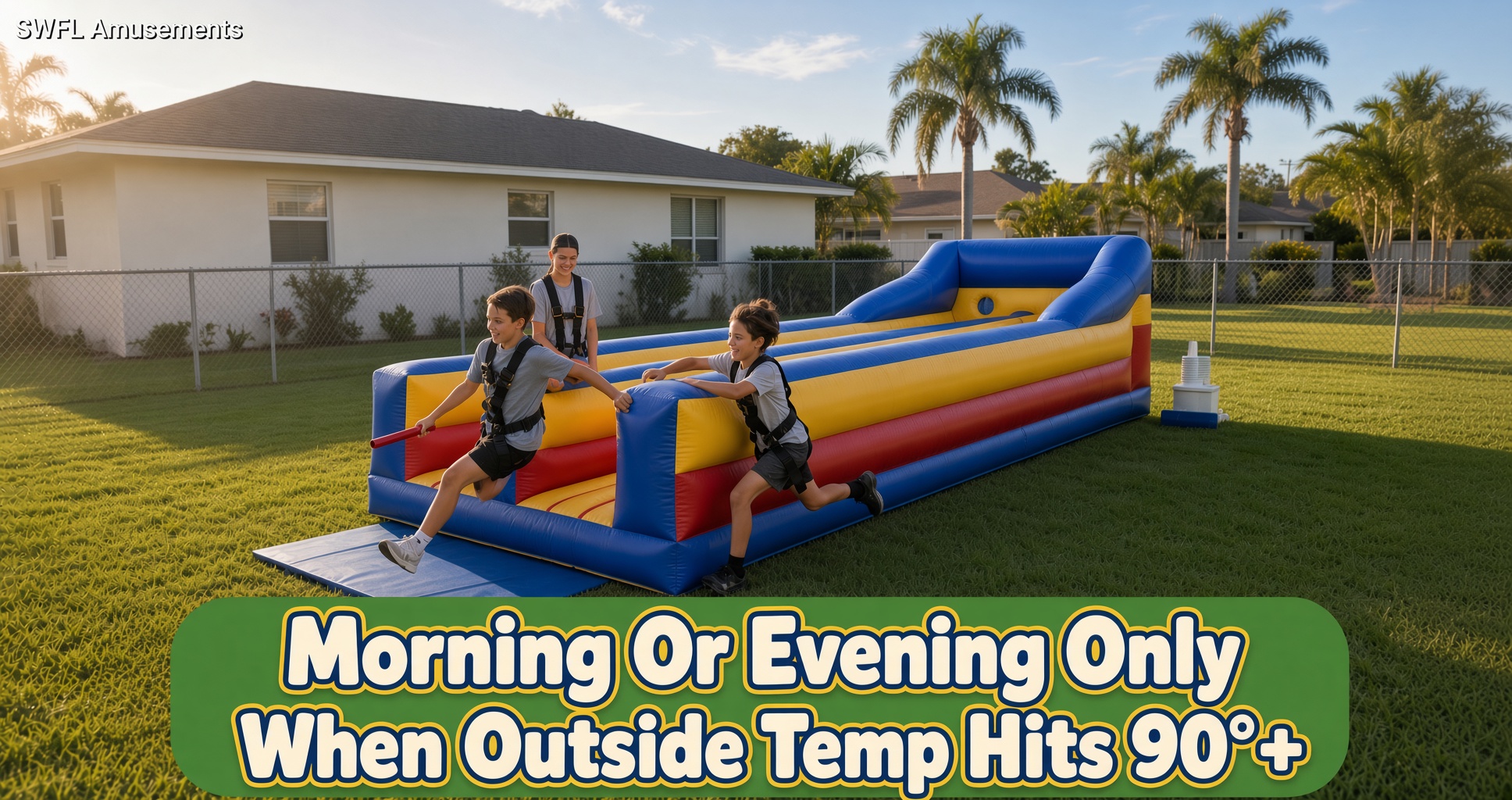
Of everything we haul, the bungee run is the only unit that asks a person to run as hard as they physically can. That sounds like a small distinction. It is not.
Every other inflatable in our catalog is self-paced. A kid bounces, climbs, slides, and stops whenever they feel like stopping. The bungee run is a 35-foot dash against a resistance cord at maximum effort, and then the participant turns around and does it again, because they are convinced they can beat their friend by another six inches. Nobody paces themselves on a bungee run. That is the whole appeal, and in Southwest Florida in late August, it is also the thing that has to drive your schedule.
So this is a straight look at the unit — what it is, what it costs, where it goes in a Cape Coral yard, and what time of day it belongs in.
What the unit actually is
The 35-foot double lane bungee run is a two-lane inflatable track. Two people harness in side by side, sprint down their own lane against a bungee cord, and plant a velcro baton as far down the lane as they can reach before the cord snaps them back. Whoever plants their baton farthest wins the heat. Then both of them argue about whether the other one cheated, which is the actual product.
Two lanes matters more than it reads on paper. A single-lane bungee run is a distance contest against yourself, and people try it once. Two lanes is a race, and a race generates the next race. That is the difference between a unit people walk past and a unit with a line in front of it.
The numbers we can put in writing
| Unit length | 35 feet |
|---|---|
| Lanes | Two, run head-to-head |
| How it is scored | Velcro baton, farthest placement down the lane wins |
| Recommended age | 6 and up, with an adjustable harness |
| Rental rate | $399 for an all-day rental |
| Included in Cape Coral | Delivery, setup, and teardown at no additional charge |
| Outside Cape Coral | We deliver throughout Southwest Florida — call (239) 212-0011 for delivery pricing |
One honest note on that table: the 35 feet is the unit length, and you want clear ground at both ends beyond it — room for a starting area, room for the crew, and room for the person who just got snapped backward. If you are working with a specific yard or a specific stretch of parking lot, call before you assume it fits. We would rather measure it with you on the phone than show up and find out together.
The part nobody asks about until it is 2 p.m.
Here is the number that should shape your entire plan for this unit between June and September.
Fort Myers averages a high near 92 degrees in August, with relative humidity running around 75 percent. Put those together and the average August heat index for this area — what the air actually does to a body, not what the thermometer says — sits near 108 degrees.
The National Weather Service sorts heat index into four bands. Everything from roughly 103 to 124 degrees falls in the band the NWS labels "Danger," where heat exhaustion becomes likely and heat stroke becomes possible with prolonged exposure and physical activity.
Read that last clause again. An average August afternoon in Lee County puts us inside the Danger band before anyone has done anything at all. The bungee run is the physical activity. It is the single most physically demanding thing we rent.
I am not telling you this to talk you out of renting it. I am telling you because the fix is free and it takes about thirty seconds of planning:
- Put it in a morning or evening slot. Before 11 a.m. or after 5 p.m. If your festival runs all day, the bungee run does not have to. We can set it up in the morning and it can simply sit unused through the worst two hours.
- Put water beside the unit, not across the field. If the cooler is fifty yards away, kids will skip it and get back in line. If it is at the exit of the lane, they drink.
- Assign an adult to the line, not just to the lanes. The person waiting in full sun for four turns is more at risk than the person running. Somebody should be watching the queue.
- Pair it with something low-effort. If the bungee run is the only attraction, the crowd stays at redline. Put a slower unit next to it and the group self-rotates without anyone enforcing it.
Where it goes on a Cape Coral lot
Cape Coral was platted on a grid. Outside the curved canal streets and a few pockets in the older southeast section, most residential blocks here run close to true north-south and east-west. That has a practical consequence most people never think about: on a standard Cape lot, the house throws its afternoon shadow toward the east, and its morning shadow toward the west.
If you are laying out 35 feet of lane, that is worth two minutes of thought:
- Late-afternoon event? The strip of yard on the east side of the house is the coolest ground you own, and it gets cooler as the event runs. That is where the lane goes.
- Morning event? The west side is your shaded side until midday.
- Either way, run the lanes north-south if the yard allows it. A racer sprinting due west at 6 p.m. in September is looking straight into low sun. In a game decided by where a velcro baton lands, that is not a small thing — it produces missed placements and disputed heats all evening.
Most people place the bungee run wherever the yard happens to be widest, and then wonder why the line thins out by the third hour. It is usually not the unit. It is the sun angle.
The other placement item is power. The blower has to run continuously the entire time the unit is up, so the setup point needs to be within reach of an outlet. On the older Cape circuits especially, tell us in advance if you are also running a bounce house, a snow cone machine, and a sound system off the same side of the house. We would rather plan the circuits than trip a breaker in the middle of a race.
Who this unit is actually for
The bungee run has a specific audience, and it is not the same audience as a castle bounce house.
It works for: school field days and PE events, church fall festivals, HOA and neighborhood block parties, corporate and team-building days, and — the one people underestimate — birthday parties for kids who have aged out of bounce houses. Somewhere around fifth grade a kid decides a bounce house is for little kids. That kid will race a bungee run for two straight hours.
It does not work for: parties where most of the guests are under six, tight lots that cannot give you a clean 35-foot straight line, or any event where no adult has been assigned to run it. This is a supervised unit. It is not a park-it-and-forget-it unit.
What it costs, and how I would think about it
I spent a lot of years as a CFO before I spent any of them hauling inflatables, and I still cannot stop evaluating a rental as cost per participant-hour rather than cost per unit.
At $399 for the day with delivery, setup, and teardown included in Cape Coral, the bungee run is not the cheapest line on a festival budget. What it is, is a line item that holds a crowd. Two lanes running steadily will keep a queue moving from the moment you open to the moment you shut it down, and a competitive attraction generates repeat participation in a way a passive one does not. On a festival where you are trying to keep families on the grounds long enough to buy food, that is worth measuring differently than a per-hour rate.
If what you actually need is raw throughput for a large crowd, the 42-foot Venom Run obstacle course at $499 is the better spend. It is also dual-lane, but participants pace themselves through it, which matters a great deal in an August heat index. If what you need is the thing the middle schoolers will line up for twice, that is the bungee run.
And if the honest answer is that your crowd is mostly under six, do not rent either one. I would rather tell you that now than take the booking.
One last thing
The question I get about this unit is almost never about the unit. It is about the slot. People already know they want a bungee run at their fall festival. What they do not know is whether it belongs at 10 a.m. or 6 p.m. on their particular piece of ground, which way the lanes should point, and where the water table goes.
If you are locking in a date for a school or church festival this fall and you want to talk that through, call me at (239) 212-0011. It is a five-minute conversation, and it is usually the difference between a line that keeps re-forming all afternoon and one that quietly stops.
About the author
Gabriel Denny — Co-owner, SWFL Amusements LLC
Gabe is co-owner of SWFL Amusements. He spent 20+ years in the Air Force, first enlisting after high school before commissioning and retiring as a Major. He is a 5x CFO, which he continues to do when not working bounce houses. He lives in NW Cape Coral and answers the company phone himself, including at 2am.