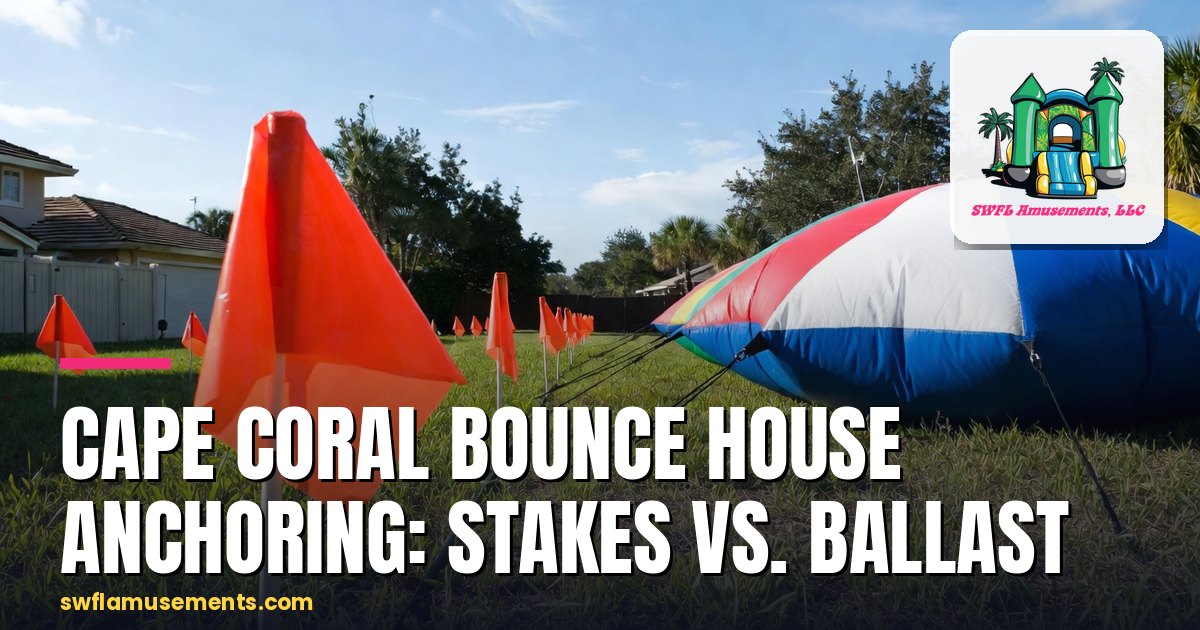
Somewhere around a third of my site walks include the same moment. The customer points at the stretch of lawn where the slide is going and asks, a little carefully, whether we are going to put spikes in it.
We are. That is how a commercial inflatable stays where you put it. The Consumer Product Safety Commission is blunt about it in its bulletin on inflatable amusement devices: anchor the unit per the manufacturer requirements and instructions, and where those instructions are not in hand, use every anchor point, every time the ride is set up. Every anchor point means every strap on the unit, not the four corners and a shrug. There is more on how we think about that on the safety page.
The better question is the one that usually comes next. What is under the grass?
In Cape Coral the honest answer is: more than most people picture, and less of it is mapped than anyone would like. The city utilities system alone carries more than 900 miles of underground pipe, and that count does not include a single foot of the irrigation lateral a previous owner ran out to the hibiscus bed on a Saturday twenty years ago. I have found a couple of those the expensive way. This is the order I walk a yard now, and the order I would walk it if the yard were mine.
1. Identify the surface before you think about the stake
Anchoring method follows surface, and in this market there are only a handful of surfaces.
- Lawn over sand. The default Cape Coral yard. Our sand is forgiving about taking a stake and less forgiving about holding one, so stakes go in at an angle and they go in deep.
- Driveway, pavers or a concrete slab. No stakes at all. Ballast only.
- Pool deck. Same as a slab, with less room to put the weight.
- Artificial turf. Usually ballast. Most homeowners who paid for synthetic turf would rather we did not perforate it, and the compacted base underneath fights a stake anyway.
- School or church field. Stakes, almost always, with the blessing of whoever is responsible for the irrigation. That conversation has its own rhythm on a campus, which I went through in the post on planning an event at an Oasis school.
That single answer changes the truck load, the setup time, and how much yard the unit actually needs. It is worth settling when you book rather than in the driveway at eight in the morning.
2. If real digging is happening in that yard, file the 811 ticket
An inflatable stake is not what Florida wrote its underground damage law for. But party weekends have a way of collecting other projects: a tent that wants stakes two feet down, a fence panel so the dog stays in, a post for the banner, somebody finally putting in the palm tree. Once you are excavating, Chapter 556 of the Florida Statutes, the Underground Facility Damage Prevention and Safety Act, is in play, and it is not optional.
Three numbers are worth carrying around:
- Two full business days. Notice goes in to Sunshine 811 not less than two full business days before operations begin. A ticket filed Thursday afternoon is not a Saturday ticket.
- Thirty calendar days. That is how long the excavation information you give the system stays valid.
- Twenty-four inches. The tolerance zone runs 24 inches out from each side of a marked line. Inside that band you slow down and work by hand.
The ticket costs nothing. Member utility operators get those two business days to mark the approximate location of their lines, and you compare the colors on the ground against the list of utilities on your ticket to confirm every one of them answered. For a Saturday event, that is a Tuesday phone call. Which is exactly why this belongs in a planning post and not in a safety checklist you read the night before.
3. Know precisely what that ticket will not cover
Here is the part that costs people money, and it is not a fine-print technicality. The 811 process gets member operators to mark the facilities they own. The lines on your side of the meter belong to you, and nobody is coming out to mark those.
In a Cape Coral back yard, the unmarked list is long:
- Irrigation laterals, plus the wire running out to each valve
- Low-voltage landscape lighting
- Buried pet containment wire
- Pool equipment plumbing and the bonding wire that rings a pool deck
- Whatever got run to the shed, the dock box or the outdoor kitchen by somebody who is no longer available to ask
Those live at exactly the depth an inflatable stake works in. Our stakes go at an angle into the top foot and a half of soil, which is the same neighborhood as a sprinkler lateral and well above anything a utility crew ever buried.
One more for the older parts of the Cape and anywhere still waiting on utilities: the septic drain field. A drain field tends to occupy the flattest, sunniest, most open rectangle in the back yard, which is also the first place anyone wants to put a bounce house. If your lot is on septic, find out where that field sits before you pick a setup spot, not after.
4. Find your own lines the afternoon before, not on party morning
This takes twenty minutes, and it is the highest-value thing a host can hand a setup crew.
- Run each irrigation zone from the controller and walk the yard while it is running. The heads tell you where the laterals are, because a lateral runs head to head, roughly in a straight line.
- Flag the heads. Orange landscape flags if you have them, upside-down plastic cups if you do not.
- Find the valve box and the backflow. The run from the box back toward the house is usually the main, and it is the most expensive thing in the yard to break.
- Photograph it. Shoot it on a bright afternoon with the flags in frame, and keep the photos. You will want them the next time anybody digs out there.
- Send me one of those photos when you book. I would rather plan a setup around your flags than discover your layout with a mallet.
Cape Coral is a specific case here, and the specifics are worth knowing. The city has been delivering reclaimed water to residential customers since 1992, and had five canal pumping stations in place by 1993 to supplement the supply when irrigation demand runs past what the reclamation plants produce. Reuse here averages more than 26 million gallons a day, which puts this city among the largest residential reuse systems in the country. The practical translation is short: in most of Cape Coral, the lawn you are about to set a 22-foot slide on has pressurized line running through it, fed by a system the homeowner did not install and has very likely never seen a drawing of.
Northwest Cape Coral carries its own wrinkle. In the utilities extension areas the lines are recent, the yard restoration is recent, and the sod over the trench may be newer than the patio furniture. I wrote in October about what the North 3 schedule change does to the party window up there. New work is usually documented better than old work. It is also shallower in spots, and the ground over it has not finished settling.
5. When you cannot stake, you ballast, and ballast is paid for in floor space
Ballast is the answer on slabs, pavers, synthetic turf, and in any yard where the lines are unknown and the owner would rather not find out on a Saturday. It works fine. It is not free, and the price is paid in space and planning rather than in dollars.
Water barrels and sandbags sit outside the footprint of the unit and have to stay clear of the traffic path, which means the open area around an anchored inflatable grows by a couple of feet on every anchored side. On a tight Cape Coral lot, that is the difference between fitting two units and fitting one. The weight also has to ride out on the trailer, which is the real reason this belongs on the booking instead of in a text message the night before.
Scale matters. The toddler unit at $99 and the 14-foot Classic Castle at $199 are modest ballast problems; both are compact, and the anchor points are few. The 38-foot Straight Shot obstacle course at $449 is a different conversation, because the anchor points run the length of both sides and there is no short way to weight that down.
6. Put it on the booking, in one line
One line is enough. Grass, slab or turf. Lines known or unknown. Stakes fine or ballast needed. That sentence decides what goes on the truck, and it is the cheapest sentence in the whole transaction.
Twenty years in the Air Force left me with one habit that transfers cleanly to this business: you do not learn the ground while you are standing on it. You learn it beforehand, from whoever has already been there, and you write down what you find. My sons and I walk every yard before a single piece of vinyl comes off the trailer. That walk goes faster, and goes better, when the host has already done one of their own. For the rest of the day-before list, I put together a yard prep rundown back in the summer that still holds up.
If you are not sure what is under your setup area, run the sprinkler zone, take a photo with the heads marked, and send it over when you book. Or call or text (239) 212-0011 and tell me grass or concrete. I will tell you what we would bring and whether the space still works once the ballast is sitting in it.
About the author
Gabriel Denny — Owner, SWFL Amusements LLC
Gabe owns SWFL Amusements. He spent 20+ years in the Air Force, first enlisting after high school before commissioning and retiring as a Major. He is a 5x CFO, which he continues to do when not working bounce houses. He lives in NW Cape Coral, runs events with his two sons, and answers the company phone himself, including at 2am.