The calls start about now. Not for August — August is quiet around here. They start now for October.
A deacon at a church off Del Prado. A woman on the social committee of a neighborhood association in the northwest Cape. A volunteer who got handed the fall family night at a community center and is not sure how that happened. Same question every time: we do not have a field, we just have the parking lot — can you still set something up out there?
Usually, yes. Cape Coral congregations and neighborhood associations carry a real share of this city’s fall calendar, and plenty of them are working with asphalt instead of turf. But a paved lot is a different site than a backyard, and almost every item on my checklist changes. I survey Southwest Florida property for my day job and I grew up here, so I have walked a fair number of these lots for reasons that had nothing to do with inflatables. Here is what I am looking at.
Your lot is not flat, and it was never supposed to be
This is the first thing, and the thing people find hardest to believe about their own property. A parking lot is a drainage structure with parking painted on it. It is graded so water leaves. If it were flat you would have standing water after every August storm, and in this city that is not hypothetical.
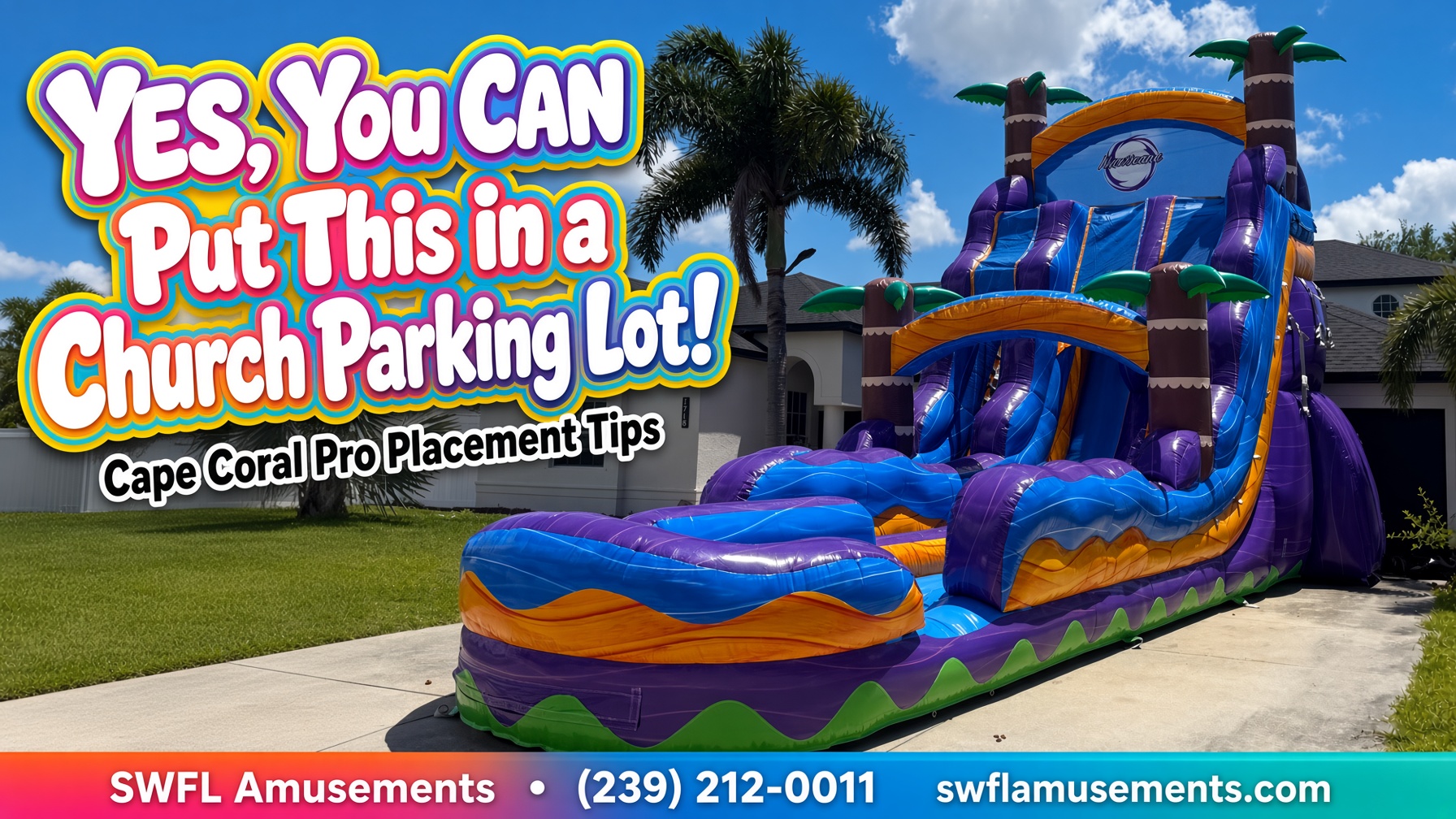
The practical convention on a paved commercial lot down here is one to two percent of fall toward the inlets. Two percent does not sound like much — a quarter inch per foot. But the setup zone for our 22-foot Tropical Hurricane slide is 45 feet long, and at two percent that is close to eleven inches of drop end to end. On a dry bounce unit you feel that as riders drifting to one corner all afternoon. On a water slide, where the pool end needs to be the low end and the climb needs to be square, it decides where the unit goes or whether it goes at all.
You cannot see eleven inches over 45 feet by eye. I have watched people swear a lot was dead level while the morning’s rain ran visibly past their shoes. Walk it right after a storm and watch where the water goes. Whatever it runs away from is your high ground — usually the crown down the middle of a double row of spaces, not the edges.
The accessible spaces are the flattest asphalt you own
Here is the small irony I end up explaining on nearly every one of these walks. Under the 2010 ADA Standards, an accessible parking space and its access aisle are held to a maximum slope of 1:48 — roughly 2.08 percent — in all directions, not just one. Everywhere else, the designer had latitude to pitch the pavement wherever the water needed to go. In the accessible spaces, they did not. Those stalls got built as close to level as anything on the property.
They are also, obviously, the stalls you may not block, screen off, or park a blower next to. Not for an afternoon, not for a good cause. So the flattest pavement on the site is off the table — but knowing why it is flat tells you where to look next. If the accessible spaces sit against the building, the grade near the building is probably gentler than the grade at the back of the lot, because the whole surface is pitched away from the structure. Start near the building and work outward.
Count the stripes instead of hunting for a tape measure
This is why a parking lot is in some ways easier to plan than a backyard. Someone already measured your site and painted the answer on the ground.
Cape Coral’s Land Development Code sets a minimum standard parking stall at nine feet wide by eighteen feet deep and a minimum two-way drive aisle at 24 feet. Your lot may be more generous, but it will not be less. That is a measuring stick you can pace in ninety seconds.
Run the math for the Hurricane, the largest thing we would put on a lot like this. The unit is 38 feet long by 18 feet wide by 22 feet tall. The setup zone we ask for — unit plus safety clearance — is 45 feet long by 25 feet wide, with 25 feet of vertical clearance. Translated into paint:
- Width: 25 feet is three stalls across. Three nine-foot stalls give you 27 feet, which leaves a couple of feet of margin.
- Depth: 45 feet is one double-loaded bay. A row of stalls, the aisle, and the row facing it comes to 18 plus 24 plus 18, or 60 feet. That is comfortably more than we need.
So the answer to "does the big slide fit in our lot" is usually: yes, if you can give up six stalls and the aisle between them for the day. That is a parking conversation, not an engineering one, and it is easier to have with your board in August than on the Thursday before the event.
The 25 feet of vertical clearance is what gets missed, because nobody looks up in a parking lot. Light poles, the drip line of a live oak, a covered walkway, a banner strung for the fall series — all of it is in play. If you are standing under something, we are not putting a 22-foot slide there.
Nothing gets staked, and that is the whole design problem
On grass we drive stakes. On asphalt or concrete, nothing goes into the surface. I would not put a steel stake through a congregation’s pavement even if a manufacturer allowed it, and nobody should be asking you to sign off on that.
What replaces the stakes is ballast — weight at every anchor point the manufacturer specifies, sized to the unit. That is on us to bring and place, and it is worth asking any vendor how they anchor on hard surfaces before you book. If the answer is vague, or if it involves anything driven into your lot, keep calling.
There is a second reason, and it is squarely my day job: you do not know what is under there and neither do I, not without a locate. On a Cape Coral commercial lot the likely candidates are irrigation laterals feeding the landscape islands and conduit running out to the light pole bases. Both are shallow, and the repair is a saw cut and a patch your congregation looks at for ten years.
The related item is wind. A ballasted unit is secure within the manufacturer’s stated limits and not beyond them, and those limits are printed on the unit. In August and September here, an afternoon cell goes from a line on the horizon to overhead in twenty minutes, and we shut down and deflate when it does. So decide before the day where a hundred kids go when that happens. A fellowship hall, a gym, a covered walkway. Anything but the lot.
Power is the item nobody walks
Every inflatable runs on a blower that never stops. On a church or clubhouse lot, the exterior receptacles you can see are often a small number of circuits doing a lot of work, and in the older parts of the Cape the building may be considerably older than the lot in front of it. Two blowers on the same fifteen-amp exterior circuit is the classic way to lose an afternoon.
Three things worth confirming before the day:
- Where the exterior receptacles are and which ones are live. Someone on your facilities side knows. Ask them to test the ones you plan to use. A GFCI that trips the moment a blower kicks on is a diagnosis, not a mystery.
- Whether those receptacles are on separate circuits. If they are not and you are running more than one unit, we are talking about a generator — a lead-time item and a placement item, since it has to sit far enough from the queue that nobody is standing in the exhaust.
- How far the receptacle is from where the unit will sit. Cord runs on a lot are longer than people estimate, because the flat spot you picked is rarely next to the wall you picked. Long runs on undersized cord cost voltage at the blower, and a blower that is not getting what it needs is a soft unit.
Shade, heat, and where the line forms
What separates a good parking lot event from a rough one here is not the equipment. It is where the line forms. Dark pavement in direct Florida sun gets hot enough that barefoot kids will not stand still on it, and at a water event they are all barefoot. Place the unit where the building throws afternoon shade across the queue — on most Cape Coral lots that means the east side — and put your tables and chairs where people wait rather than where they eat. If the only flat spot puts the entry steps in full sun, tell us and we will bring matting for the approach.
One more: kids coming off a slide do not look for traffic. The exit should never face a live drive aisle or the door a caterer will back a van into at four o’clock.
The five-minute walk, before you call anyone
Do this much before you pick up the phone and the rest of the conversation takes about four minutes.
- Go out after a rain and note where the water runs. Mark the high ground.
- Pace how many stalls wide and how many bays deep your candidate area is. Three wide and one bay deep covers almost anything we own.
- Stand in the middle of it and look straight up. Write down what is over your head.
- Find the nearest exterior receptacle and count your paces back to the spot.
- Note which accessible spaces and which fire lane you are near. Those stay clear no matter what.
- Take one photograph from the building doors looking out at the area.
That last one does more work than the other five combined. Send it along and we can usually tell you on the spot whether the lot works and what it costs you in parking.
If your congregation or neighborhood association is picking an October date right now and the only flat surface you have is the parking lot, call me at (239) 212-0011 and we will walk it together, or start with our Cape Coral rental page. Anchoring specifics for every surface we work on are on the safety page.
Slope, stall, and accessibility figures here are published minimum standards. Your lot may differ. Confirm anything that affects an approval with your own facilities staff or engineer.
About the author
Christopher Johnson — Co-owner, SWFL Amusements LLC
Chris is co-owner of SWFL Amusements and a professional surveyor by day. He spends his working hours mapping Southwest Florida properties, which means he knows the canal-front quirks, the older Cape circuit grid, and which intersections back up during snowbird season. He proudly lives in Cape Coral, where he was born and raised.