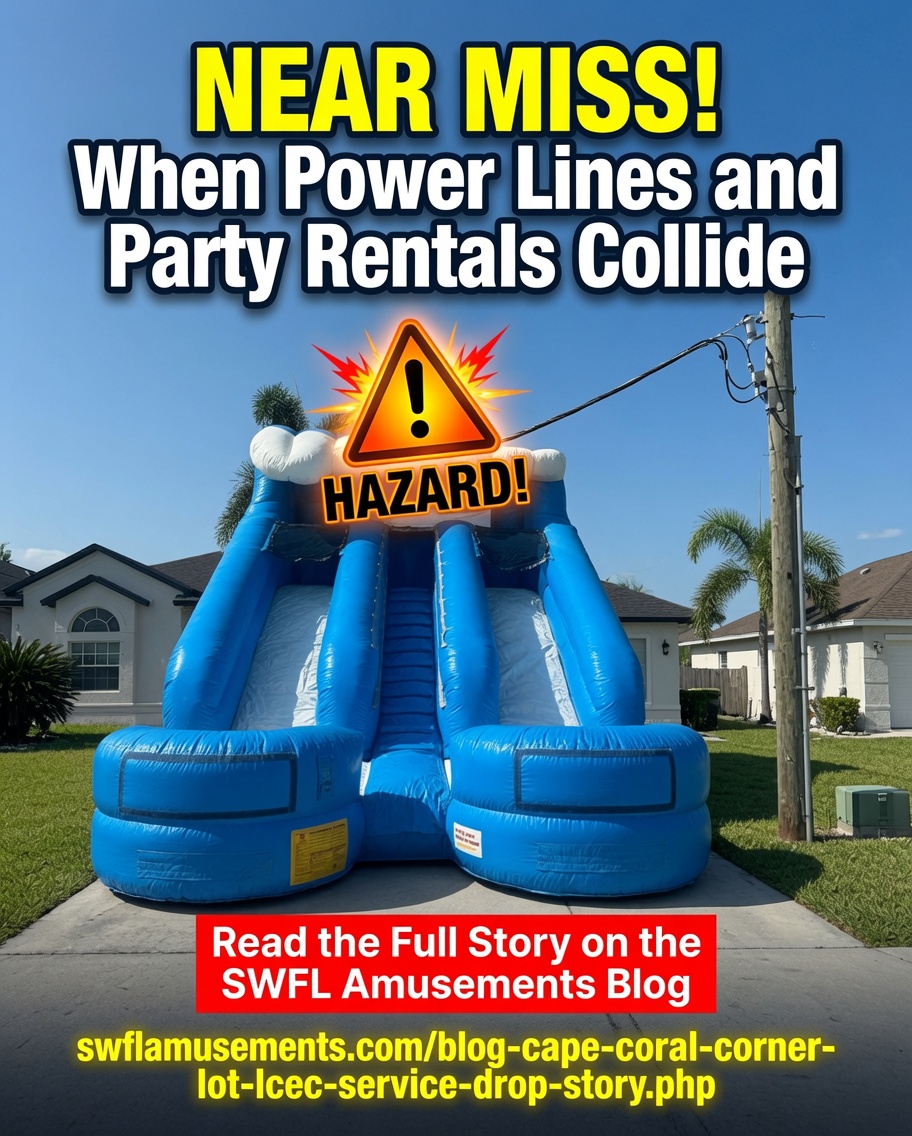
The call came in mid-July, on a Sunday afternoon. A grandmother in the older mid-Cape grid, off Del Prado somewhere south of Cape Coral Parkway. Her grandson was turning eight the following Saturday, and he had asked for “the tallest slide you have.” She had already looked at our lineup online and settled on the 22-foot Tropical Hurricane. She was calling to confirm two things — that the unit was available on July 25, and that her yard was big enough for it. She had walked out with a tape measure that morning and gotten forty-five by thirty on the flat area at the back of the lot. That is a comfortable footprint for the Hurricane, which needs about forty feet of runout for the slide plus a few feet of clearance on the sides. On paper, she was fine.
She lives on a corner lot.
That single detail is what made me tell her I would drive over the next day before we booked anything — no charge, no obligation. I do not always insist on a walk-through for a corner-lot fit, but the older mid-Cape corner lots are a specific animal, and on that stretch of the grid I would rather look with my own eyes.
Why corner lots read differently to a surveyor
On my day job I spend a lot of time reading Cape Coral plats. The utility easements in most of the older Cape subdivisions are drawn along the front lot line, along the rear lot line, and along one or both side lot lines. On an interior lot, the front-line easement is the one that carries the power drop from the pole to the house, and the drop cable runs a fairly short span across the front yard. On a corner lot, you get an easement on both the “front” and one of the “side” frontages, because both of those sides face a right-of-way. That doubled-up easement is where LCEC runs the pole line, and it is where they put the poles themselves.
The house still needs a service drop — the set of insulated conductors bringing power from the nearest pole down to the weatherhead on the side or gable of the house. If the pole sits at the corner and the weatherhead sits on the yard-facing side of the house, the drop cable arcs across the airspace of the back yard on its way from the transmission line at the top of the pole down to where it enters the house.
The cable is quiet. Homeowners eventually stop seeing it. Then somebody wants to put a twenty-two-foot inflatable in that same corner of the yard.
What I saw when I got there
Monday morning, a little after nine. She met me at the driveway with a printed satellite image of the property. That already told me who I was working with. I like a customer who wants to look at the picture before we walk the ground.
The lot was the standard Cape eighty by one twenty-five, oriented so that the long side of the house faced the numbered street and the short side of the lot faced the named street cross-frontage. The back yard was open, mostly turf, a few young sabal palms along the rear fence line, a screened enclosure over the covered lanai, and no pool. The forty-five by thirty measurement she had taken was correct as a flat-area number.
The utility pole sat at the front-side corner of the lot, on the numbered-street easement, roughly where the property lines meet the sidewalk. Standard placement. The LCEC service drop came off the crossarm near the top of the pole, ran diagonally across the corner of the back yard, and terminated at the weatherhead on the yard-side gable of the house about thirty-five feet away. Standard triplex sagging in a shallow catenary between the two attachment points, the way service drops always do.
Here is what makes this a Hurricane-slide problem specifically. The forty-five by thirty flat area sat directly under the diagonal run of the drop cable. The Hurricane at full inflation stands about twenty-two feet at the peak of the slide. At mid-span sag, the cable was on the order of fifteen or sixteen feet above ground — enough to satisfy the NEC ten-foot minimum over a lawn, enough that a homeowner walking beneath it never notices, but nowhere near enough for a twenty-two-foot inflatable rising into it.
Positioned wrong, a wet inflatable pushed up into a live 240-volt service drop is a very bad afternoon for everyone on the property.
What the fix looked like
I laser-mapped the drop cable's angle, the pole-side attachment height, the weatherhead-side attachment height, and the actual clear-airspace envelope in the corner of the yard. The good news was that the drop only intruded into the corner of the flat area. The bulk of the yard — if you rotated the unit ninety degrees from her original plan and slid it about eight feet toward the driveway side of the lot — had full open sky above it.
The Hurricane went in the following Saturday morning at eight-thirty. Long axis of the unit ran parallel to the numbered street, slide runout aimed toward the rear fence, entrance facing the covered lanai. That put the tall end of the unit as far from the drop cable as the yard would allow. From the top of the slide platform you could look sideways and see the cable at an angle above eye level about twenty feet off, well clear of the inflatable and clear of the fall zone below the slide.
The whole intervention was the rotate-and-shift on the setup footprint. There was nothing to modify at ground level. The Hurricane ran wet from ten to three, twelve kids and four parents in the mix, one grandmother who I understand had a very good afternoon.
The picture she texted me at four was of the eight-year-old asleep on the lanai couch, hair still wet, a paper crown from the cake sitting cockeyed on his head. The caption read, “Thank you. He never noticed the cable once.”
What this tells you about corner-lot fits in Cape Coral
The practical lesson is short. If you have a corner lot anywhere in the older Cape Coral grid and you are thinking about a tall inflatable — the Hurricane, the taller freestanding slides, the tallest of the wet/dry combos — go outside and look up before you book.
Three specific things to look for.
First, the utility pole. If it is on the corner of your lot or the corner of your neighbor's lot, look up along its length. Is there a bundle of insulated cable coming off the crossarm and running toward your house? That is your service drop. On a corner lot the answer is yes more often than not, because your house is close to the pole and the drop is short.
Second, trace where it lands. The drop terminates at the weatherhead on the side of the house closest to the pole. Draw a straight line in your head from the top of the pole to the weatherhead. Anything under that line is airspace the drop cable occupies.
Third, look at the vertical geometry. The drop cable is a diagonal from the crossarm on the pole down to the weatherhead on the house, sagging in the middle. Anywhere under that diagonal, the sky is lower than it looks. A twenty-two-foot inflatable set in that airspace will hit cable before it finishes inflating — and unlike a tree branch, that cable is carrying live household voltage.
Interior lots in the older Cape almost never have this problem. The pole sits at the front-line easement and the drop runs a short span from pole to house front, well clear of the back yard. Corner lots are the exception. Newer far-NW Cape neighborhoods are a mixed bag — some buried the utilities entirely, others kept the same overhead pattern as the older grid.
Why the vendor you pick matters more than the sticker price
This story is really the argument for hiring a bounce house company that knows what it is looking at when it walks a yard. Florida does not license inflatable operators. There is no state inspection, no permit, no required training. The industry standard is ASTM F2374 — the American Society for Testing and Materials standard for the design, manufacture, operation, and maintenance of inflatable amusement devices. Following it is voluntary. Reputable rental companies follow it. The person selling you a bounce house on Facebook Marketplace for a hundred and fifty dollars all-in almost certainly does not.
What that gap looks like in practice is the story above. A pole-and-drop-cable arrangement that a trained operator flags in ten seconds is invisible to somebody who was never taught to look for it. Same with weather-triggered evacuation thresholds, anchor loading on a canal lot, and the dozen other small decisions that go wrong quietly when nobody is watching for them.
Before you book anyone, ask the question. “Do you follow ASTM F2374?” A vendor who does will say yes without hesitating and can tell you what it covers. A vendor who does not will change the subject. That one question filters out most of the too-good-to-be-true offers on the local buy-and-sell pages, and it costs you nothing to ask.
Why this is a call, not an online booking
Service drops do not show up in the aerial imagery most homeowners use to eyeball a yard. Triplex cable is maybe a half inch across at the outside. From directly above it is invisible against the roofline. From the ground it blends into whatever is behind it. On a corner-lot fit for the Hurricane or for the tallest combo units, I would rather drive over and measure the airspace before you commit than have the truck show up on party day with the wrong answer already loaded. The visit is free.
If you are on a Cape Coral corner lot this summer and the tallest slide you are looking at is the one that made your kid's eyes go wide, call (239) 212-0011 before you book. Ask for me by name. Bring a tape measure and a printed satellite image of the lot when I get there, and we will have your answer inside of twenty minutes.
This story is anonymized — names, exact street, and address details have been changed. The scenario is real. We have had this exact fit come up on a Cape Coral corner lot, and the LCEC service-drop observation, the pole placement, and the rotate-and-shift solution are drawn from what we actually did on the ground.
About the author
Christopher Johnson — Co-owner, SWFL Amusements LLC
Chris is co-owner of SWFL Amusements and a professional surveyor by day. He spends his working hours mapping Southwest Florida properties, which means he knows the canal-front quirks, the older Cape circuit grid, and which intersections back up during snowbird season. He proudly lives in Cape Coral, where he was born and raised.