The call comes in the first week of October every year, and it is almost always a school. A PTO president. A fall festival chair at a church off Del Prado. A booster club treasurer who drew the short straw. They have a date, a stretch of blacktop or field, and a budget somebody approved back in August. And they almost always open with the same sentence: we need a bounce house.
Sometimes they do. More often, for the thing they are actually running, they need close to the opposite of a bounce house.
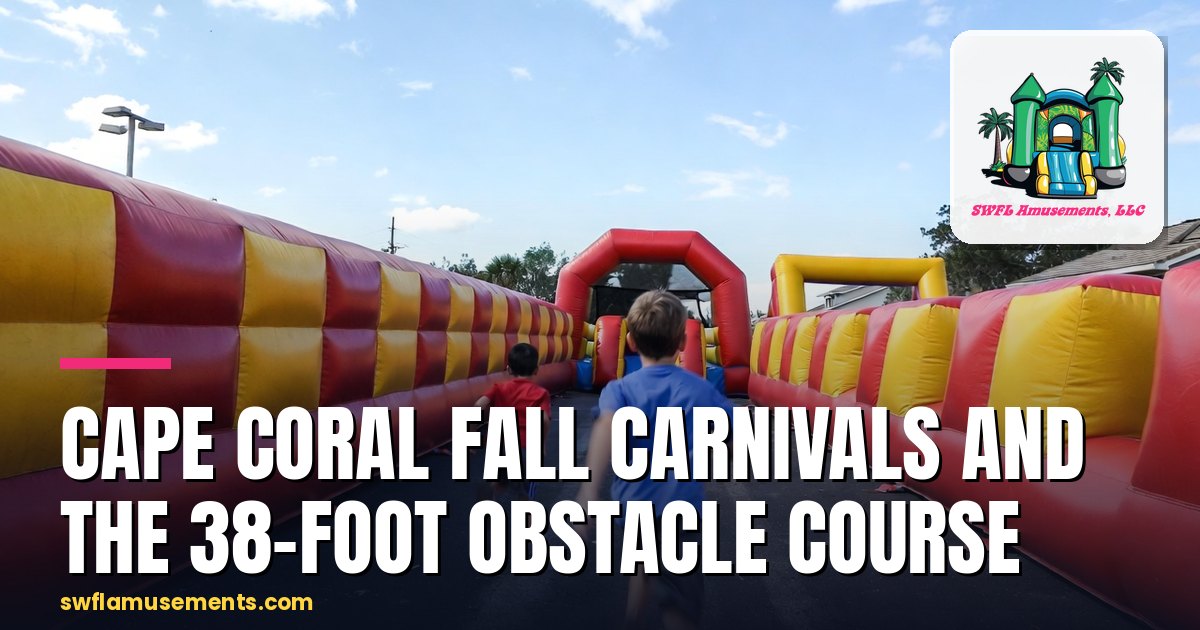
So this is a post about one specific unit on our trailer — the 38-foot Straight Shot obstacle course, $449 for an all-day rental with delivery, setup, and teardown included in Cape Coral. It is not our largest piece of equipment and it is not the one that ends up in the most photos. For a ticketed fall carnival it is the one I would put on the ground first, and the reason has very little to do with how it looks.
What the unit is, on paper
- Length: 38 feet, in a straight line. Not a loop, not a switchback.
- Lanes: two, side by side, which makes every pass a race.
- Obstacles: climb-overs, crawl-unders, and a slide at the exit end.
- Ages: all ages, with an eye on younger kids at the climbing sections.
- Price: $449 for an all-day rental, with free delivery, setup, and teardown in Cape Coral. Outside the city we quote delivery by distance.
- Power: a blower on a standard household circuit, running continuously the whole time the unit is up.
Inflated width and height I measure against your site rather than quote out of a catalog, because the number that decides a delivery is almost never the unit’s width. It is the width of whatever we have to get it through. More on that further down.
Dwell time versus passes
Here is the distinction I wish every festival chair had in their head before they picked up the phone.
A bounce house sells dwell time. A dozen kids climb in, they stay five or ten minutes, the parents get a break, and the attraction is doing its job precisely by holding a crowd in one place. That is exactly what you want at a birthday party in a back yard off Trafalgar, where there are twenty-two kids and the entire goal is three contained hours.
A straight obstacle course sells passes. Two kids in, half a minute, two kids out, next pair. Nobody dwells. The unit is a turnstile with padding on it.
At a ticketed carnival, passes are the product. You are not trying to gather a crowd — you already have one, and it is moving. Every attraction that holds people in place becomes a bottleneck in a floor plan that is already carrying a cake walk, a dunk tank, and a line for the pizza. The attractions that make a carnival run smoothly are the ones that eat a line rather than create one.
Running the number before you book
I spent a little over twenty years in the Air Force before this, and a good share of that was moving people and equipment through fixed points on a schedule. Then I spent a second career as a CFO, which I still do when I am not loading a trailer. Both jobs leave you with the same reflex: before you buy the thing, work out what one unit of output costs.
So here is the arithmetic on a 38-foot course, with my assumptions written down so you can argue with them.
A pair of kids clears 38 feet of climb-and-crawl in well under thirty seconds. The course itself is never the constraint. The constraint is the reset — clearing the finished pair off the exit, getting the next pair onto the start line, and dealing with the one kid who stops halfway to examine something. With an attendant who keeps it moving, a cycle of roughly a minute per heat is a fair planning figure. Two kids a heat, sixty heats an hour, and then take a real discount for volunteer staffing and for kids who want a second run.
I plan on 60 to 80 passes an hour. That is a budget number rather than a measured one, and I would rather be conservative on a figure a board is going to hold me to. Over a three-hour carnival it works out to roughly 180 to 240 passes. Against $449 for the day, that is somewhere between about $1.85 and $2.50 per pass before you count a single ticket.
Whether that math works is your call and not mine. But it is a number you can carry into a meeting, and if you drop your own ticket price into it you will know in about ten seconds whether the unit pays for itself or whether you are buying a loss leader on purpose. Both are legitimate decisions. Making the decision by accident is not.
Straight is a staffing choice, not a styling one
This is the single most useful thing I know about this particular unit, and it is the reason I will steer a school or a church toward a straight course over a flashier one nearly every time.
Stand at the midpoint of a 38-foot course and you can see the start line, every obstacle, and the slide exit without moving your feet. One adult covers the whole unit from one position. That same adult can hold a pair at the start, watch the crawl section, and call the next heat without turning around.
Now put that adult on a course with a tunnel, a turn, or a switchback. There is a section of the unit they cannot see. At a birthday party with eighteen guests and three attentive parents, that is manageable. At a school carnival, where the attraction is staffed by a volunteer who signed up for a forty-five minute shift and is also scanning the crowd for their own kid, a blind section is not a theoretical problem. It is the problem.
A straight course is not a safer inflatable than any other inflatable. It is an easier one to supervise with the staff you actually have, which in volunteer-run events is usually the thing that is in shortest supply. Our general supervision guidance applies to every unit we own, but guidance only does any work if somebody can see the kids it applies to.
Where 38 feet actually goes
A linear unit is easy to place and hard to squeeze. Call it 38 feet plus a few feet of working clearance at each end, so you are looking for somewhere around 45 feet of straight run. The width requirement is modest by comparison.
At a school that is a lane of blacktop or a strip of field along a fence line, and it is usually the simplest attraction on the entire floor plan to site. One detail catches people every year: you cannot stake into asphalt, a hardscaped courtyard, or pavers. Those setups get sandbag ballast instead. That is routine on our end, but we need to know before delivery day so the right ballast is on the trailer rather than back in the shop.
At a house, 45 feet of straight run is a side yard on a wider Cape lot, or more often the driveway. My business partner Chris is a surveyor by day, which turns out to be a genuinely useful thing to have in a bounce house company, and he wrote up the lot-fit side of obstacle courses in more detail than I would manage — including the gate-width measurement that strands more deliveries than any other single item.
Wherever it lands, the blower runs continuously, so we need a working exterior outlet within reach of the setup spot or a cord run somebody on site has signed off on. On a school campus that is usually a custodial decision, and the custodian is the person your event quietly depends on. Learn their name before the day rather than during it.
The mid-October squeeze
If you are reading this as a school volunteer, the calendar is working against you this month in a specific and predictable way.
The published 2026-27 Lee County school calendar puts the end of the first quarter on Friday, October 16, 2026, with Monday, October 19 as a professional duty day when students do not attend. Report cards land, and a Saturday-plus-Monday window opens up directly behind them. Confirm those dates with your own school before you build a plan on them, because individual campuses add their own events on top.
That window is the one a large share of the fall events in this county are aiming at. First-quarter celebrations, PTO fundraisers, church festivals, and every organization that has been waiting for the school calendar to breathe all converge on the same two or three Saturdays. We are a small company with a finite number of units and two owners who load their own equipment, which means mid-October Saturdays are the first dates to close out on our board every year.
None of that is a sales pitch. It is a scheduling fact, and it cuts both ways: if your date sits inside that window, lock it early and sort the smaller details later. If your date is flexible, the Saturday after is materially easier to book.
Who should skip this unit
Two groups, and I would rather say so here than on delivery day.
If your crowd skews heavily under six, a 38-foot course with climb-overs is the wrong purchase. Small kids stall at the climbing sections, the lane backs up behind them, and you have rented a turnstile that does not turn. For that crowd the Little Kids Bounce & Slide Combo at $99 is built for ages one to five and does the job the course cannot. At a mixed-age carnival, running both is the better plan: the course takes the six-and-up line, the toddler unit keeps the little ones out of that line entirely, and the pair comes in under $550 before tax.
And if the only open space you have is wide rather than long — a square patch of lawn, an interior courtyard, the bulb of a cul-de-sac — a linear unit is a poor fit. I would rather tell you that on the phone than after the truck is loaded.
If you have a fall event on the calendar and a stretch of blacktop or lawn you are not sure about, call (239) 212-0011 with a rough length and a rough width and I will tell you in one conversation whether 38 feet works where you want to put it.
About the author
Gabriel Denny — Co-owner, SWFL Amusements LLC
Gabe is co-owner of SWFL Amusements. He spent 20+ years in the Air Force, first enlisting after high school before commissioning and retiring as a Major. He is a 5x CFO, which he continues to do when not working bounce houses. He lives in NW Cape Coral and answers the company phone himself, including at 2am.