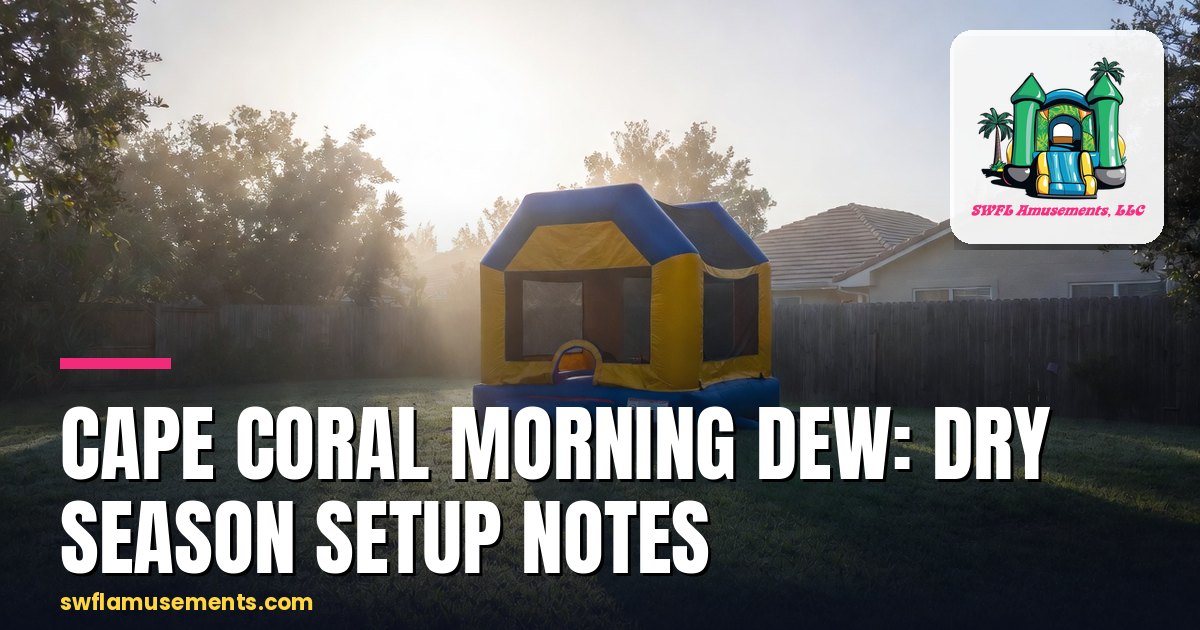
Here is something it took me two cool seasons to stop being surprised by. In July I set up on a Cape Coral lawn the morning after a thunderstorm and the grass is damp. In November I set up on that same lawn after three weeks without a drop of rain and the grass is soaking.
Not damp. Soaking — wet through my shoes by the time we have the unit laid out, and one of my boys is already wiping down the floor before anybody is allowed on it.
That is not one odd yard. It is what dry season does in Southwest Florida, and it runs backwards from what the name suggests. The rain stops and the mornings get wetter. If you have a party on grass between now and March, this is the one local condition most worth planning around, and almost nobody brings it up.
The numbers behind the season change
Start with rainfall, because that part behaves the way you would expect. These are the NOAA 1991–2020 climate normals for Fort Myers at Page Field, the closest long-record station to Cape Coral, as published by the Florida Climate Center at FSU:
- October: 3.08 inches of rain, average high 86.6°F, average low 69.4°F
- November: 1.78 inches of rain, average high 81.3°F, average low 61.8°F
- December: 1.90 inches of rain, average high 77.3°F, average low 57.3°F
Rain drops about 42 percent from October to November. The afternoon gives up roughly five degrees. The morning gives up almost eight, and that last figure is the one that decides what your yard looks like at eight on a Saturday.
Why a dry month produces wet grass
The National Weather Service states the mechanism in one line: "Dew forms when the temperature becomes equal to the dewpoint." The ground gets there first, because it sheds heat upward all night, and the NWS lists what has to line up for a heavy dew. Clear skies, because they "allow for the maximum release of longwave radiation to space." Light wind, because it "prevents the mixing of air right at the surface with drier air aloft." Moisture in the soil. And a small gap between the air temperature and the dew point.
Now put our two seasons against that list.
In August the sky is full of cloud most nights, the low sits near 75, and the clouds radiate heat back down at the ground so it never cools far enough. Plenty of humidity, no dew worth mentioning. In November the fronts start pushing the cloud out, the wind lies down after midnight, the Gulf is still warm enough that dew points stay up in the 60s for much of the month — and the overnight low falls to about 62. The gap closes. The grass reaches its dew point and water condenses straight onto it.
So dry season is not dry at ground level overnight. It is the wettest the grass gets all year. The difference is that in summer the water falls out of the sky in the afternoon and in winter it forms on the blade before dawn.
What that does to an inflatable
Four things, in the order they show up:
The floor picks up water from both sides. Dew settles on the top surface of the vinyl at the same time the underside is sitting on wet turf. Wet vinyl under socks is slick, and slick is the condition behind most of the minor spills I see. We towel the floor at setup and again before the first group goes on, and I would rather a parent know that is part of the job than wonder why we are standing around with rags. If you have not read it, the short version of the rest is on our bounce house safety page.
The grass under the unit stops drying. Once a 15-by-15 footprint is laid down, that patch is in shade for the rest of the day. The open lawn beside it will be dry by ten. Underneath, it stays as wet as it was at seven.
Everything else you staged early is wet too. Tables and chairs carried out at eight in the morning need a wipe at eleven, and a tablecloth put on early is a lost tablecloth. If you are renting tables and chairs with the unit, set the hardware out early and the linens out late.
A unit folded wet has to be opened and dried. That one is our problem rather than yours, but it is the reason we do not leave inflatables standing overnight in cool season, and the reason a Sunday morning pickup on a Saturday party is a conversation rather than an automatic yes.
The timing adjustment, which is small
None of this argues against a November party. November is the best month of the year to put twenty-five people in a Cape Coral back yard. It argues for moving four decisions:
- Start at eleven, not nine. By mid-morning the sun has taken the dew off open turf. Eleven to two is the clean window in November, and it has the side benefit of landing inside the warmest part of a day whose average high is 81.
- Put the unit in the sun, not the shade. This is the exact opposite of the July rule, and it catches people who planned a summer party at the same address. In June you hunt for shade because the vinyl gets hot. In November shade is where the dew stays past noon. Walk out at nine and look at where the sun has already hit; that is your spot.
- Shut off the irrigation for one cycle. Dew you cannot do anything about. A zone that runs at four in the morning the night before the party is a choice, and it doubles the problem. Skip that one cycle. The lawn will survive a week in dry season.
- If the only open ground is the driveway, take the driveway. Concrete sheds dew in minutes; St. Augustine holds it for hours. A driveway setup is anchored with sandbag ballast instead of stakes, which is routine and does not change the price. Tell me when you book so we load for it rather than find out in the street.
The part that happens before we get to you
The same physics produces the other dry-season feature nobody plans for. The NWS forecast office in Miami is direct about it: "The main period for fog formation in South Florida is from late Fall to early Spring," and when radiation fog forms it tends to show up over the Everglades and the southwest Florida coast. That is us by name, not a general Florida caution.
Which means a seven-in-the-morning delivery in November is a different drive than the same delivery in July. Towing a trailer on a two-lane road in fog is slow, and the honest answer is that we build the slower number into the schedule instead of discovering it. Twenty years in the Air Force leaves you with a weather brief before the mission rather than an explanation after it, and the CFO half of my brain adds the other half of that habit: when a variable is outside your control, schedule it at the longer number and keep the slack. It is why the early stop on a winter Saturday gets a wider window than the math strictly needs.
The practical version for you: if your party is the first setup of the day and the forecast has fog in it, we may land closer to the back of your delivery window than the front. That is built in, not a surprise, and it has never cost anybody a start time.
What I cannot tell you
I do not have a drying time for your yard. Nobody does. It depends on exposure, how much canopy is over it, which way the lot faces, how deep the thatch is in the St. Augustine, and whether the irrigation ran. I know the direction — open sun beats shade, eleven beats nine, concrete beats turf — but I am not going to hand you a number of minutes I made up.
What I can tell you is that you can measure your own yard for free this weekend. Walk out at eight, then again at ten, and look at the same patch of grass both times. Whatever you see is roughly what we will be setting up on. If what you see makes you want to move the unit or move the start time, call or text me at (239) 212-0011 and tell me what the yard did. That one observation changes where the unit goes more often than anything else a customer tells me.
About the author
Gabriel Denny — Owner, SWFL Amusements LLC
Gabe owns SWFL Amusements. He spent 20+ years in the Air Force, first enlisting after high school before commissioning and retiring as a Major. He is a 5x CFO, which he continues to do when not working bounce houses. He lives in NW Cape Coral, runs events with his two sons, and answers the company phone himself, including at 2am.