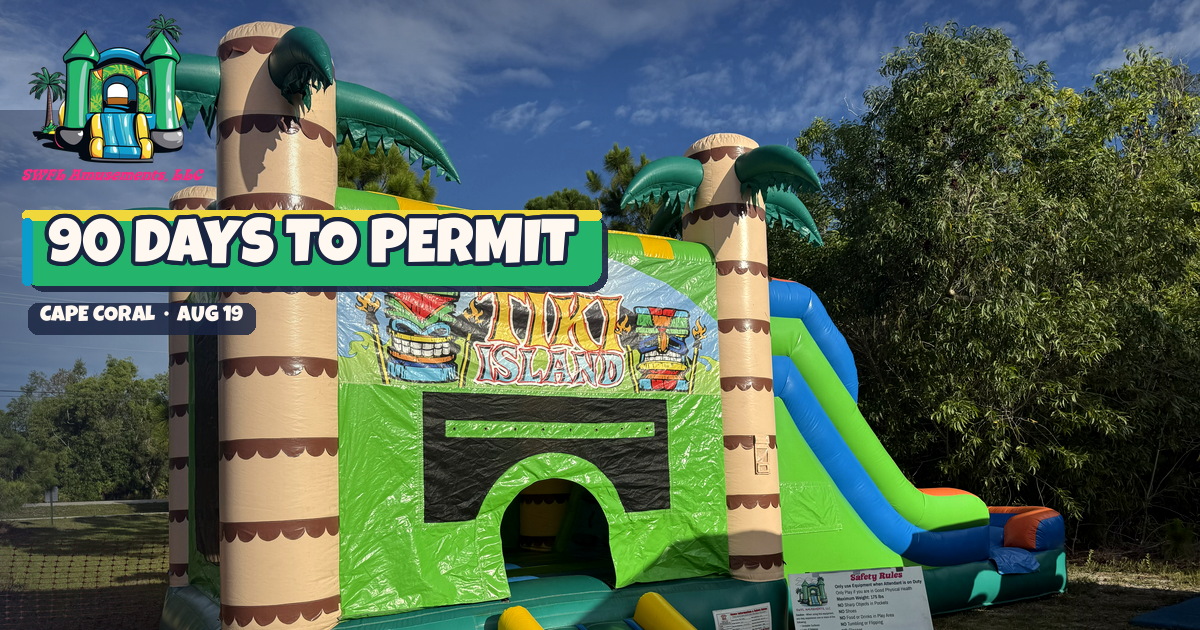
Today is August 19. If your church, your HOA, your booster club, or your civic group is putting something on the calendar for the third week of November or later, the City of Cape Coral would like to hear from you roughly now. The Special Event Permit Application is supposed to be submitted 90 days before the event date. Ninety days from today is November 17.
That is the entire reason I am writing this in August instead of October. Every fall we take calls from good people running real community events — a festival at a church off Chiquita, a veterans breakfast, an HOA holiday thing at a clubhouse — who have the volunteers lined up, the food handled, the inflatable picked out, and no permit. Some of those events go forward anyway because they are small and on private property. Some do not, and watching a volunteer board find that out in week two of October is not something I enjoy.
Ninety days is a coordination number, not a stalling tactic
I spent more than twenty years in the Air Force, enlisting out of high school and retiring as a major, and most of that career ran on planning cycles. Here is the thing I wish more volunteer organizers understood: a lead-time requirement is almost never about the person reviewing your form. It is about how long it takes several departments that do not report to each other to look at the same piece of paper and sign it.
A Cape Coral special event permit gets routed to every pertinent department in the city. Police look at traffic and crowd. Fire looks at access lanes and cooking. Public works looks at the right-of-way. Risk management looks at your certificate of insurance. The city notes that very large or complex events may also require a meeting with the Special Events Committee before the event date to confirm logistics. None of that happens in a week, and none of it happens faster because you are a nonprofit with good intentions. The staff work is real, and ninety days is what the city has decided that coordination costs.
What the city actually asks for
The permit package is not one form. It is one application plus whatever subset of five attachments applies to your event. Working from the city's own Special Event Permit Process page:
- Special Event Permit Application. Submitted through the EnerGov Citizen Self-Service portal. The city describes this as the form for events with more than 500 participants in the venue, and lists a $40 processing fee.
- Special Event Permit Checklist. The city's own list of every document a complete package needs. Print it and work it like the checklist it is.
- Food & Cooking Notice. Required for any event that involves cooking at the event location. The city specifically suggests you keep a copy to hand out to your food vendors so the proper fire extinguishers are actually on site. That sentence is doing more work than it looks like.
- Use of Private Property Authorization. Required for any event on private property, and it has to be signed by the property owner. If your festival is in a church lot, a plaza, or a business parking lot, this is your form.
- Police Detail Application (form F-49). Required for any event that requires police presence.
- Special Event Signature Survey. This is the one that surprises people. Special events in Cape Coral require notice and sign-off from residents and businesses affected by the event. You are going door to door.
Read that last item again if you are planning something on a residential street. The signature survey is not a formality you knock out the night before. It is a canvassing job, and on a block with any number of absentee owners it can eat two weekends. Build it into the ninety days rather than discovering it on day eighty.
The insurance sentence people misread
Event insurance for events on city property is required. Not suggested — required. The city wants an ACORD certificate carrying four specific items: the name of the event, the location, the time and date, and the City of Cape Coral named as additional insured. Send those four things to your insurance agent in one message and the certificate usually comes back correct the first time. Leave one out and you will be doing it twice, which on a ninety-day clock is a week you did not budget.
For events not on city property, the city says event insurance is not required but is recommended. I will put it more plainly than a municipal web page can: get the policy. A one-day event policy for a community festival is a small number next to what an all-volunteer board is exposed to without one.
Separate point, and it comes up on nearly every call we take from a nonprofit. Our insurance is not your insurance. SWFL Amusements carries its own commercial general liability coverage on the equipment and the crew, and we will issue a certificate naming your organization or your venue whenever you ask. That certificate covers our operation. It does not cover your bake sale, your parking plan, or the volunteer who put up his own canopy. Two different pieces of paper, and the city may want to see both.
Where the inflatable can actually go
This is where Cape Coral trips up organizers who assume a public park is the easy option. City parks here do not allow inflatable rentals. We laid out the exact rule and where it comes from separately, but the short version is that reserving a pavilion at a city park does not buy you the right to set a bounce house next to it.
What that means in practice is that most community events in this city land on private property with a signed authorization form — a church lot, a school campus, a plaza, an HOA clubhouse with its own grounds. That is a solvable problem. It is also a dependency, because the property owner's signature has to exist before your package is complete. Solve it at day ninety, not day twenty.
A backwards plan from the event date
Here is how I would sequence it. The military calls this a backwards plan and it is the single most useful habit I brought out of that career into this one.
- T-120, four months out. Call the Special Events Division. Confirm which forms actually apply to your event so you are not filling out three you do not need. Get the venue verbally committed.
- T-110. Use of Private Property Authorization signed by the owner. This is a signature from a human being with a calendar, so give it real time.
- T-105. Insurance quote requested, with the four ACORD items in the first email.
- T-100. Signature survey started. This is the long pole in the tent.
- T-90. Application submitted with the $40 processing fee. This is the city's stated deadline, and you want to hit it with a complete package rather than a partial one plus a promise.
- T-60. Equipment reserved. Fall Saturdays in Cape Coral book early, and the last two weekends of October are the tightest of our year.
- T-14. Food and cooking notice copies distributed to vendors. Confirm the police detail if one was required.
- T-3. Site walk. Measure the footprint you were promised rather than the one on the site plan. These are not always the same shape.
If you are reading this on the day it published and your event is November 17, you are at T-90 right now with none of the earlier steps done. That is recoverable, but it means the phone call to the city happens today rather than after the next board meeting.
The budget side, since somebody has to say it
I have been a CFO five times over and I still do this job with a spreadsheet open, so here is the arithmetic I give volunteer boards.
A community festival inflatable is not priced per child. The number that matters to your board is cost divided by attendance. Our Classic Castle bounce house runs $199. The 24-foot World's Largest Twister mat is $399. The Giant Corn Maze is $499. Put the corn maze in front of 400 people at a fall festival and the entertainment line is $1.25 per head. Put the same unit at a 60-person church picnic and it is $8.32. Neither number is wrong. They are answers to different questions, and the question your board should be arguing about is which kind of event this actually is.
The other line item volunteer organizers routinely miss: the $40 permit processing fee is the smallest number in the whole package. A police detail, if your event requires one, is not. Ask the city early what your event is likely to need. A police detail quote landing at day thirty has wrecked more community event budgets than any rental invoice ever has.
Who to call first
The Special Events Division sits on the second floor of Cape Coral City Hall at 1015 Cultural Park Boulevard. Their published contact is [email protected] and (239) 573-3123. Call before you fill anything out. The fastest path through any permitting process I have ever dealt with is a five-minute conversation at the front end that establishes which forms apply to you, followed by completing only those.
One honest note about the city's own page, because you will hit it too. The top of it states that all organizers who wish to conduct a special event must apply for a permit, while the application itself is described as the form for events with more than 500 participants in the venue. Those two sentences do not obviously agree, and I am not going to guess on your behalf. A 120-person fall festival in a church parking lot is exactly the case where the answer is worth a phone call instead of an assumption.
If you sit on a volunteer board and you are trying to work out what an inflatable does to your event budget before you commit to a date, call (239) 212-0011 and ask for Gabe. I will run the per-head math with you on the phone. Five minutes, no charge, and you can take the number back to your board with a straight face.
About the author
Gabriel Denny — Co-owner, SWFL Amusements LLC
Gabe is co-owner of SWFL Amusements. He spent 20+ years in the Air Force, first enlisting after high school before commissioning and retiring as a Major. He is a 5x CFO, which he continues to do when not working bounce houses. He lives in NW Cape Coral and answers the company phone himself, including at 2am.