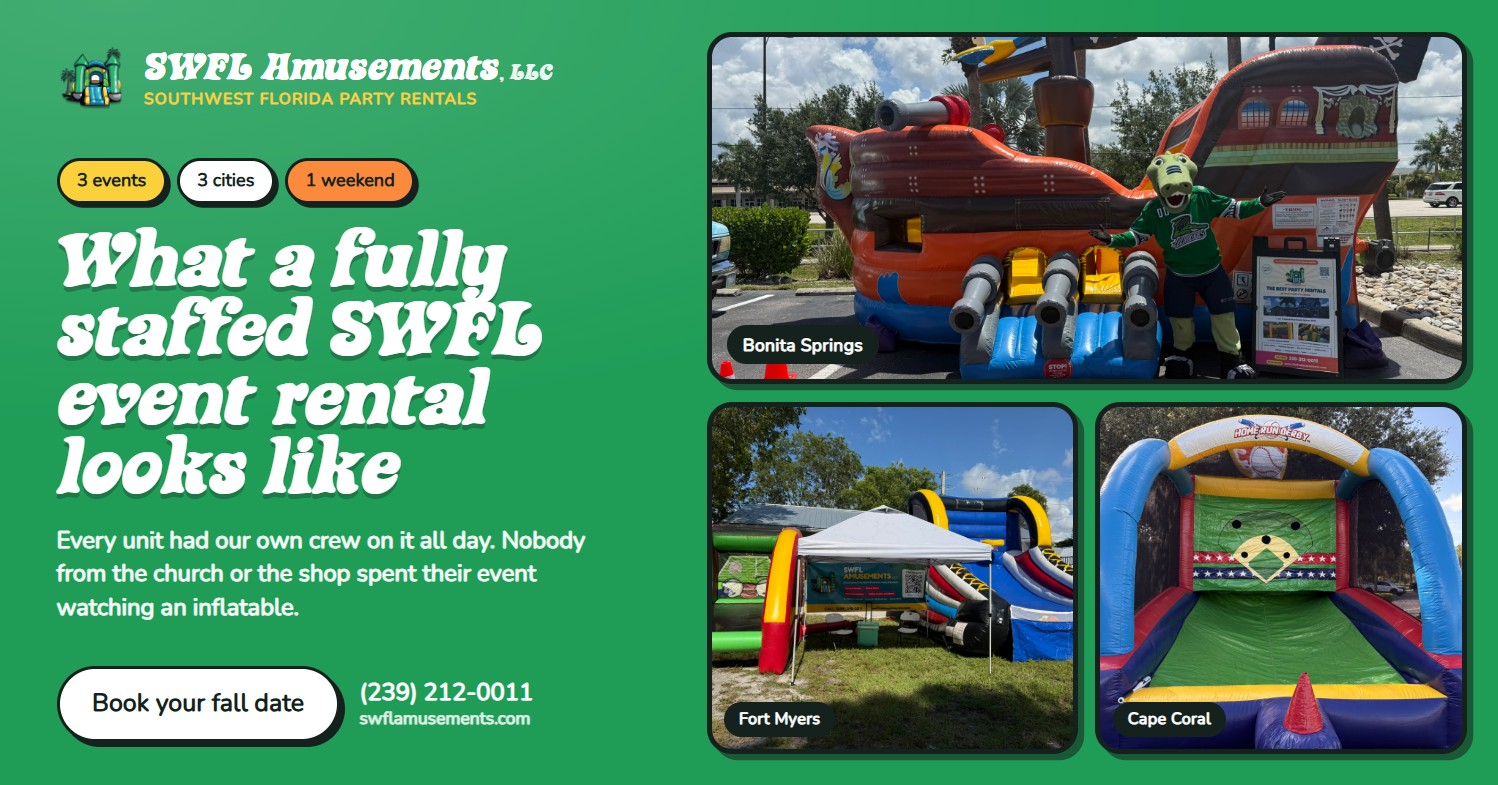
This past weekend we ran three events in three different cities. Grace Church's Cape Coral campus on SE 21st Place. Grace Church's Fort Myers campus. And Beards and Brews, the barbershop on South Tamiami Trail in Bonita Springs. Roughly thirty miles from the northernmost setup to the southernmost, which in Southwest Florida on a Saturday means you are not moving a crew between them casually. Each one got its own staffed team for the length of the event.
I want to write about that weekend, but not as a highlight reel. I want to write about the specific thing that made it work, because it is the thing most people do not think to ask a rental company about until after they have already booked one.
Nobody from those three organizations spent their event watching an inflatable.
The drop-and-go problem
Here is the model that dominates this industry. A truck arrives, a crew sets up the unit, someone hands the organizer a clipboard, and the truck leaves. It comes back at the end of the day. In between, the inflatable is your problem.
That sounds fine on paper. In practice it quietly converts one of your people into an attendant for the entire event.
Somebody has to stand at that unit. Somebody has to count how many kids are inside, pull the ten-year-old out of the toddler section, tell the kid with the shoes on to take his shoes off, notice when a stake works loose, watch the sky, and decide whether that gust was the kind of gust that means you shut it down. That is not a job you can rotate a different volunteer through every twenty minutes and expect consistency. It is a real job, and if the rental company does not fill it, you do.
At a church event, the person who ends up filling it is almost never someone with a free morning. It is a volunteer who was supposed to be greeting, or running the check-in table, or leading something. At a business event like the one at Beards and Brews, it is an owner or a manager who is now standing in a parking lot instead of talking to the customers who came out to see them.
That is the cost, and it does not show up on the invoice. Which is exactly why it is easy to miss when you are comparing two quotes and one of them is sixty dollars cheaper.
What our crew is actually doing out there
People sometimes assume “staffed” means someone sitting in a folding chair near the unit. It is more active than that, and after enough events you learn what to watch.
- Sorting riders by size, not by age. Age is a proxy and it is a bad one. A large seven-year-old and a small eleven-year-old belong in different rotations, and the person making that call has to make it in about two seconds without embarrassing anybody.
- Managing the line, not just the unit. Most of what goes wrong at a busy event happens in the queue, not inside the inflatable. Kids in a line in August sun are a heat problem before they are anything else.
- Anchoring to the actual surface. This is the part my day job makes me particular about. A church lawn takes stakes. A barbershop parking lot does not, and anyone who tries to drive a stake into asphalt is telling you something about how they operate. Ballast on hard surfaces, staked on turf, and the weight is not a guess.
- Watching the weather honestly. Manufacturer guidance on most inflatables puts the shutdown threshold at around 15 to 25 mph sustained wind depending on the unit. In August here, the call that matters more is the storm cell that builds over the Gulf and moves inland in the afternoon. Somebody has to be watching radar and be willing to be the one who says the ride is closed for twenty minutes.
- Load and power. Blowers draw real current. Running two units off one 20-amp circuit at a facility that was not wired for it is how you find out where the breaker panel is, in front of everybody.
None of that is glamorous. All of it is the difference between an event where the inflatable was a feature and an event where the inflatable was a distraction.
Three sites, three different problems
The reason a weekend like this one is worth writing about is that no two of those venues presented the same problem.
A church campus event has a known audience and a brutal arrival curve. Everybody shows up inside about a twenty-minute window after a service lets out, which means the line at the inflatable goes from nothing to its maximum almost instantly and then decays over the next hour. You staff for the peak, not the average. You also put the entrance to the line somewhere that does not cut across the path people naturally take from the doors to the parking lot, or you spend the morning untangling foot traffic.
Running two campuses of the same church on the same weekend adds a wrinkle that has nothing to do with equipment: consistency. If one campus gets a sharp setup and the other gets a thrown-together one, the church absolutely notices, because those are the same staff comparing notes on Monday. Two separate crews, one standard.
A business event like the one at Beards and Brews is the opposite shape. Traffic trickles in across the entire window instead of arriving in a wave, and a real share of the people who stop are walk-ups who had no idea anything was happening until they drove past. So the layout question flips: you want visibility from the road, and you want safe separation from moving cars, and on a stretch of South Tamiami Trail those two goals pull directly against each other. That is a surface-and-sightlines problem. It happens to be the kind I am comfortable with, since measuring what actually fits inside a given envelope is what I do the other five days of the week.
The half of the business people do not know about
The other thing that came up more than once last weekend: organizers were surprised we could handle more than the inflatables.
We have spent a few years building a network of people we actually trust in this market — DJs, food trucks, face painters, and entertainers — plus the equipment side we own outright, including PA speakers and wireless microphones and specialty attractions beyond the standard inflatable lineup.
The practical value there is not variety for its own sake. It is that you make one call instead of six, and one person is accountable for how the pieces fit together. Six separate vendors means six arrival windows, six points of contact, six people who each assumed somebody else was bringing power, and one organizer standing in a parking lot at 8 a.m. trying to reach a DJ who is not answering.
When we coordinate it, the load-in order is planned. The food truck is not parked where the generator noise sits on top of the sound system. The face painter is in shade, because a face painter in direct August sun in Southwest Florida will lose half her line by 11 a.m. Small things, but they are the things that decide whether the day feels organized.
I will also say the unglamorous part: sometimes the right answer is that you do not need the thing you called about. We have talked organizers out of a second inflatable more than once when what their layout actually needed was more shade and a second entrance to the line. Telling a customer to spend less is not a sales tactic, it is just what happens when the person on the phone has stood at these events.
Why this matters more in the next ninety days
The calendar is about to get dense. Lee County students return August 11. Fall festival season at churches and schools runs from roughly late September into early November, and it is concentrated into a handful of Saturdays. Trunk-or-treats stack onto the same three or four weekends every year.
What that means practically is that the weekends fill from the outside in, and staffed weekends fill first, because crew is the constraint. Equipment sitting in a warehouse is not the limiting factor. People are.
So if your church, school, HOA, or business is planning something for the fall and you have any expectation of a real crowd, the useful move is to get the date on a calendar now and figure out the details later. We can adjust units, add vendors, and change layout well into the month before. What we cannot do is manufacture a crew for a Saturday that is already committed.
If you are putting together a fall event anywhere from Cape Coral down through Bonita Springs and you would rather spend the day running your event than running an inflatable, call (239) 212-0011 and tell us what you are trying to pull off. If it needs more than what we own, we probably know who does it.
About the author
Christopher Johnson — Co-owner, SWFL Amusements LLC
Chris is co-owner of SWFL Amusements and a professional surveyor by day. He spends his working hours mapping Southwest Florida properties, which means he knows the canal-front quirks, the older Cape circuit grid, and which intersections back up during snowbird season. He proudly lives in Cape Coral, where he was born and raised.