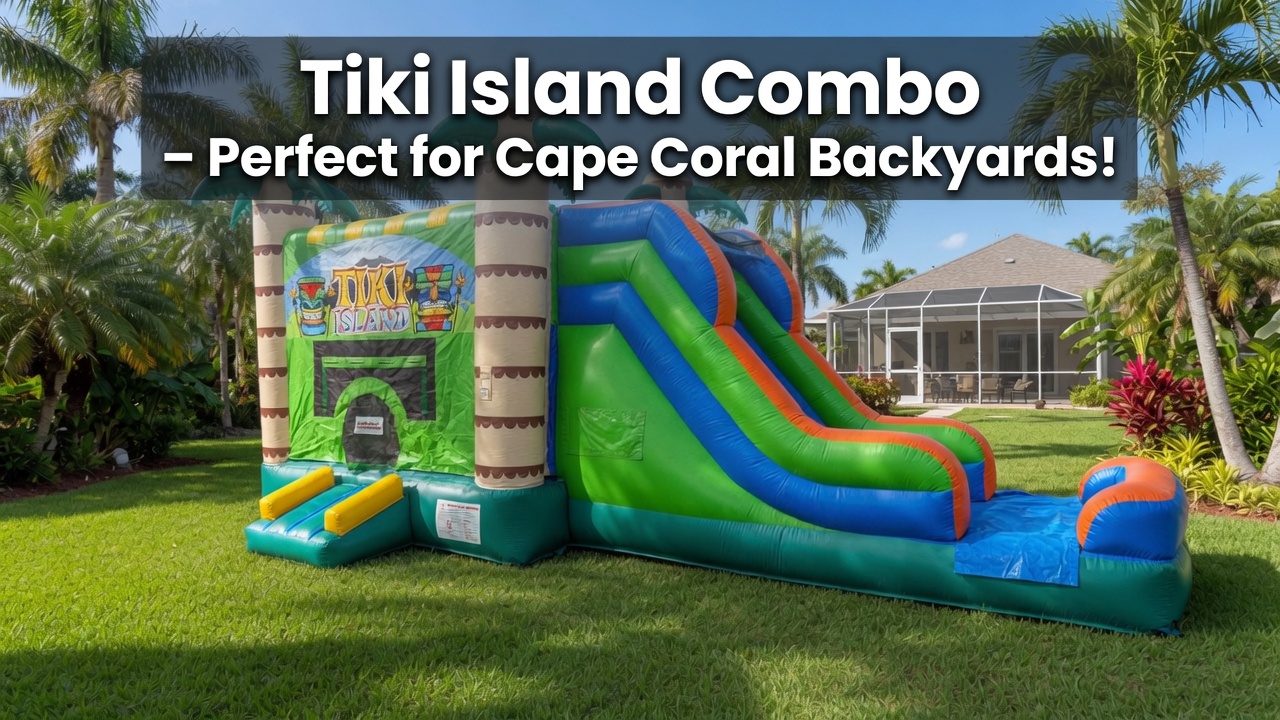
Most of our June and July bookings have one question in common: which combo unit do we own that handles both the heat and the lot. The answer for a lot of those bookings is the Tiki Island. It is the unit we are taking to Mango Mania on Pine Island on Saturday July 11, which I will get to at the end, and it is the combo unit I quote most often for Cape Coral and Fort Myers backyards once school is out. This post is a closer look at the unit from the surveyor side — what it actually measures, how the wet setup works, and where it fits on a standard Cape Coral lot.
The specs, before anything else
| Footprint | 15 feet wide × 27 feet long |
| Setup space needed | Add 3 feet of clearance on every side — so plan for 21 by 33 of clear ground |
| Configuration | Combo unit — bounce floor on the front half, climb-wall on the inside, slide on the back half |
| Wet or dry | Both. Slide is rigged for a garden-hose connection if you want it wet |
| Theme | Tropical — palm trees, tiki masks, beach-vibe graphics |
| Power | One standard 20-amp outlet within 50 feet |
| All-day rental | $399 with free delivery, setup, and teardown to Cape Coral; call for delivery pricing outside Cape Coral |
| Product page | tiki_island.php |
What this unit actually is
Tiki Island is a bounce-and-slide combo, not a straight bounce house. The 15-foot-wide footprint is split: roughly the front 12 feet is the bounce area — an enclosed bouncing chamber with mesh walls so the parents can see in — and the back roughly 15 feet steps up into a climb wall, over the top, and down a slide that comes out the side. The whole thing reads as one unit visually because the canopy ties it together, but from a kid's point of view it is two activities, which is the entire reason it works for a longer party than a plain bounce house does.
A plain 15-by-15 bounce house is great for an hour. After that, kids cycle off and the unit sits empty until the next wave shows up. A combo with a slide on it keeps a rotation going — the kids who got tired of bouncing climb the wall, hit the slide, run around to the door, and start over. On a four-hour booking that is the difference between a unit that earns its keep and a unit that becomes furniture by lunch.
Wet versus dry — what the conversion actually involves
The slide on the Tiki Island has a hose hookup near the top of the slide platform. Hook a standard garden hose to it, turn the water on at the spigot, and the slide runs as a water slide. There is a small splash pool at the base — not a swimming pool, more of a 4-by-6 catch area — that collects the runoff.
A few things are worth knowing before you decide wet or dry:
- Wet does not mean swimsuit-only. Plenty of families run it wet and let the kids wear what they wore over. T-shirt and shorts that can get soaked is fine. The slide is fast, not deep.
- The bounce side stays dry. The water is on the slide only. If a kid runs out of the slide and goes back into the bounce area without drying off, you get a slippery bounce floor, and we will close the bounce side until it dries out. The kids figure this out about ten minutes in.
- Water adds about 10 minutes to the setup window. We run the hose, check the spray pattern, check the splash-pool drain, and confirm the spigot pressure is enough. On a city-water Cape Coral lot it is almost always fine. On a well-water older Cape lot we sometimes get a pressure drop — not a problem, but worth knowing if your house is original construction from the 60s or 70s.
- The catch pool drains to the lawn. So position matters. We will not aim the drain at a sidewalk, a patio that pools, or your neighbor's property line. On most Cape lots there is an obvious downhill direction and we send it there.
The lot-fit question
This is the question that wins or loses the booking. A standard Cape Coral residential lot is 80 feet wide by 125 feet deep — a 10,000 square foot lot, which is what most of the older Cape grid sits on. The house takes about 50 feet of width and 50 to 60 feet of depth, depending on how it is set on the lot. That leaves you something like 35 to 45 feet of back yard depth and a narrow strip on each side.
For a 15-by-27 footprint with the recommended 3-foot clearance on each side, you need a clear rectangle of 21 by 33 feet. On almost every standard Cape lot, the back yard accommodates that with room to spare. Where it gets tight is on the lots where the screened pool cage eats the back yard depth — common in the SW Cape and on the Yacht Club side. On a pool-cage lot, the usable back yard between the cage and the rear setback can be as little as 15 to 20 feet deep, which does not fit the Tiki Island long axis.
Two things to check on your own lot before you book:
- Pull a tape from the back of the screen cage (or back of the house if no cage) to the rear property line. You need 33 feet. If you have it, the unit fits length-wise in the back yard. If you do not, jump to step two.
- Check the side yard or the driveway as a fallback. A standard Cape lot has roughly 15 feet of side yard on the wider side. A driveway on a Cape Coral home is typically 18 to 22 feet wide and 30 to 40 feet long — which is the right shape for the Tiki Island, just oriented differently. If we set up on the driveway we use sandbags instead of stakes and the unit performs identically, with the small caveat that the kids should wear water shoes on the wet setup so they are not running on hot asphalt between the slide and the bounce door.
If you want a real-world version of the side-yard-versus-driveway decision, I wrote about it in detail two days ago in the Cape Coral lot-placement walkthrough. Same logic applies, slightly bigger unit.
Shade timing in mid-summer
I wrote a few days back about how hot the vinyl on a bounce house gets in June and July sun — surface temps 30 to 40 degrees above the air. The Tiki Island helps on this in two ways. First, the slide-and-splash setup means the kids are cycling through water every couple of minutes, which keeps the body temperature in check even when the air is 92. Second, the canopy over the bounce area shades the bounce floor and the climb wall, so the two surfaces the kids spend the most time on stay closer to ambient.
That said: the slide itself is exposed. A 12 PM start in direct sun in June, the slide vinyl will be hot to the touch. Two ways to handle this:
- Position the slide on the east side of the unit. By 2 PM the slide is in the house's afternoon shade and the temperature drops noticeably. We will set the unit this way by default in June and July unless your yard layout will not allow it.
- Run it wet from the start. Wet vinyl reads cool to the touch even in full sun. If you are on the fence about wet versus dry in July, my vote is wet every time.
Where the Tiki Island works best
I quote this unit most often for these:
- Mid-June through August birthday parties. Cape Coral, Fort Myers, Lehigh, Estero. Heat is the constraint and wet-capable beats dry-only.
- Multi-age family parties. The bounce side works for the under-6 crowd, the slide works for everyone over 6, and the parents have a single unit to keep eyes on rather than two units in two parts of the yard.
- Tropical or beach or luau themes. The graphics actually match instead of clashing — you do not have to drape a princess castle in tiki-bar streamers.
- HOA pool parties. A lot of Cape Coral and Estero HOAs have a clubhouse with a pool deck and a small grass area. The Tiki Island fits the grass area on most of them and ties thematically to the pool already being there.
Where it is the wrong unit:
- Pool-cage backyards with under 33 feet of cage-to-fence depth. The footprint does not fit and the driveway is the only alternative. Workable, but if the customer wants the unit in the back yard specifically, I will quote the smaller 15-by-15 standalone bounce house instead.
- Indoor venues. The Tiki Island stands tall — the climb-wall and canopy push it over 12 feet at the high point — and almost no Cape Coral or Fort Myers indoor venue ceiling clears that. Indoor parties get a different unit.
- Toddler-only parties. The slide is graded for ages 5 and up. For an under-5 birthday I quote the toddler bounce house instead, which is gentler and lower.
Coming up: Mango Mania, Pine Island, July 11
The Tiki Island is one of the two units we are running at Mango Mania 2026 — the Greater Pine Island Chamber of Commerce's annual tropical fruit fair at the Winn Dixie Plaza, 9940 Stringfellow Road in St. James City. Saturday July 11, 9 AM to 5 PM. The Tiki Island theme matches the fair's theme almost too well, which is part of the reason it is going. If you are bringing your kids over the bridge for the fair, this is your chance to see the unit in person before you book it for a summer party. Walk up to the kids' zone, watch the unit run for ten minutes, then call me about your own date.
If you have a date in mind already and want to talk through whether the Tiki Island fits your specific lot, the product page is at tiki_island.php and the booking page is swfl-booking.php. Or call (239) 212-0011 and ask for Chris — I will walk through your yard on Google Maps with you and tell you whether the long axis fits before we book anything.
About the author
Christopher Johnson — Co-owner, SWFL Amusements LLC
Chris is co-owner of SWFL Amusements and a professional surveyor by day. He spends his working hours mapping Southwest Florida properties, which means he knows the canal-front quirks, the older Cape circuit grid, and which intersections back up during snowbird season. He proudly lives in Cape Coral, where he was born and raised.