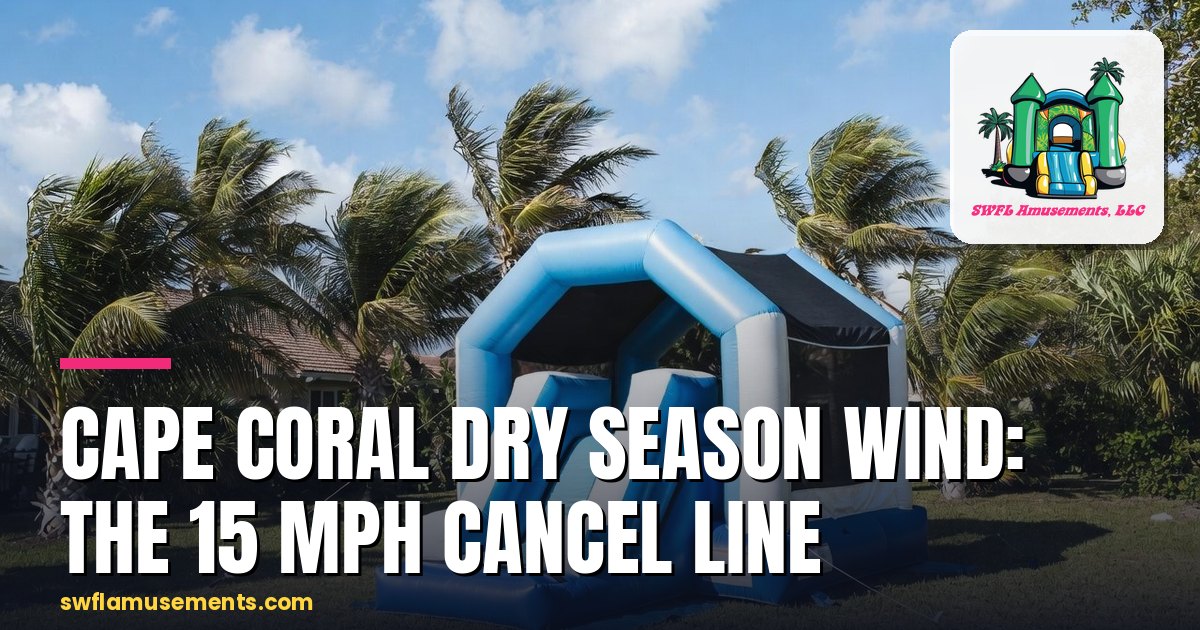
The call I least like making happens on a Saturday morning in February. The sky over Cape Coral is the blue that sells postcards. There is not a cloud between here and Sanibel, nothing on radar anywhere in the state, and I am on the phone telling somebody their bounce house is not going up today.
No rain. No thunder. Just wind.
Most people who have lived here a few years have the summer version of a weather cancellation figured out. June through September, when we call off a setup, you can see the reason coming. There is a wall of gray over Pine Island, the radar is lit up, the first fat drops hit the driveway while we are still talking. Nobody argues with that. Dry season does not give you the courtesy of a visual. The number that stops the setup is the same number either way, and in December through April it arrives on a day that looks ideal in every photograph you would take of it.
So: that number, where it comes from, and what to do with it.
What our agreement actually says, and when it says it
This is not judgment made up in the moment. It is written into our terms of service, and the mechanics matter as much as the threshold.
We use the National Weather Service hourly forecast for the venue zip code, from forecast.weather.gov. We look at it at 7:00 AM local time on the day of the event — not the night before, not three days out. Two things in that forecast cancel an outdoor setup: thunderstorms during your scheduled window, or sustained winds greater than 15 MPH.
If that trigger hits and you have no approved indoor location, the event is cancelled and you get a refund of 25 percent of the contract price. If you do have an indoor location, the event goes forward and we bring as much of the contracted equipment as that space can safely hold. Once an event is running, a separate rule takes over: lightning inside five miles, or high wind or rain at the site, and we suspend operation on the spot. Lightning has to stay out of the area a full 30 minutes before anybody gets back on. Time lost to a suspension mid-event is not refunded.
One word in there does the heavy lifting. Sustained. That is the average wind over a period, not the peak. A forecast of 12 MPH sustained with gusts to 22 is not a cancellation under our rule, and a forecast of 16 MPH sustained with no gusts worth mentioning is. People get this backwards constantly, because gusts are the number that sounds scary. For an anchored inflatable the steady push is what matters, because it does not let up and give the unit a chance to settle.
Why the wind shows up right as the rain leaves
In rainy season, sustained wind above 15 MPH almost always comes attached to a thunderstorm cell. The cell passes, and an hour later the air is calm again. That is a one-hour problem. Dry season wind is a different animal. It is driven by pressure gradient behind a cold front, it has nothing to do with convection, and it does not pass in an hour. It sets up and sits there for a day, sometimes three.
The published monthly averages do point the right direction, though I want to be careful about how much weight they carry. Weather Atlas lists average wind speed for Fort Myers at 8.0 MPH in January, 7.6 in February, 8.0 in March and 7.8 in December, against 5.7 MPH in July — the calmest month on their table. Climates to Travel, working from 1991 to 2020 normals, shows the same shape in metric, with its highest monthly value in March. The two databases do not agree on which single month is windiest here; Weather Atlas names October and November, while the Climates to Travel table peaks in March. They do agree that every dry season month runs above the midsummer minimum.
And now the honest limit on all of that: an 8 MPH monthly average is nowhere near 15, so the average is not what cancels anything. What cancels a party is the tail of the distribution — the specific afternoons behind a front that sit at 15 to 20 sustained for six hours straight. I do not have a published count of how many of those afternoons a Cape Coral dry season delivers, and I am not going to invent one. What I can tell you from running a schedule here is that the wind cancellations cluster in the cool months and the thunderstorm cancellations cluster in the warm ones, and people are only ever braced for the second kind.
Cape Coral and Fort Myers sit in two different forecast zones
Something almost nobody local knows, and it is worth two minutes.
Lee County is not forecast out of Miami. Our zone forecasts come from the National Weather Service Tampa Bay office in Ruskin, in a product titled “Zone Forecasts for West Central and Southwest Florida.” Inside that product, the county is split in two:
- FLZ165, Coastal Lee — listed as including the cities of Cape Coral, Captiva and Sanibel.
- FLZ265, Inland Lee — listed as including the cities of Fort Myers and Lehigh Acres.
Cape Coral is in the coastal zone. Fort Myers is in the inland one. The same front can produce a materially different wind forecast for the two, and the reason is friction. Air moving across open water does not get slowed the way air moving across ten miles of houses, fences and ficus hedges does. Behind a front, the coastal zone runs windier.
Our rule keys off the hourly forecast for your zip code, not the zone text, so the zone does not decide your event. But it tells you which side of that line your yard is on, which is worth knowing when you pick a January date.
Then there is the yard itself, which no forecast knows about. A canal lot off a short dead-end street in the middle of the Cape, houses on three sides, is a different wind environment than a yard facing the Caloosahatchee near the Cape Coral Yacht Club, or one looking west toward Matlacha Pass. Same forecast number, two different afternoons. When a yard has open water on the windward side, I want to know at booking, not at 7:00 AM.
Where this comes from, for me
I spent 20 years in the Air Force, and the thing that stuck hardest was that you set go and no-go criteria on the ground, when nobody has anything riding on the answer. You do not decide what counts as too much wind while you are standing in it. The moment there is a yard full of arriving guests and a kid in a birthday shirt, every incentive in the situation pushes toward going anyway, and that is exactly when your judgment is worth least.
The CFO half of my working life says the same about the 25 percent. That figure exists so nobody is negotiating a refund in a bad moment. It is agreed to before anybody needs it, which is the only time a number like that gets agreed to fairly.
Five things worth doing if your date falls between now and April
- Pick a start time, not just a date. Surface wind generally builds through the day as the lower atmosphere mixes, then eases after sunset. A 10:00 AM start and a 3:00 PM start on the same windy Saturday are not the same gamble. Early is the better bet in dry season — the reverse of August, when early is about heat.
- Decide your indoor answer before you need one. Under our terms an approved indoor location turns a cancellation into a modified event. Be realistic about what the space holds: most residential garages lack the ceiling height for a combo unit with a slide, and a screened lanai is not an indoor location. A church hall or school gym usually is.
- Read the hourly, not the icon. The sun icon on a phone app is telling you about precipitation. Open the NWS hourly table for your zip, find the wind row, and look at your window.
- Know that anchoring is not a workaround. More ballast or deeper stakes make an inflatable right for the ground it is on. They do not raise the wind ceiling. If you want the detail on what is actually under a Cape Coral lawn and how we anchor to it, I wrote that up in stakes versus ballast. Our safety page covers the rest of what we check on arrival.
- Have a low-profile fallback in mind. A tall slide and a ground-level game are not equally exposed. On a day that rules out a 22-foot slide, a Twister mat laid flat on the grass or a set of yard games may still be perfectly fine. Ask about the swap rather than assuming the whole day is off.
The trade you are actually making
None of this is an argument against a winter party here. December through April is the best stretch of the year to be outside in Southwest Florida, and it is not close: low humidity, no afternoon storm clock, temperatures that let kids stay in a bounce house for three hours without anybody overheating. That is why our calendar fills up in season.
The trade is just that you swap one weather risk for a less familiar one. In summer you plan around a two-hour storm window and you can usually see it coming by lunchtime. In winter you plan around a front that may hold 17 MPH sustained across your entire afternoon under a cloudless sky. The first one feels like weather. The second one feels like an insult. It is the one that moves more parties.
If you are holding a date between now and April and your yard faces open water — a river view, a wide canal, anything with a long fetch on the west or north side — tell us when you book. Call or text (239) 212-0011 and we will look at the hourly together a couple of days out, so the conversation happens with options still on the table instead of at seven in the morning with none.
Sources: SWFL Amusements terms of service for the 7:00 AM review, the 15 MPH sustained threshold, the 25 percent refund and the lightning suspension rules. Zone identifiers, zone names and included cities are from the National Weather Service Tampa Bay (Ruskin, FL) zone forecast product for West Central and Southwest Florida, issued November 26, 2026. Monthly average wind figures for Fort Myers are from Weather Atlas and from Climates to Travel (1991 to 2020 normals); the two tables disagree on the windiest month and both are cited above as published.
About the author
Gabriel Denny — Owner, SWFL Amusements LLC
Gabe owns SWFL Amusements. He spent 20+ years in the Air Force, first enlisting after high school before commissioning and retiring as a Major. He is a 5x CFO, which he continues to do when not working bounce houses. He lives in NW Cape Coral, runs events with his two sons, and answers the company phone himself, including at 2am.