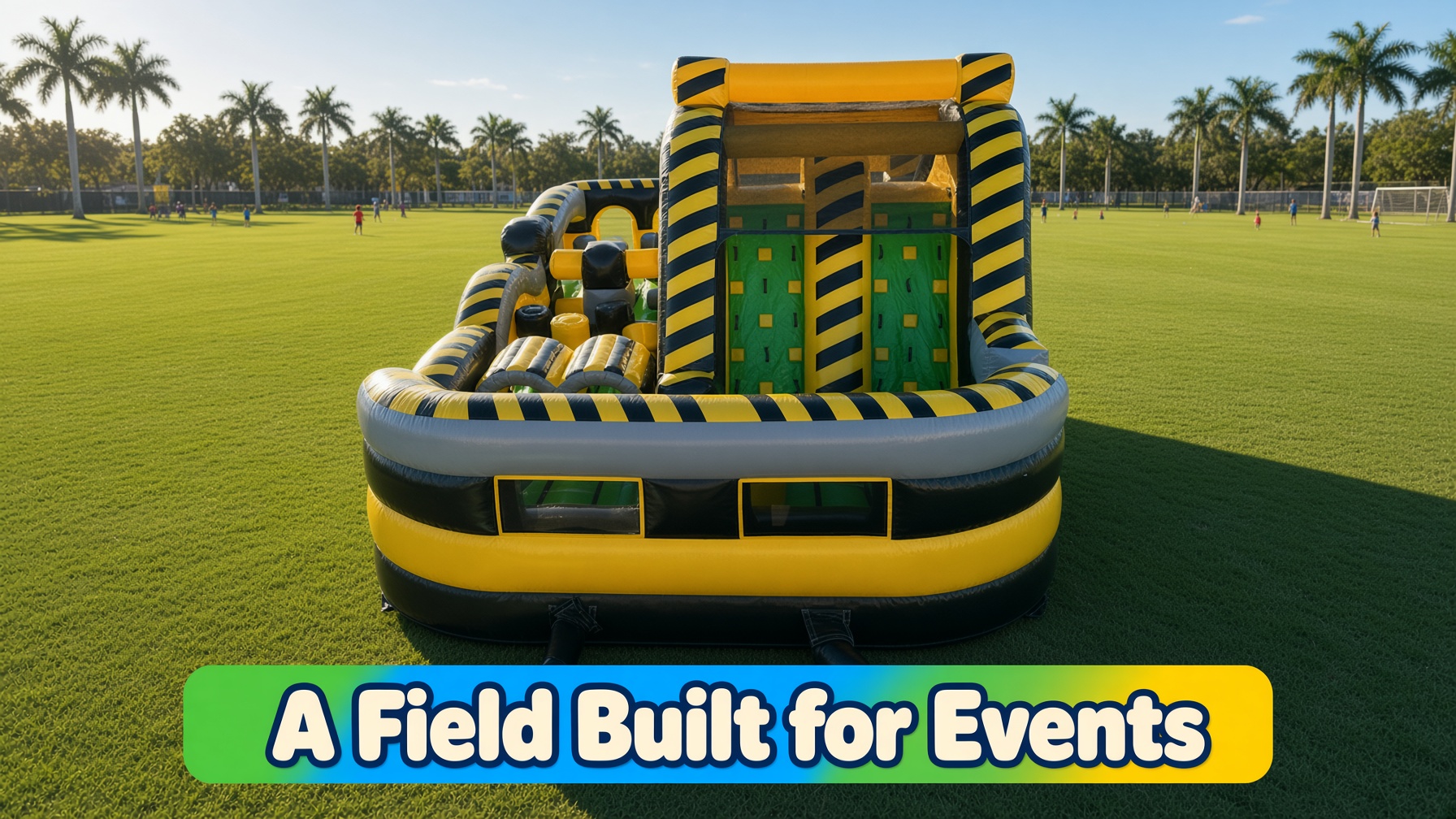
Festival Park opened a week ago today. The ribbon-cutting was at 9 a.m. on Friday, August 14, and the public was invited. I live in the northwest Cape, so this one is close to home in a literal sense — and it is the first genuinely new large-event venue this city has added in a long time.
I want to write about it the way I would think about it if you called me tomorrow and said you were planning something there. Not as a press release. As a site.
What it is and where it is
Festival Park sits in the north Cape. The city lists the park address as 2609 N.W. 11th Court on its project page; the Cape Coral Breeze put the ribbon-cutting at 1030 N.W. 28th Street. Both are describing the same grounds — a large parcel is going to have more than one point of entry — but if you are meeting a vendor there, confirm which gate before you send anybody.
The city broke ground on July 26, 2024. Notice to proceed was July 1, 2024, on a 510-day contract. Substantial completion came in on July 24, 2026, and the park opened three weeks later. For a municipal capital project of this size, that is a schedule worth noticing.
The numbers behind it, from the city and from the Breeze’s reporting at groundbreaking:
- $17.8 million — estimated cost of the project improvements at groundbreaking
- Approximately $29.9 million — estimated land acquisition cost for the 517 parcels the city had compiled and purchased as of June 2022
- $60 million — the total Parks GO bond initiative voters approved in 2018, of which this park is one component
I spent a lot of years signing off on capital budgets, so those figures land a certain way for me. The land cost more than the improvements did. That is what happens when you assemble 517 separate residential lots on a platted grid into one usable field. It is also why this city has not had a purpose-built festival grounds before now, and why it probably will not get a second one soon.
What actually opened, and what did not
This is the part I would want a straight answer on before booking anything, so here it is.
Open now: multi-use sports fields, festival grounds for large events, a concessions and restroom building, and unpaved event overflow parking. The final site plan shows four soccer fields built, with six more shown as future.
Not open: the amphitheater. What is in the ground today is the electrical infrastructure for a future amphitheater — conduit and service, not a stage. Councilmember Rachel Kaduk was quoted saying the second phase, which would include the amphitheater, is what she is most looking forward to.
Councilmember Bill Steinke put it plainly in the Breeze: “While it won’t open with all the component parts and facilities completed, it will offer a great place for our citizens to enjoy outside activities.” I appreciate a public official saying that out loud. Plan around what is there, not around the rendering.
Why a purpose-built grounds is different to work
Most of what we set up in this city goes in one of three places: a residential backyard, a church or school parking lot, or a park pavilion area that was designed for picnics and is being asked to host four hundred people.
Each of those comes with a compromise. Backyards have a fence line, a lanai cage, and a service drop overhead. Parking lots are asphalt, which means sandbags instead of stakes, and in August the surface temperature is a real consideration. Pavilion areas usually have one 20-amp GFCI outlet on a post and a lot of people who want to plug into it.
A field built for events removes several of those constraints at once. Turf takes stakes. Open field means no overhead obstruction to negotiate. Purpose-built festival grounds means the site was laid out expecting crowds and vehicles, not just Sunday afternoon foot traffic. That changes what is practical.
Four things I would check before I booked an event there
1. Distance from your setup point to power
This is the number that decides more setups than any other. Every inflatable we run needs a blower going continuously, and the blower needs to be within a workable distance of a real circuit. Our Venom Run obstacle course, for example, wants power within 50 feet of the entrance. On a large open field, “there is power at the concession building” and “there is power where I want the obstacle course” can be two hundred yards apart.
Walk the site with a tape or a phone measuring app before you commit to a layout. If the distance is long, the answer is a generator, and a generator is a line item and a fuel plan, not an afterthought.
2. Which surface you are actually on
Turf fields anchor with stakes, which is the setup every crew prefers — faster, more secure, and no ballast to haul. But a brand-new field is somebody’s pride, and any facility use agreement is going to have language about it. Ask specifically whether stakes are permitted on the playing surface or whether the event footprint is expected to sit on the festival grounds portion instead. Get that answer in writing before you build a layout around it.
3. The overflow parking is unpaved
The site plan labels it as unpaved event overflow parking, and that is a genuinely useful thing to have. It is also a rainy-season variable. We are in late August in Southwest Florida. If a Saturday morning event follows a Friday afternoon storm, an unpaved lot behaves differently than an asphalt one, both for your guests’ cars and for a box truck carrying eight hundred pounds of vinyl. Have a wet-ground plan.
4. The permit clock has not changed
A new venue does not shorten the city’s special event permit timeline. Cape Coral asks for special event permit applications well in advance — we walked through the 90-day backwards plan in a recent post on the permit process. If you are thinking about a fall festival or a league tournament on these grounds, the application is the long pole, not the inflatables. Start there.
What the space opens up
Here is the part that actually excites me about a large flat field with power infrastructure and parking.
Most of our inventory is sized for a Cape Coral backyard, because that is most of our work. A typical Cape lot is 80 feet wide, and after you subtract setbacks, a lanai, and a pool cage, you are frequently working with a usable rectangle around 30 by 40 feet. That constraint shapes the whole catalog.
A field does not have that constraint, and the units that were previously hard to place become easy:
- Giant inflatable corn maze — 34 feet 2 inches by 33 feet 4 inches, about 1,140 square feet of walls and dead ends, walls 6 feet 3 inches tall, roughly 300 feet of corridor folded into the footprint. It holds 30 people. We ask for a 43-by-48-foot clear area so there is a 4-foot safety perimeter on every side. Almost no backyard in this city can host it. A festival field can host it without thinking about it. It is $499 and arrives late September 2026.
- Venom Run obstacle course — 29 feet long by 18 feet wide and 15 feet tall, with 42 feet of course run because it doubles back inside the unit. We ask for a 50-by-50-foot setup area and 17 feet of overhead clearance. On an open field, overhead clearance stops being a conversation. $499.
- Interactive sports games — baseball, basketball, football, and soccer inflatables at $299 each. These are the right call for a soccer complex specifically, because they queue well, they run on modest power, and a line of four of them along a sideline handles a large crowd without a single bottleneck.
The through-line is capacity. At a backyard party you are entertaining twenty kids and the math is simple. At a tournament weekend or a community festival you are managing throughput, and throughput comes from having several stations rather than one large one. A field lets you spread out. A parking lot rarely does.
The honest caveat
This park is one week old. I have not run an event on it yet, and I am not going to pretend otherwise. Everything above is what I know from the city’s published project documentation, the site plan, local reporting, and fifteen-plus years of putting equipment on ground in this county.
What I would tell you is what I told a booster club president last fall about a venue none of us had used: go stand on it. Walk the distance from where you want the inflatable to the nearest outlet. Look at where the trucks come in. Find out who has the key to the electrical panel on a Saturday. Half of what goes wrong at a large event is a logistics assumption nobody checked, and the checking takes an hour.
If you are putting something together at Festival Park this fall and want a second set of eyes on the layout, call me at (239) 212-0011. I will meet you out there and we can measure it together.
About the author
Gabriel Denny — Co-owner, SWFL Amusements LLC
Gabe is co-owner of SWFL Amusements. He spent 20+ years in the Air Force, first enlisting after high school before commissioning and retiring as a Major. He is a 5x CFO, which he continues to do when not working bounce houses. He lives in NW Cape Coral and answers the company phone himself, including at 2am.