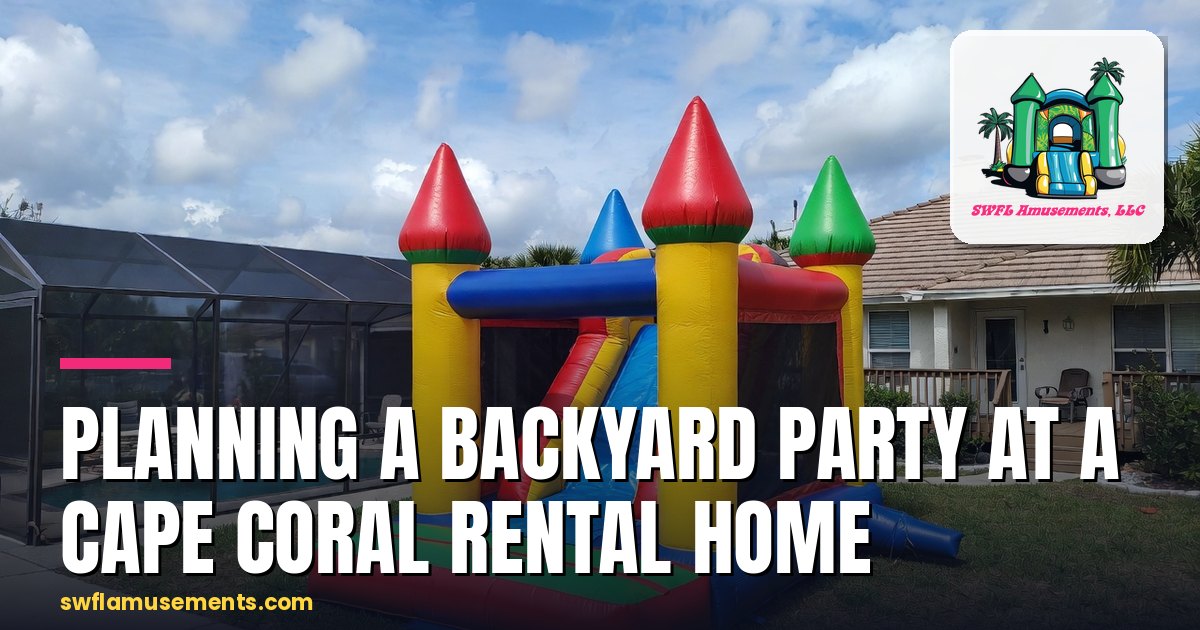
The season call started last week. Somebody has a house booked off Country Club Boulevard for six weeks in January, the grandkids are flying in, and the question is whether you can put a bounce house in a yard you do not own.
You can, almost always. And Cape Coral happens to be an easier place to do it than most of Florida, for a reason that has nothing to do with bounce houses and everything to do with an ordinance that took effect at the start of this year.
Here is what I ask people, in the order I ask it.
Know which kind of rental you are in
On January 1, 2026, Cape Coral began requiring every residential rental property in the city to be registered annually with the City Clerk. The fee structure tells you how the city thinks about the two categories, and the second line is the one that matters for a party.
| Long-term rental (more than 6 months) | $35 per property, per year |
| Short-term rental (6 months or less) | $350 per property, per year |
| Short-term minimum stay | Seven days, which is six nights |
| Governing code | City Code Section 12-129; Resolution 279-25 sets the fees |
| Who registers | The owner, annually, on the anniversary of the original registration |
None of that paperwork is yours to deal with as a renter. The owner carries it. But the minimum stay changes what is realistic in a way worth saying out loud: there is no two-night rental market in Cape Coral anymore. If you are in a Cape Coral short-term rental, you are in it for at least a week, and the city has shown it will enforce that — one owner was fined over $30,000 across three properties in 2025, including $1,500 a day for repeat minimum-stay violations.
A week is what makes a party at a rental sane. On a two-night stay, hosting anything is absurd — you arrive, you unpack, you leave. On a six-night stay you have a Tuesday to figure out the yard and a Saturday to use it. Most of the seasonal people I deliver to are here far longer than that, a month or a whole winter, and those are the easiest bookings I take all year.
Who actually has to say yes
Three different people might, and they are not interchangeable.
- The owner. The one whose answer counts. The registration ordinance works in your favor here, because the city requires the owner to keep current contact information on file and to notify it within 30 days if the property manager changes. There is a documented responsible party for every registered rental in the city. Ask for them.
- The property manager. Usually the person you can actually reach, and often authorized to approve this. Often not. "I do not see why not" from a manager is not the same as permission, and I have had a setup questioned on arrival by an owner who had never been asked.
- The association. If the rental sits in a deed-restricted community or a condo, the association rules sit on top of everything else, and the owner may not have read them in years. This is the one people skip.
Get it in writing. An email reply saying yes is plenty. And when you ask, ask three things at once, because they are the three I will need answered anyway:
- Is an inflatable on the lawn acceptable, and is there anywhere on the property it should not go?
- Is there an in-ground irrigation system, and does anyone know where the lines run?
- Which exterior outlets work, and are any of them on a switch inside the house?
One more piece of housekeeping: the rental agreement gets signed by the person renting the equipment, which is you, not the homeowner. We are insured, and I am happy to send a certificate to an owner or a manager who asks for one. That request comes up a few times a season and it is never a problem.
What the yard needs, whoever owns it
The physical requirements do not change because the house is a rental, and they are not negotiable, so it is worth measuring before you ask anyone for permission.
Our rule is the unit footprint plus four feet of clearance on every side and four feet overhead. Run that against two units at opposite ends of our catalog:
- The 14-foot Classic Castle is 14 by 14 and holds six to eight kids at a time. With clearance it wants roughly 22 by 22 of reasonably level ground. At $199 for the day, it is what I put in most rental yards, because most rental yards in this city are a lanai, a strip of St. Augustine, and a seawall.
- The 22-foot Tropical Hurricane is 38 feet long, 18 wide and 22 tall, and needs about 45 by 25 of ground with 25 feet of vertical clearance. It is $449. It fits a minority of Cape Coral lots and almost no rental lot with a mature tree in it.
Every inflatable also needs a standard 110V outlet within 100 feet of where it sits. On a rental this is the question that trips people most often, because the exterior outlet by the pool equipment may be the only one that is live, and nobody who is only staying six weeks knows which breaker is which.
Then there is the path in. We arrive towing. A unit has to physically get from the trailer to the setup spot, which on a Cape Coral canal home usually means one side gate. Measure the gate opening and tell me the number when you call. It saves both of us a wasted trip.
The pool cage, which is most of the inventory
Cape Coral has more than 400 miles of navigable waterways across roughly 120 square miles, and the rental inventory skews heavily toward canal-front pool homes because that is what people fly down here for. Which means that a large share of the yards I am asked about are mostly taken up by a screened pool enclosure.
Two outcomes. Either the unit goes inside the cage, which depends entirely on the cage door opening and the interior height, or it goes outside on whatever grass is left between the cage and the seawall, which is often a narrow strip. I have written up the measurements and the clearance math separately in the pool cage planning guide, and the short version is that the door is almost always the limiting dimension, not the floor space.
If you are still choosing between rental houses for the winter and a party is part of the plan, this is a thing to look at in the listing photos. A fenced side yard with open lawn is worth more to you than a bigger pool.
Anchoring into grass you are not responsible for
This is the part I care about most, and it is the one nobody thinks to ask about.
On grass, an inflatable gets staked. Our stakes go well down into the soil, which in Cape Coral is mostly sand and takes them easily. The risk is not the holding power. The risk is what is already down there. Irrigation laterals in this city are often shallower than people assume, and a rental home's sprinkler system is a system you did not install, cannot see, and are not going to be the one paying to repair.
So the honest answer on a rental lawn is that I would rather weight the unit than stake it when nobody can tell me where the lines are. Sandbags on a lanai, a driveway or a patio work fine and put nothing into the ground. On open lawn with a known irrigation layout, stakes are better and we use them. What decides it is whether somebody has an answer to question two above, which is exactly why I tell people to ask the owner about irrigation before they ask about anything else.
Same logic on the sod itself. A unit sitting on St. Augustine for a day will flatten it and the grass comes back. A unit sitting on it for three days in October heat will not, and re-sodding a stranger's lawn is a conversation worth avoiding. If you want multiple days, say so when you book and we will talk about where it sits.
The two mistakes I see every season
The first is booking the inflatable for arrival day. I understand the impulse — the grandkids land Friday, so Friday is the party. But deliveries run in windows, not appointments, you are unloading luggage and finding the grocery store, and children who have just flown from Michigan are not at their best. Put it on day three or day four. The six-night minimum is doing you a favor; use the middle of the stay.
The second is treating the property manager's goodwill as the whole approval. In a deed-restricted community it is not, and the association is the entity that shows up with a complaint. Twenty minutes of asking saves the afternoon.
Beyond those two, planning a party at a rental is barely different from planning one at your own house. You measure the yard, you find a working outlet, you pick a unit that fits, you ask the person whose name is on the deed, and you schedule it for the middle of the week you are here. If you want our standard safety rundown to pass along to whoever else is supervising, it lives on the safety page.
If you are down for the season and working out whether a yard you are borrowing will take a unit, call or text (239) 212-0011 with the cross streets and the gate width, and I will tell you what fits before you ask the owner anything. I have set up in a lot of rental yards in this city and I probably know the street.
About the author
Gabriel Denny — Owner, SWFL Amusements LLC
Gabe owns SWFL Amusements. He spent 20+ years in the Air Force, first enlisting after high school before commissioning and retiring as a Major. He is a 5x CFO, which he continues to do when not working bounce houses. He lives in NW Cape Coral, runs events with his two sons, and answers the company phone himself, including at 2am.