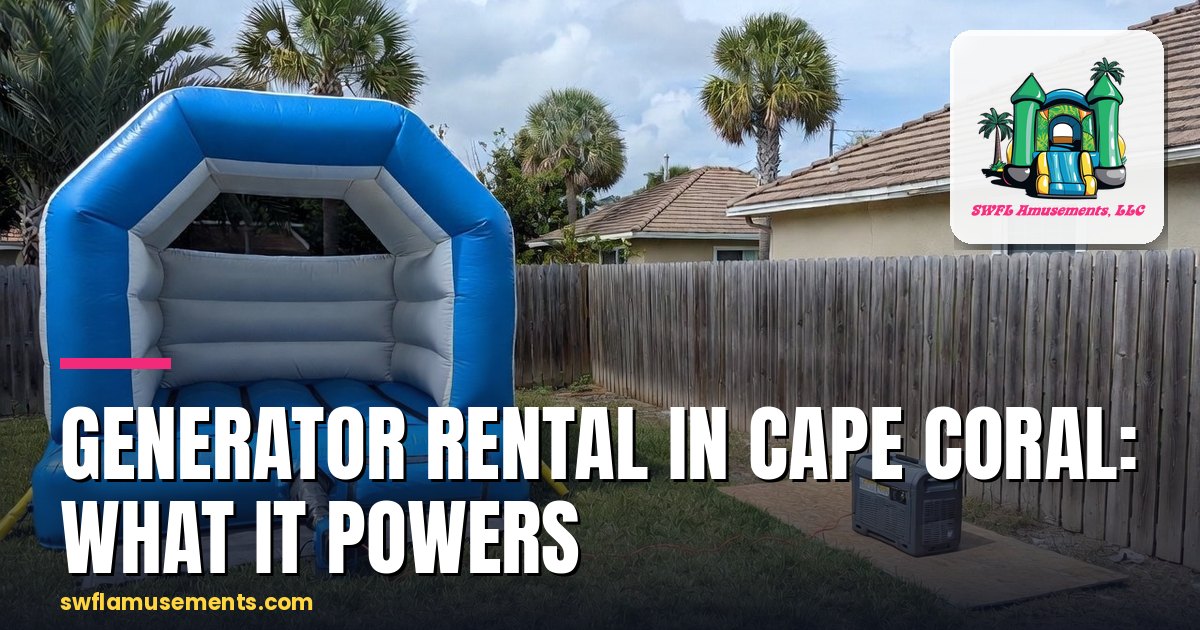
The generator is the least interesting thing on our truck. It is also the piece that decides whether a handful of events each season happen at all, and almost nobody thinks about it until two guys are standing in a yard with a bounce house half unrolled, looking for somewhere to plug in. So this is the whole unit, front to back, including the part where it is not the answer to your problem.
What the unit actually is
One model, one price. We rent a Coleman Powermate 6250 at $150 for an all-day rental, fuel included.
| Model | Coleman Powermate 6250 |
| Maximum output | 6,250 watts |
| Running output | 5,000 watts |
| Household outlets | Four, standard 120 volt |
| Other outlet | One 120/240 volt twist-lock |
| Fuel | Included, arrives fueled |
| Rate | $150, all day |
The two wattage numbers confuse people, and they are both real. 5,000 watts is what the engine will carry continuously, hour after hour. 6,250 watts is what it will tolerate for the two or three seconds a motor needs to spin up from a dead stop. Electric motors pull far more current starting than running, which is why every generator on earth carries two ratings. For our purposes the 5,000 figure is the one that matters, because an inflatable blower does not start and stop. It runs continuously from the moment we inflate the unit until the moment we strike it.
Our blowers pull 1,000 to 1,500 watts each. Do that arithmetic and the generator looks enormous: three blowers at the high end is 4,500 watts, inside the continuous rating with room left over. That arithmetic is correct, and it is also not the reason most people need one.
The number in the rental agreement, not the number on the website
Here is the sentence that actually governs your setup. It is in our terms of service, which is the document you agree to when you book:
“The customer confirms there will be a dedicated 115 VAC, 15-amp electrical outlet within 50 feet of each equipment item. Each blower motor requires its own dedicated circuit — shared circuits are not acceptable due to the high wattage of the equipment blowers.”
Read that twice, because two words in it do most of the work. Dedicated. And each.
Most people hear “do you have power out back” and answer yes, because there is an outlet on the lanai. That answer is about a receptacle. The agreement is about a circuit. On a typical Cape Coral house the exterior receptacles — lanai, front porch, the one by the hose bib, sometimes the pool equipment — are daisy-chained onto a single circuit, and that circuit is frequently sharing with something indoors. One blower on it is fine. Two blowers on it will hold for a while and then trip the breaker, usually at the worst possible moment, and usually while the homeowner is inside slicing cake and nobody notices the unit sagging for ninety seconds.
So the real question is not “is there an outlet.” It is “how many independent circuits reach the lawn.” For almost every house in this city the honest answer is one. If you have booked one inflatable, that is enough and you do not need us to bring anything. If you have booked two, you have a decision to make, and the generator is one of two ways to make it. The other is mapping your panel, which is a longer conversation and one I have already written up in detail on planning backyard circuits.
What four outlets on one engine is, and is not
I want to be precise here, because it would be easy to oversell this. Four household receptacles on the generator panel is not the same thing as four dedicated house circuits. Everything plugged into that generator is drawing from one engine and sitting behind the generator's own breaker. It is a pool of 5,000 continuous watts shared four ways, not four independent 15-amp branches.
What it does give you is headroom you can see and count, which a residential panel does not. I know exactly what the generator will carry. I do not know what else is on your lanai circuit, and neither do you until something trips. That is the trade: the generator is a known quantity parked on your grass, and the house is an unknown quantity behind a wall. For a two-inflatable party, moving one blower onto the generator and leaving one on the house is the cleanest split there is, and it is what I recommend most often.
One operational note that comes from doing this rather than reading about it: start the units one at a time, not together. Three blowers hitting a cold engine simultaneously is exactly the surge condition the 6,250 number exists for, and there is no reason to lean on it. Thirty seconds between startups and the engine never notices.
The twist-lock outlet, and why you will not use it
The fifth receptacle on the panel is a 120/240-volt twist-lock, and I get asked about it enough to address it directly. Nothing we rent uses it. Not a blower, not a foam machine, not a PA speaker, not a projector. That outlet exists because this class of generator gets sold primarily for home standby duty — it is the connection point for a transfer-switch cord feeding a panel after a storm. On an event it is decoration. If somebody at your party produces an adapter and wants to get creative with it, the answer is no.
Where it sits
Placement is not arbitrary, and it is the thing I would most like people to understand before the day of.
- Downwind, and never near the blower intake. An inflatable blower pulls outside air continuously and pushes it into an enclosed space full of children. A gas engine sitting upwind of that intake is feeding exhaust into the unit. We put the generator well clear and on the downwind side, and on a breezy day we will move it again after we feel which way the air is actually going.
- Off the walking path. The cord run between generator and blower is a trip hazard, and a yard full of running kids finds every cord. We route along a fence line or a bed edge rather than across open lawn.
- On something level and firm. A running engine on soft St. Augustine will settle and lean. Pavers, a driveway edge, or a scrap of plywood.
- Far enough that you can still hear your own party. The engine is not quiet. Your blower is also not quiet, and most people are surprised that the two together are the loudest thing in the yard. Distance is free. Use it.
Where a generator solves the problem, and where it does not
It is the right call for a church lot, an HOA common area, a school field, a vacant lot beside the house, the back half of a deep lot where no receptacle reaches, and any canal-end setup where the outlet is ninety feet of lawn away from where the inflatable has to go. Those are the calls I take, and the answer is usually yes, add it, and it costs $150.
It is not the fix for a Cape Coral city park. The city's own pavilion use application reads “Jumping balloons, moonwalks, dragons, bounce houses or similar apparatus are prohibited.” That is a rule about inflatables, not about electricity, so bringing your own power changes nothing. If a park pavilion is where you were headed, read the city rule on pavilions and bounce houses first and plan the pivot early rather than on a Friday afternoon. Worth knowing while you are in there: the city lists pavilion reservations at $50 to $100 plus tax per day, required at least a week in advance and 60 days out for events over 100 people, and it does not refund for weather.
One thing I will not pretend about
Every year around the start of hurricane season somebody asks whether they can rent the generator as storm insurance. The answer is no, and I would rather say it plainly than be cute about it. This is an event generator. It goes out with a booking and it comes back on our truck the same day, and if a storm is coming nobody is delivering anything to anybody. A rental you have to give back is not a preparedness plan. Buy one, or do not, but do not put a rental in that slot on your list.
What it is good for is the ordinary, unglamorous case: the party is in the right spot and the power is in the wrong spot. That happens constantly here, and it is a $150 problem rather than a reschedule.
When you book, tell us where the inflatable is going and where the nearest outside outlet is — just pace it off, a rough count of steps is fine. If the gap is real, or if you have two units and one circuit, call or text (239) 212-0011 and we will sort out whether you need the generator before the truck is in your driveway rather than after.
Sources: our own generator product page for the Coleman Powermate 6250 output ratings, outlet configuration and rate; SWFL Amusements terms of service for the electrical requirement; City of Cape Coral Pavilion Use Application and Checklist for the prohibited-apparatus language; City of Cape Coral park shelter reservations page for pavilion fees, advance-notice windows and the weather refund policy. Blower draw figures are our own equipment.
About the author
Gabriel Denny — Owner, SWFL Amusements LLC
Gabe owns SWFL Amusements. He spent 20+ years in the Air Force, first enlisting after high school before commissioning and retiring as a Major. He is a 5x CFO, which he continues to do when not working bounce houses. He lives in NW Cape Coral, runs events with his two sons, and answers the company phone himself, including at 2am.